All posts by [x]cube LABS

[x]cube LABS is a leading digital strategy and solution provider specializing in enterprise mobility space. Over the years, we have delivered numerous digital innovations and mobile solutions, creating over $ 2 billion for startups and enterprises. Broad spectrum of services ranging from mobile app development to enterprise digital strategy makes us the partner of choice for leading brands.
Digital Transformation

Dispel the Top 4 Myths about Digital Transformation

Digital Transformation

As digital consultants, we come across a wide variety of perspectives and viewpoints as well as misconceptions in our dealings with enterprises large and small. When working with businesses that are just starting to be aware of the digital transformation opportunities, we typically spend time and energy getting them up to date on the overall landscape.

Interestingly, even when working with organizations that are more aware of the digital technologies landscape, we’ve found that a number of misconceptions persist, which cause these businesses to do too much, or to excessively focus on specific aspects while ignoring the bigger picture.

Based on this experience, we’ve identified a few common misconceptions–or myths, about digital transformation. We’re not looking to make an exhaustive list, but here’s a quick overview of some of the most common myths:

1. Every company should undergo digital transformation

The myth that every process & every company should transform would hold true if it were a software upgrade or some improvisation technique. The revenue, market share, and profit of the organization would determine the impact of the transformation initiative. As our digital consultants would tell you, before even thinking of transformation you need to assess your organization’s existing processes and whether they would be able to adapt themselves to the new model. Your company should be able to inherit those modifications smoothly and efficiently.

There is a lot more to digital transformation than just trying to become an online business. In fact, that may not even be the right goal in most cases. The idea should be for you to deliver on your niche products or services and simultaneously develop new lines of revenue. To achieve this, you might not need to transform every process. Not all processes are equal from a digital transformation perspective: some maybe only tangentially connected with the new digital revenue streams you’ll be developing, and others may have no direct impact on your digital initiatives, at least in the short term. As such, the transformation of existing business systems, rules, procedures and models might not always prove to be helpful even if it seems to be affordable and doable.

With digital consulting services you can streamline the vital processes of your company. Your transformation process must help you leverage technology to expand the company’s core strengths and create a competitive advantage to prevent you from becoming obsolete.

2. Only technology enterprises can become digital natives

We often equate the evolution of digital transformation to disruptive technologies, and as a result, assume that digital transformation is the prerogative of technology companies. That’s certainly not the case, as undertaking a journey of becoming a digital native enterprise is a lot more complex than simply adopting a few new technologies. However, there is a lot more to it.

We can dispel this myth by using examples from our own experiences. From popular restaurant chains to leading insurance agencies, we have helped them all in their transformation journeys.

While deploying some new technology is almost always necessary, just deploying new technology will not get you the results you are hoping for.

The first steps in the digital transformation journey invariably need to focus on identifying processes, envision product or service improvements, reimaging customer experience, and so on.

3. IT can bring about digital transformation on its own

IT drives Digital transformation; however, it is not entirely dependent on IT. Digital Transformation is much about leadership than IT, and digital leadership demands a wholly new mindset at every level. This digital mindset helps assess how the technology will be used to innovate in terms of business model or product offerings and will drive value for the business. According to predictions made by digital consulting firms, the 3 factors that will drive digital transformation for the balance of this decade are: creating value for the business, strong leadership and culture of constant change.

When working with one of our clients from the healthcare industry, we observed that what really needed to be changed, apart from their existing IT systems, was their outlook on the workplace culture. Technology is a powerful enabler of Digital Transformation, however, besides technology, the people, the organizational structure and the resources that the business has, are key differentiating elements to set this transformation successfully. The organizational structure should be such that it supports the objective of the project. The culture must connect people and systems. An open mindset that accepts the rationale for change would be an added benefit for the entire journey of digital transformation.

4. Digital Transformation is an extravagant & rapid process

Digital transformation is a challenging and complex task, and hence it requires utmost clarity and step by step supervision. Taking on too much at once causes you to miss out on the little details and the foundational elements.

Additionally, too many people continue to be unaware of the varying pace in a transformation journey: You might start off seeing very rapid progress initially, but the momentum will slow down–as it should–when things start to scale beyond a little innovation lab into the wild. Pacing your transformation journey correctly is critical, and knowing when to expect rapid change and when to slow things down is essential.

Digital Transformation isn’t a one day task; when we take up the task of transforming a business, we do it with utmost patience and keen observation of what strategic change would work best for you. It is a continuous process finding relevant answers, understanding what you’re solving for and what results you’re seeking to achieve. Simultaneous application of technology will make your transformation journey a smooth ride.

It’s very important to have a proper understanding of what digital transformation entails for your business and try to make it work according to your requirements.

Instead of sitting back and allowing yourself to believe in these preconceived notions, why not get in touch with digital consulting firms with knowledge and expertise on how technology can make your business run more efficiently and guard against disruption?


5 Trending Technologies Transforming Healthcare Industry

Healthcare Industry

As the world is getting digitized healthcare industry has embraced plenty of technology trends in the past few years. Emerging technologies are creating a huge impact on healthcare deliveries and patient experience. Patients are able to engage and interact with their physician using their smartphone or use it as a medical device, which tells you what to eat, your medicine schedule, and when to exercise. The unfolding opportunities of the digital world are offering the medical industry with the potential to excel the impact of medical care and patients to have a safe and healthy life.

IDC predicted, “by 2019, more than 50% of life science and healthcare companies will have dedicated resources to support accessing, sharing, and analyzing real-world evidence for use across their organizations.”

Looking at the growing speed of technology trends and increasing faith of doctors and patients, 2018 will see some significant progress and it is going to offer advance, secure and complete care. Let’s check out how these five trending technologies are transforming healthcare industry in 2018.

Augmented Reality (AR)

The growing fascination of people in augmented reality (AR) has become a driving force in the healthcare industry. In the coming years, the technology is going to be routine in healthcare and offer quicker and personalized care to patients worldwide. It is estimated that in the next 3 years, more than 5% of the global healthcare expenses would be consumed by the digital healthcare services.

This is one of the most impressive technologies that overlaps a user’s view with a computer-generated image while being grounded in the real world. These unique features help surgeons to detect a tumor in any part of the body and perform surgeries more effectively. It also helps patients to have better visualization of their problems and how the treatment is helping the recovery.

Artificial Intelligence (AI)

The progress of artificial intelligence (AI) in healthcare is advancing rapidly and is going to have a greater impact this year. The technology is helping healthcare industry decode various problems for both hospitals and patients. More than 80% of healthcare industries are using AI today and by 2020 it is expected that the industries are going to spend an average of $55 million on this technology.

Artificial intelligence is helping healthcare providers to manage or examine their patients’ medical reports or data which empowers care management to offer a faster and more orderly service. AI technology has evolved to treat patients who need chronic care, diagnostic counseling, personalized attention, and so much more. Witnessing the potential of AI to enhance our healthcare quality and take control of our own health, 2018 foresees even more developments in the healthcare industry.

Blockchain

As humans are trusting more on new technologies such as AI, it is driving our focus on aggregating and managing huge data to secure patients confidential data. There’s a lot of buzz around blockchain technology. HIMSS (Healthcare Information and Management Systems Society) has an exclusive work group who examine blockchain distributed ledger technology and its potential implications for the healthcare information and technology community. The team is more focused on evaluating the thought leadership, best practices, and key use cases for how blockchain technology might affect the healthcare ecosystem and challenges the technology might impact in the future.

Blockchain technology is a progressive data management system which is designed to systematize, store and share critical data across different collaborators. All the data is recorded in an unchangeable ledger. 2018 will see a plenty of blockchain solutions in care management as healthcare providers and payers have identified the huge potential of this technology and have already started adopting blockchain solutions in medical care.

Internet of things (IoT)

Introducing new tools and applications, yes! IoT is transforming the healthcare industry. IoT has fortified the whole health tech by ensuring advanced healthcare and treatment results, delivering unique abilities that are cutting down healthcare costs.

Connected devices that allow real-time monitoring is helping the remote patient during emergency cases. For example, a physician who is on a vacation can use a smartphone that allows him to collect his patient’s health-related data. This data is transferred from a smart medical device connected to the patient’s smartphone app and save the patient’s life in case of medical emergency. Along with the patient care, IoT allows interoperability, data exchange, M2M communication which helps medical provider to deliver more effective healthcare solutions. More than half of the healthcare industry has already adopted the technology and in the coming years, almost 80% of healthcare industry would be implementing IoT solutions in various areas of their organization. According to the predictions by Forecast, IoT is just into its beginning phases and will expand to an overwhelming volume of 75 billion devices till 2025.

Robotics

This is one emerging technology that is managing time-consuming tasks, minimizing human interference so that human workforce can focus on other priorities. For example, nurses in the hospitals can use such tools for operating room schedule, to know which rooms and nurses are assigned to which patients. IDC’s worldwide health industry predictions for 2018 states that “by 2020, one hospital in four with 200 or more beds will have deployed robotics to handle time-consuming tasks, reduce labor and prevent errors to enhance the sustainability of its business operations and improve patient safety.”

Adoption of these technologies is automating current healthcare processes, therefore, boosting productivity by keeping patient’s comfort in mind and at the same time reducing the costs related to the medical workforce. It is predicted that one in four large hospitals will have robotics to automate their tedious tasks and advance patient security, by 2020.

Final Takeaway

According to Gartner prediction, “by the end of 2020, 40% of large health systems will shift from digital health pilot programs to full-scale rollouts, up from less than 5% in 2017.” As there are so many new technologies out there, these trends are most likely to have a huge impact on the healthcare industry in the coming days. 2018 is expected to bring a new wave of technological changes in our digital world, benefiting everyone in medical care including patients.

Digital Transformation: Swapping Your Old Work Culture For New Age Technology

Digital Transformation

Staying relevant in a market that is continuously growing and changing, is the single most difficult task for most new companies out there. And in an age where a majority of the companies are getting digitized, sticking to traditional approaches might just become the reason why your company doesn’t make it too far. Digital transformation is your answer to problems related to your company’s speed of service, maintaining a good relationship with your clients and your overhead costs. And these are but a fraction of the issues that can be taken care of. There’s a lot more that can be done, much to explore and learn.

So now, you read this and decide to jump on the bandwagon immediately. Great!

Hold on though, what’s going on here? Your employees don’t seem to share the same enthusiasm and excitement at the prospect of bringing in all these new changes!

The problem is, choosing to go through a digital transformation alone is not going to cut it. Your company needs to change its entire outlook, and this is where inculcating a completely new digital culture comes into play. It is by no means an easy task. When a company has been running a certain way for quite a while, people get used to the values and the work environment. Having reached a level of comfort, most people start adopting the “If it ain’t broke, don’t fix it” motto. Making them understand the future implications of such an attitude is important, and should be first on the list of things to do when trying to change your office culture.

Here are a few things that should be kept in mind:

  • First The Management, Then The Employees:

Employees will start warming up to the idea of a digital transformation only when they have the management to set an example for them. If your managers are disgruntled, it will inevitably reflect on their subordinates.

Talk to your team of managers. Explain to them why these changes are not only important but absolutely necessary to stay relevant. Take a leaf out of the booklets of your biggest and most well-established competitors. Chances are, you’ll find that they have been making use of the latest of innovations to drive their business ahead.

  • Avoid Big Changes In The Beginning:

As the saying goes, Rome was not built in a day. These changes are something that needs to be eased into, otherwise, they’ll serve no purpose and simply overwhelm everyone involved.

Accept that the process of digital transformation will be slow and keep working at it. Now that you’ve established that there’s no escaping these changes, hold discussions and come to a consensus on the approach that’s most suitable for your company. Just because a method worked for someone, does not mean it’ll work for you too. You’ll need to consider what your employees will be the most comfortable with.

  • Create An Open Environment:

Even if your company follows a strict hierarchy, try giving your employees the chance to open up about their ideas. Insights from every corner should be made welcome. The more your employees are able to open up about their ideas, the more areas you can cover that can be enhanced with the use of digital mediums. All major stakeholders should also be given a chance to share their inputs.

Talk to your employees. Encourage them to think creatively and express their thoughts on the requirement of digitization, and the key areas at the office that can benefit from new digital systems. Who knows, maybe you’ll find that your employees are actually a lot more tech-savvy than they’re letting on.

  • Invest In Proper Training:

Your employees’ ability to adapt to the changes and the quickness with which they’re able to learn to utilize technology to their advantage needs to be measured. Depending on their limitations, training sessions should be provided to help them get better acquainted with the technology that they’ll be dealing with most frequently.

It is important that enough time is spent on addressing queries. Even if each person cannot be taken care of individually, an overall satisfaction with the session is imperative. Every time a new change is made, a quick session on updates should also be included.

  • Ask For Regular Feedback:

Once your new systems are up and running, give your employees some time to get used to it, after which you can ask them how the new changes have been affecting their work. Note their efficiency, as compared to what it was before. Has the change been for the better? If not, you’ll need further investigation to pinpoint the areas that have been giving your employees the most trouble.

Regular feedback can help monitor the working of the systems. If a problem arises, authorities can be notified immediately so they can start working on a solution.

  • Encourage By Rewarding:

Let’s be honest here, the quickest way to make people accept something new is by giving them the right incentive. And what could be a better incentive than appreciation in the form of rewards!

Monitor your people and cherry pick the ones who have really taken to this cultural shift in the best possible way. Also, note the ones who have shown the most improvement. They’ll be the ones who weren’t as well acquainted with the idea of digital transformation as the rest but worked the hardest to incorporate it into their work lives. Rewarding them will encourage others to follow suit.

It isn’t always easy to find the right balance between your existing work culture and the new-age ideas that have become almost a necessity now. However, companies that are able to work through all this have a higher chance of looking at long-term success.

How Do You Execute A Successful Digital Transformation?

Digital Transformation

Implementing digital transformation is not just obtaining new or fancy technologies. It’s about experimenting virtually, studying, enhancing and continue adopting the change in an agile manner. This is what a digital enterprise needs to succeed with the digital transformation.

Most of the time we don’t know what idea might do the crossword, so we have to keep polishing our concepts and shape the most well-to-do ones. Executing digital transformation in an organization isn’t easy. It is even more challenging than traditional transformation. The survey conducted by Bain & Company says, “only 5% of companies who adopted digital transformation acquired their set objectives vs. a success rate of 12% for conventional transformations. A full 71% of these companies settled for dilution of value and mediocre performance.”

Most of the time digitally empowered enterprises fail to invest in the large businesses and their culture that allows agility. They focus more on the outcome without reaching inwards. Therefore innovation requires an expert who can rapidly position digital technologies to decode problems and enhance performance across the organization.

“By the end of 2019, digital transformation spending will reach $1.7 trillion worldwide, a 42 % increase from 2017.”

IDC

Key Factors That Drive Digital Transformation:

The most challenging part for a digital leader is to create the right culture and direction along with balancing the transparency and performance of an organization.These five factors will help you drive successful digital transformation:

Data Plays A Significant Role

Data is a significant factor that drives a business to success. It is impossible for a digital leader to drive digital evolution without having data analytics. Having a real-time data can help the decision-maker predict the company’s future, understand their customers’ behavior, offer personalized experiences and stay competent. IDG QuickPulse rolled out a survey, “48% of respondents saw improved visibility into customer information and behavior with data strategy and 42% have successfully reduced costs and increased operational efficiencies, and 40% report improved internal decision making.”

Agility Is A Key

Agility is a key component, particularly when driving right culture inside an enterprise. Being agile will empower an organization to enhance, transform and unlock the new digital opportunities. If a digital leader fails to identify agile innovation, the enterprise is going to be the last one to enter the digital marketplace. And we know how crucial it is to be early in this competitive world to grab a significant place in the marketplace. According to Mckinsey, “shortcomings in organizational culture are one of the main barriers to company success in the digital age.”

Customer-Centric Approach

When you have access to real-time customers’ data you will be able to predict or understand your customers’ behavior. Still, more than half of the digitally empowered enterprises fail to meet their customers demand. No matter what high-quality products you build if it’s not meeting customers expectations your digital transformation execution is unsuccessful. Understand the customer, build a connection and consistently meet customers’ need or expectations throughout the digital transformation journey.

Strategies To Execute A successful Digital Transformation

Today, living in this digitally competitive world we have witnessed how technology has changed our lifestyle and how it became vital for every business to adopt the change to survive. Even though only around 25% of enterprises are fully set or organized to execute a successful digital transformation. It requires a perfect strategy to quantify digital transformation and utilize the digital opportunities to its complete potential.

  • When it comes to strategizing a successful digital transformation for your organization, the first thing you want to do right is to have a right person with the necessary authorities. It’s become a challenging task for a CIO alone to take charge on a superficial level. There must be a continuous communication between a CIO and a manager. Managers have enough access to tools to automate the process and integrate both human and technical resources and prepare a report on a daily basis.
  • There are numerous divisions across an organization, and each one has to be in sync accurately with each other to run a successful digital transformation. This brings “monitoring” into the spotlight. You must have a powerful software that can monitor digital transformation and help IT department to identify the issues well in advance and fix it even before it goes out live. It is the most cost-effective step you can take to enhance your customers’ experience.
  • Your digital transformation strategy must have three right things, i.e, right people, right time and the right technology. As technology is rapidly disrupting the role of all digital leaders, focusing only on one thing will not drive digital transformation. As new technologies are emerging rapidly, everyday people are coming up with new technology-based innovation. As a digital leader, you need to be able to build a quick framework and predict the future with significant accuracy. According to Gartner, “By 2020, five of the top seven digital giants will willfully “self-disrupt” to create their next leadership opportunity.”

Allianz a European financial service provider with over 140,000 employees worldwide, serves 88 million customers in more than 70 countries, started their digital transformation journey and brought culture change within the organization back in 2015. They built a common platform (Allianz Connect) where CEO and all their employees can communicate, connect, share ideas. It’s a knowledge hub to increase their work efficiency. Bate believes technology is the key to deliver a personalized experience. Oliver Bate, CEO of the Allianz Group said, “Digital transformation is a journey and Allianz has spent the last few years laying the foundations. This means bringing in new people, and also leveraging the asset of our existing people – bringing the two together will make a difference.”

Final Takeaway

Though technology isn’t the only piece that runs successful digital transformation, however, embracing new and innovative technologies are going to unlock numerous broadways of improvements, reach, and change in the organizations. It is going to offer omnichannel and more personalized users experience. To be able to execute successful digital transformation a digital leader must be ready to perform and scale their ideas that provide an edge from their competitors and become a connected digital leader.

Digital Native Enterprise: Journey Of A Digital Enterprise

Digital Native Enterprise

The world of business has evidently invaded the age of digital natives. The enterprises that are rapidly embracing the digital transformation are witnessing how digital is helping their organization to outperform amongst the competitors.

Marc Prensky coined the title “Digital Natives” and “Digital Immigrants” back in 2001 article entitled Digital Natives, Digital Immigrants. In the article, Marc talks about the “the arrival and rapid dissemination of digital technology in the last decade of the 20th century”. He referred all the new students of today as the “native speakers” of the digital language of computers, video games, and the internet. Those who were not born into the digital world but have adopted the aspects of the new technology, he compared them as the “Digital Immigrants.”

Well, the panorama on this thesis has evolved over the years and if you compare it with the conventional wisdom being a digital native remains quite potent for many people. For example; distance is no more a hitch, using the innovation-driven digital technology, people can connect with anyone from any part of the world. Get instant access whether it’s a movie ticket, travel, shop or watch TV shows on your smartphones or connected devices. It means in this digital era the dream has become a part of the reality.

How to Transform into a Digital Native Enterprise?

The rise of digital technology has a potential to create opportunities, and if it’s executed correctly, it can transform the whole organization’s innovation process and convert them to become a “digital native” enterprise indeed. Adapting the change and business priorities are what going to success your organization in this digitally disrupted era. Turning into a digital native enterprise is going to accelerate the advancement and will revamp your digitally empowered business into a reliable source. It is essential to remain tangible, identify the new and innovative business model in this emerging marketplace. Digital transformation is not only critical but necessary for a digital enterprise. Therefore to start a digital native journey, you must know where your business stands and where it aims to be.

Few essential points for the organization to become a truly digital native enterprise;

  • It is important for them to be familiar with digital tools.
  • They should be able to identify the changing business model within the marketplace.
  • Understand the importance of Digital Transformation (DX) journey and then create the strategy by focusing on innovation to create new expansion.
  • The major players of this game are the digital leaders who lead the IT and new digital capabilities that offer digitally enhanced products, services, and experiences to the enterprise.

Frank Gens, Senior Vice President and Chief Analyst at IDC, said, “we are at an inflection point as digital transformation efforts shift from ‘project’ or ‘initiative’ status to strategic business imperative. Every (growing) enterprise, regardless of age or industry, must become ‘digital native’ in the way its executives and employees think, what they produce, and how they operate. At the same time, 3rd Platform technology adoption and digital transformation are happening much faster than most expected and early competitive advantages will go to those enterprises that can keep pace with the emerging DX economy.”

We have seen an enormous boom in digital technology which is highly driven by innovation, which has transformed every aspect of our life. Companies to survive in this new digital world will need to vigorously innovate and then make themselves fit into the modern world, or they are going to be closed. So, it becomes vital for a company to be a digital expert who can gently sculpt their business plan and build a robust strategy to stand successfully among the competitors. International Data Corporation (IDC) predicts, “by 2020, all enterprises’ performance will be measured by a demanding new set of DX-driven benchmarks, requiring 20-100% or better business performance.” IDC also expected that “at least one-third of every industry’s top 20 companies will fail to reach these new benchmarks, thereby opening the door to heightened competition and disruption.”

Amazon’s Digital Disruption Journey

According to Gartner’s survey, globally, “IT spending will be driven by growth in software and IT services revenue and is forecasted to reach $3.5 trillion in 2017, up 3% from 2016 estimated spending of $3.4 trillion.” The combat for ownership of digital platforms has just started, and Amazon is already leading. One apparent reason why Amazon is leading in the digital world is that their strategy is digital. Being digital native creates a vast database to analyze and predict the future and consistently meets or exceeds the user’s expectations by continuously reinventing.

The world economy initially encountered the wave of digital disruption back in 2001. Amazon was able to embrace the evolving digital economy and managed to survive, where other million dollar worth retailers had to shut down their businesses. By 2016, it became the world’s largest e-commerce site among the other top retailers in the United States. Amazon Business is one of best examples that they are one step ahead of the other digital native enterprises. Amazon introduced ‘Amazon Business’ in April 2015, to expand their customer-centric platform to a unique forum for B2B transactions. As per World Economic Forum (WEF) report, the platform serves as an example of ‘digital customer’ expectations which transitions to the B2B world. With over 250 million products, Amazon Business unique features include:

  • Free two-day shipping on orders of $49 or more, exclusive price discounts, hundreds of millions of products, purchasing system integration, tax-exempt purchasing for qualified customers, shared payment methods, order approval workflows, and enhanced order reporting among others.
  • Live Expert program that allows manufacturers to connect with buyers & answer questions about products easily.

Amazon Business took over from Amazon Supply which was launched in 2012 that grew to over 2.25 million to hundreds of millions of products. Amazon now is taking on the challenge with the potential to further disrupt and keep accelerating technological progress by providing the best user’s experience than their competitors.

A successful digital native enterprise should be able to build a journey with the potential to recognize the change in the digital economy and offer a great customer experience by being omnipresent. It should be efficient in leveraging new technologies and optimize customers’ data into a competitive advantage.

Why Customer Behavior Matters For A Digitally Empowered Business?

customer behavior

2017 was an excellent year for technologies like IoT, Artificial Intelligence, Digital Twins, Augmented Reality and so on to haul its potential out of the shed. Organizations living in the disruption age are required to reinvent their business, deliver a unique customer experience and have a substantial insight to understand their customer behavior. Survival is no more a concern today. Digitally empowered enterprises are required to adopt agility. Only an agile enterprise who understands their customer and can reply rapidly to their evolving behavior are going to thrive in this disruptive era. It is also necessary to embody a culture of innovation into your customer experience framework and build partnerships to amplify your company’s outreach and connections.

“Get closer than ever to your customers. So close that you tell them what they need well before they realize it themselves.”

– Steve Jobs, CO-Founder, Chairman Apple

Importance Of Customer Behavior

Emerging technologies have empowered both buyers and sellers. It has improved the way both the parties connect and behave. Customer behavior is nothing but a buyer’s actions that can be monitored, which include buyers looking for a product, their opinion, and ultimately consumption. Analysing and measuring the entire process will help businesses to uncover if customers are satisfied or not with their offerings. With this valuable data, business leaders will be able to recognize the features that provoke buyers to complete the buying process.

For example, if a customer spends 25 minutes on average, browsing online for products, deciding what to buy, gives the digital marketer a very little time to have their brand impact on customers and influence customers to complete the buying process. In fact, more than 50% of online shopping remains undecided. Here digital leaders have to spend a lot of time and money to understand the customer behavior and come up with a design that pushes customers to buy.

A successful digitally empowered business should be able to drive digital transformation by measuring the most valuable customer data and analytics. There are countless potential customers out there and reading their mind is not that easy because everyone will have a  different style, requirements, and shopping attitude. Living in a digital age you know nothing is constant, be it people’s lifestyle, technology or fashion. The way products are designed today, and their consumptions, everything is changing continuously. However, if you can comprehend the concepts, study, and excel on all these factors, this will help you master in understanding customer behavior and build products or services accordingly and publicize them more efficiently.

Strategies To Understand Customer Behavior

Emerging technologies are still changing customers’ shopping behavior, and only businesses who are focused on serving the real needs of the customer are not only going to survive but thrive.

Now customers have access to multiple devices to connect with their favorite brands and stay updated. This gives challenge as well as an opportunity to the digitally empowered businesses to thrive on being active and accessible across all devices. Embrace technology and connect with your customers where they are and meet their needs. Today around 80% of customers say being available across all devices is very crucial.

Technology today has turned the table to the customers’ side. Increasing power has raised the expectations, and now customers get to decide what product they want to buy, from where and at what time. As a business being accessible is not just enough, you have to be available for your customer 24/7 or else they will replace you with the one who meets their expectations.

Social media platform have given customers the power to make or destroy any brand image. If you fail to meet their expectations, even a single review or rating on social media can damage your entire brand reputation. Another way is, if you can successfully make use of this platform, then you are going to have access to vast amounts of data. Having access to millions of peoples’ data will help you quickly research the customers’ behavior and utilize the data more efficiently.

Key Focus Areas

Customers have become sophisticated in this digital era. Understanding each customers journey and reinforcing individual zone adds excellent value in personalizing the business offerings. Figure out the complexity, the opportunity and then take the floor. To be able to offer personalized service you should be able to observe your customers’ behavior more closely. This means predicting your customers’ action and their interest will help your offer a personalized approach which will amplify loyalty, driving long-term value for your business.

For example, if it’s a weekend and it’s raining outside. Customers more likely to prefer staying home and tempted to order mouth-watering food. Predicting customers actions under such case is critical to target the right audience, at the right time and sending them the notifications with the latest offers will give the brand the potential to automate marketing responses.

Data plays a key role. Using big data will help the digital leader to analyze and calculate customers’ behavior and uncover the patterns, trends along with the pre-sales operations report. As a decision maker of your company, this will help you to take the right steps, build an effective customer experience transformation framework and underpin that individual’s advancement throughout their journey.

Final Upshot

As per Forbes survey report, “a vast majority of executives who have been overseeing predictive marketing efforts for at least two years, reported an increase of 86% in their return on investment (ROI) as a result of their predictive marketing.”

Knowing your customers and predict their action becomes unavoidable to survive in this competitive digital world. If you can do it right then, you will be the disruptor of this digital era. 2018 is going to be an active year in tech and are expected to make waves in businesses and our living. A lot of research and innovations have already set in technology like AI to understand customers behavior and to meet their expectations for personalized experiences.

Blockchain – A Promising Technology Partner For IoT

Internet of Things

“There will be more than 24 billion IoT devices and 4 smart devices on average owning capacity of an individual by 2020.”
-Gartner Report

Internet of Things is a computing concept that has already transfigured the use of technologies. Connected devices are going mainstream, IoT has made it easier to set up a smart home, wearables, automobiles, machinery and several other devices which can be remotely controlled through smartphones.

IoT connected devices are today’s buzzword, but the technology still has a long way to reach its full potential. With the ability to generate $64.1billion by 2020, IoT has ushered us a step closer to the digital world and are molding future beyond our imagination. While the IoT has a lot to offer, it also upended the concerns to manage security. Wirelessly connected sensors are inserted in all IoT connected devices, which means all the connected devices can be tracked. Over 10 billion IoT connected devices are currently in use and experts are expecting it to grow up to 24 billion in the next two years — it’s complicated to protect all those connected devices.

As IoT is emerging, marketers are responsible for embracing a flawless secure technology — Blockchain. The conceptually groundbreaking technology Blockchain is altering the way IoT is viewed. Blockchain technology provides a secure network by using the decentralized system to increase the security, privacy, and compliance of all the IoT connected devices.

IoT Challenges

The blockchain technology is not just powering Bitcoin or FinTech. The immense feasibility and the disruption of both IoT and blockchain technology have urged the rapid growth in a vast range of industries today. Merging Internet of Things with Blockchain technology has become the top priority of all digital leaders of various enterprises. However, C-suites are still taking time to understand the potential of blockchain technology and figuring out how to integrate it into their business operations.

Where IoT is opening channels that enable billions of devices to connect and exchange data around the digital world, security becomes the most critical challenges of IoT, such as data privacy and data storage safety. Hackers can misuse these vulnerabilities and reduce a data security assurance. Hackers can steal or hack sensitive data through smart connected devices. As emerging IoT technology has become a part of our lives, such security threats cannot be overlooked.

Maximum enterprises have augmented their business process framework for the digital age. Connectivity has to be kept in mind while designing digital products. However, for a large-scale industry, the primary structure is a centralized model where all the users are connected. The challenge here is, there are unreasonably numerous IoT to monitor the centralized model performance. An organization needs to envisage the obstacles of the decentralized model to oversee all the advanced IoT connected devices.

Benefits Of Blockchain Technology

Well, all these challenges have one solution, i.e., blockchain. Business leaders are focusing more on building IoT enabled devices while keeping a close eye on blockchain technology integration. Blockchain ensures secure networks with its decentralized nature that provides responsibility and assurance for each transaction — immediate security benefits for enterprises and preventing from creating chaos in business processes.

The technology makes it impossible for hackers to corrupt the data and impart an enhanced authentication and outbreak control. It has the potential to deliver cross-platform interoperability and manage a stable running of million connected devices on numerous platforms by creating a standard machine-to-machine contract. IoT devices can use blockchain technology such as Ethereum, a distributed computing platform to build a common platform for communication and transactions.

According to IDC report, “global spent on blockchain solutions was $945 in 2017 and are expected to reach $2.1 billion in 2018”

The blockchain is a robust technology today that has increased people’s trust by offering reliable and safe solutions. This robust technology can help enterprises to achieve their multiple business goals involving less cost as it has numerous open source possibility.

Blockchain Revolutionizing IoT

Integrating Blockchain with IoT makes its easier for enterprises to execute confidentiality and robustness — a critical element that guarantees well-grounded connections and secures the many IoT connected devices network.

Blockchain technology primarily consists of three essential elements: security, encryption, and agreement. These three aspects running together will upshot allied network streamline and detailed data at every single time. Therefore, by creating such unbreakable network security, blockchain can provide a firm foundation for IoT enabled reliable interconnection, thereby reducing the threats that compromise central server models to a great extent.

According to the most recent news published on Global Trade Review, Skuchain, a blockchain technology startup partnered with NTT Data to bring blockchain’s benefits in supply chain and logistics management. According to the report, both of them are facilitating companies in Japan to use supply chain platform to offer inventory financing offered through the blockchain platform. IoT allows manufacturers to scan products on a collective basis, using smartphones. The implication of blockchain technology helps manufacturers to track their products at every point of the supply chain. The users can follow and trace products. Merging blockchain with IoT helped Skuchain to reduce their stock wastage, increase their efficiency, speed and better control over their supply chains.

Merging blockchain and IoT can spot the missing link emerging from accuracy and confidentiality concerns on the Internet of Things. It ensures all the data or information of billion devices are safely recorded and allow IoT devices to communicate securely.

Future Aspects

“By 2019, as IoT adoption grows in major industry, government, and consumer sectors, 20% of all IoT deployments will have basic levels of blockchain services enabled.”
– IDC

Today IoT is all about remote monitoring, data collection, and device automation. In the next few years adaptation of this emerging technology will have autonomous connected device interactions and make smart decisions on their own without having any need of human assistance. Ahmed Banafa, an experienced research analyst, said, “the decentralized, autonomous, and trustless capabilities of the blockchain make it an ideal component to become a fundamental element of IoT solutions.”

Blockchain in future is more likely to underpin our economy with M2M interactions. For example, the smart refrigerator will know when it’s time to be replenished and automatically place an order, negotiate the price and pay for the items using virtual currency. Also, it can negotiate the price through smart contracts and considers the owner’s preference while doing that.

Blockchain technology is expected to fulfill the requirements of the IoT based enterprises and become an enormous technology supporting Internet of Things.


Customer Engagement A Top Priority For CMOs

Customer Engagement

Acquiring customers attention is easy, gaining their trust is difficult, but engaging them is even more challenging. Customer engagement is the most essential element that unfolds your customers’ feelings for your brand. If you are able to successfully engage your customers with your brand, you will be able to earn a loyal customer for the lifetime. It’s a personal, intangible yet very powerful indicator that drives customer interactions and provides seamless customer experience.

Every year, companies lose about billion dollars as they fail to offer the best customer experiences. That’s where CMOs are expected to do magic and merge art with science. With a solid customer engagement strategy, CMOs can drive personalized engagement. Jonathan Martin, CMO at Pure Storage said, “today, the primary task of CMOs is to deeply understand customer buying behavior and intent; and the context of where someone is in their decision journey; be able to predict what they’re most likely primed to do next, and be ready to influence them at the right moment.”

Harvard Business Review stated, “most CMOs, we’ve observed, have a few areas of core responsibility. More than 90% are responsible for marketing strategy and implementation, and more than 80% control brand strategy and customer metrics. But beyond that, the range of duties—from pricing to sales management, public relations to e‑commerce, product development to distribution—is mind-boggling.”

Why it’s important?

As our world is becoming more tech-savvy, fulfilling what customer wants has just become mainstream. Right at this moment, customers are demanding greater experience for each brand they interact with. CMOs must augment real-time customer marketing to productively engage their customers with the most recent approach and help their enterprise to successfully transform from the conventional marketing method.

“67% of CMOs plan to increase their spending on digital advertising”
-Gartner

If you are able to engage customers with a remarkable experience they will come back. According to Forrester’s research, “86% of customers will pay more for a better customer experience.”  To offer great customer experience CMOs must acknowledge digital transformation in their organization to grasp the opportunities of digital technologies and transform the entire operation processes. Increased engagement drives an upsurge in ROI as well as builds a lifetime relationship with your customers, which is why customer engagement must be a top priority for CMOs.

Strategies To Follow

  • There are multiple ways to reach out to customers as soon as they go online. CMOs must know their customers’ interest and figure out a right, creative and personalized approach to engage them. They should be able to create an outstanding experience every time they interact with the customers.
  • Around 80% of CMOs believe their customer engagement approach is effective. However, only 50% of customers agree to that. If you want to sell your product or service and make a profit out of it, then you must listen to what customers have to say or want. Spending more time listening to customers will help CMOs to pick the most effective approach and add value to their customers.
  • CMOs are responsible to build a strong identity of their organization. They have to work closely with CIOs to be fluent with all the technologies or digital trends. Understanding all the marketing aspects, CMOs need to keep evolving it, adding innovative stuff and keep spreading their wings to remain on the top.

According to Economist Intelligence Unit (EIU), “CMOs will focus on interactive channels. The top three channels CMOs report to focus more in 2020 are social media (63% of respondents), the World Wide Web (53%), and mobile apps (47%) and mobile web (46%).

Challenges & Opportunities

CMOs are required to be proactive in dealing with customers because one wrong move, your customer will replace your brand. CMO’s work is far more challenging than you think. They need to have immense expertise in incorporate customers’ data and deliver a right message at the right time via the right channel.

It has always been a challenge to meet customer expectations. Emerging technology brings opportunities and at the same time opens up the portal for expectations which keeps changing with the trend. It is expected from CMOs to have an expertise in all areas and generate ROI for the organization. In short, CMOs will be given limited budget from which they have to strategize their investment plans and rethink before they make MarTech investments to offer personalized customer experience and enhance their customer engagement.

According to “The Gartner 2016-2017 CMO Spend Survey”, “marketing is responsible for critical customer-facing, revenue-generating systems, and applications. Enterprises need to appoint a chief marketing technologist who will look after this emerging technology estate. Which means, marketing has a responsibility to collaborate with enterprise IT.”

Future For CMOs

CMOs are responsible to apply innovative insights to market challenges, with the right metrics while building seamless customer experiences across multiple channels and keep customer engagement on the top priority list. Although CMOs have budgetary pressures, they will keep investing in the right technologies and innovations and 23% of CMOs have fixed annual innovation budget and 10% is earmarked for innovation, according to Gartner CMO spend survey 2017-2018.

Forbes published CMOs’ plan for 2018, where Nuno Teles, CMO, Heineken USA said, “I would say that my biggest marketing breakthrough in 2018 is to focus on Max Impact Marketing to drive top-line growth: At Heineken we are looking forward to having more and more ambidextrous marketers that are able to deliver on the art part of marketing, the outstanding creative quality work, as well as on the science part of marketing, with numbers and analysis that drive relevant business insights. We want our four priority brands, Heineken®, Dos Equis, Tecate, and Strongbow, to be actively part of the digital, social conversation of our relevant audiences, and that’s only possible with science and storytelling.”

Innovation is happening everywhere, every minute, and marketers have to outperform to become the most customer-centric organization. CMOs have realized that advertising product features and benefits are not just enough to stay competitive. As we have already stepped into 2018, CMOs need to think out of the box or become a bit more creative and discover new ways to deliver a fabulous customer experience. This will help them secure an advantage over their competitors and win customers for a lifetime.

5 Ways Facial Recognition Technology Is Going To Change Things Around You

Facial Recognition Technology

How Facebook is able to identify the appropriate individual’s face to tag or smartphones are easing our task to earmark photos of our friends and families and organize them. The power of this technology is not restricted to these areas and it seems to be unstoppable.

Facial recognition is an emerging technology that has the potential to augment the way people live or appreciably shape the digital world in the next five years. It is a biometric technology that scans people’s face or photographs and recognizes an individual. It discerns facial features like space between the eyes, depth of the eye sockets, the width of the nose, cheekbones, and jawline. The software reads approximately 80 nodal points designed from a numerical code, called a faceprint and records it in its database. Once the faceprint is recorded the software compares a person’s face from the data captured.

More than half of the American population’s faceprint is recorded in a facial recognition database. According to Transparency Market Research(TMR) report, “the global facial recognition market has gained popularity from diverse emerging tech trends, whether it’s switching from 2D facial recognition technology to 3D and facial analytics. Because of the higher accuracy in terms of identifying facial features, the market for 3D facial recognition technology segment is expected to record faster growth as compared to 2D facial recognition technology during the forecast period. In addition, a growth of the market for facial analytics, an emerging technology used for examining facial images of people without disturbing their privacy, is further expected to record steady growth as compared to that for 2D facial recognition technology.”

“The global facial recognition market will grow steadily at a CAGR of close to 23% by 2021.”
-Technavio

In China, employees use their faces to get an entry in their office building. There are multiple industries who are increasingly adopting this emerging technology such as healthcare, retailers, hospitality industries, manufacturing and so many. How are recognition systems impacting all these industries?

Here are the 5 ways facial recognition technology is changing things around us.

1. Payments

Facial recognition is creating a huge buzz today in the market. The technology has been rapidly picked up by restaurants and retail to accelerate the cashless economy. A few years back, a financial services company, MasterCard introduced “selfie pay” a biometric mobile payment authentication app. The app allowed users to confirm a payment simply by using their camera. Fast food giant Caliburger is gaining customer engagement with facial recognition technology to identify loyalty program members without loyalty card swiping at the store. This saves both the parties time and escalates customer experience.

John Miller, CEO of Cali Group said, “face-based loyalty significantly reduces the friction associated with loyalty program registration and use; further, it enables a restaurant chain like CaliBurger to provide a customized, one-on-one interactive experience at the ordering kiosk. Our goal for 2018 is to replace credit card swipes with face-based payments. Facial recognition is part of our broader strategy to enable the restaurant and retail industries to provide the same kinds of benefits and conveniences in the built world that customers experience with retailers like Amazon in the digital world.

2. Access and security

Facial recognition technology is set to go mainstream in 2018. It will not only change the digital world but enhance the way we live or work. Processing payment is not the only thing this technology is capable of. The usage of facial biometrics is enormous and is going to be omnipresent. House or car owners will be soon able to access all these with their facial features. No more worrying about losing car or house key. Unlocking smartphones are already out on the market today. Apple has recently launched their new iPhone X that uses face ID to unlock the user’s phone. The unique feature had tugged everyone’s attention. Several companies have already adopted this technology and few are potential to take advantages of the FRT technology to secure their sensitive data and manage it.

3. Criminal identification

Police and security forces are the keenest to integrate facial recognition technology to verify citizen identities by analyzing their faces. In 2017 the software helped Chinese police to spot out 25 criminals at the Qingdao Beer Festival. The technology can recognize one face from millions in just one second, an additional security level designed for people’s safety. It has a high accuracy rate of around 99% in a supervised traffic. Likewise, other countries like UK, US, Russia, Germany are using facial recognition technology to control security risks. Having more than half of the population’s faceprint sounds unusual but it is actually helping all the lawkeepers to track down criminals across the country and keep all the citizens safe.

4. Advertising

FacTech has benefited advertising industries in boosting customer engagement, marketing, advertising and so much more. The power to identify one individual from millions has given advertisers an opportunity to offer more personalized product or services to their targeted audiences. The technology allows advertisers to reach their audiences outside their homes digitally (DOOH) with creative and innovative messages based on the studied demographics. As the technology keeps evolving, DOOH is going to become an essential part of the digital world. DOOH can recognize a customer’s emotional state and show a relevant ad. US is foreseen to spend around $4 billion on DOOH advertising in the next two year. Similarly, UK giant supermarket, Tesco are the early ones to adopt OptimEyes to run personalized ads based on the customers’ age and gender. For example, if the customer is a male between the ages of 15 and 20, the system might display an ad showing what drinks he can pick.

“MarketsandMarkets estimates sales of facial recognition software and equipment were $2.8 billion worldwide last year and forecasts they will increase to $6.19 billion by 2020.”

5. Healthcare

You walk into the hospital and the person sitting at the front desk calls you by your name and quickly assigns you to the medical help that suits your ailment. Surprised? Yup, it’s a FaceTech camera that identifies you and your data, which helps you check in quicker and direct you to your physician’s room. Your physician examines you and writes prescriptions which will automatically be sent to the drugstore and by simply verifying your biometric identity you get the medicines home, without carrying any single piece of paper. This allows healthcare industries to secure their patient’s data by using a facial recognition technology. According to Market research future, “global healthcare biometrics market is expected to grow USD 5.6 billion at the CAGR of 22.3% by 2022.

You can unlock your house door with your face or pay your bills, order foods, pass security checkpoints. Apple launched their new iPhone with facial recognition feature to unlock the phone. KFC in Beijing uses customers’ faces to recommend meal items based on their age, gender and mood – Forbes report. Also, luxury retailers in Europe are using this technology to recognize their VIP customers to offer special care. Airports in Australia use facial recognition technology to allow passengers fly without carrying their passport and soon this technology is going to be used in US airports. Sounds strange but this is going to be our future soon.

5 Customer Engagement Strategies For Digital Products

Digital Products

“90% of growth in the consumer products industry over the next decade will go to companies that engage more deeply with consumers.”

-Simon Ellis predicts that, IDC analyst

There is so much research that shows customer engagement is a major differentiator of a winning enterprise. With big investments being made in customer engagement strategies, business leaders seek to create a relationship with their customers to enrich brand loyalty and awareness. As research says around 50% of customers are not willing to engage with the brand because of a bad experience. So, how are you planning to engage your customers more deeply in this digital era?

Your business entails a digital transformation in order to build strategies to engage evolving customers for your digital products. The transformation is huge and CIOs have to think about it end to end. This will help brands to individualize products or services as per the data collected and enhance the lifetime value with the customers while providing the customer with a seamless engaging experience with the omnichannel approach. This will also lead to automation, which means, all the communications that are taking place be it interacting with a customer or internal management process are done using advanced technologies. Technologies like virtual assistants or AI have already started engaging customers and delivering customer satisfaction in an outstanding manner According to Gartner, “by 2019 more than 10% of IT, staff in customer service department will be spending most of their time writing scripts for the bot.”

In this digitally competitive world, survival is not the option anymore. Your business’s success is built upon the potential to add more customers and retain the existing ones. Businesses are required to rapidly adapt to the diversified behavior of customers and win at every interaction they have with them.

Digital native enterprises have acknowledged the power of digital transformation and new requirements of customer engagement strategies for their digital product. They are more focused on designing new digital experience for digitally enlightened customers.

According to the IDC MarketScape: Worldwide Digital Strategy Consulting Services for Digital Product Innovation 2016 Vendor Assessment, the demand for digital consulting services, particularly in support of enterprise product and service innovation is in “hyper-growth”.

Pwc

These 5 customer engagement strategies will help you spot the right approach or digital strategy for a successful digital product in the digital era.

Seamless Interaction Experiences

Customers demand more seamless interaction experiences as they have more options and platforms available to shop online. Websites, mobile apps or any other online interactions are more convenient, a customer will have more variety to choose from and compare the prices. As a digital product manager, you must ensure that with each interaction you deliver value and the interaction must be seamless.

A born-digital company like Google has introduced revolutionary email services that have offered users with a cloud storage to store and share any file without email attachment and can be accessed from any device. Therefore being a digital leader of an organization you must endorse every customer product being developed and design a framework for product development to deliver a seamlessly connected interaction round the clock with customers.

Test and Integrate

A great customer experience requires effectiveness, uniqueness and a human touch. As a digital product leader, product knowledge becomes more vital to offer a personalized and great experience. The enterprise must evolve the potential to rapidly lead new products or services by adding new features and functions covering multiple channels. Test among different sets of customers and integrate what works well. Instead of slowly developing the ideal new product or service and then making it available on all the channels to the customers. Any program initiated with this end goal in mind should cater to incorporate customer’s behavior & feedback and include rapid modifications and implementation of new ideas.

Pull More Users First

The ultimate goal isn’t to draw revenue from the digital products. To run a successful customer engagement strategy a digital manager must be able to gather users information that will further help them to refine their digital products. For example, how many apps get downloaded? How many active users? How much time is each user spending on the website or app? All these measures the success of digital products. Allow users to download the app for free, don’t care about the revenues. Once you’re able to collect customers data, you can watchdog users activities, figure out what features customers are liking and then start strategizing for monetization.

Data and Analytics

Data plays a key role when you are strategizing customer engagement for your digital products. However, you will be able to withdraw any conclusion if you’re able to analyze the collected data accurately. The objective is to draw a dashboard that shows real-time data and based on the data, product manager take rational steps to develop a framework for customer engagement for digital products. Data helps an enterprise to forecast the future market and boost their revenue generations. The data can be used to upsell or cross-sell product or services to the customers. Hospitality industry exploits the customer data and analytics to offer personalized services such as their customers favorite in terms of food, facilities, preferences, etc.

Customize Global Marketing

The digital manager has to design their digital products or services for worldwide customers, as it’s persona is not confined. Introducing your products or services to this digital world is not easy as we think. There are diversified behavior customers because cultures, languages, around the globe, differs universally. It becomes challenging for a product manager to cater and customize each product or service to customers at the individual level. These all things need to be kept in mind while framing customer engagement strategies for digital products. It is always better to have a basic technology first, research well, analyze the data and then personalize your digital product or services as per the market demand.

Essentially, if the customer engagement strategy for digital products is done right, the upshot is revolutionary innovation and business success. As per Mckinsey, “over the next three to five years, we see the product-management role continuing to evolve toward a deeper focus on data (without losing empathy for users) and a greater influence on non-product decisions.”

5 IoT Benefits To Amplify Your Digital Strategy

IoT

“By 2021, 75% of enterprises launching IoT initiatives will adopt IoT-aligned strategic roadmaps, from a level of 10% in 2017.”

-Gartner

IoT’s promptly advancing technologies have steered in innovative disruptions at a high-speed. It has become the game changer of the digital world by moving trials to full deployments. Industries such as retail, healthcare, finance, manufacturing, or services saw the most impact while taking the advantage of benefits like business efficiency, productivity and drive business value for success.

Manufacturing industries have connected their manufacturing equipment and solutions to a cloud-based network that helps manufacturers to track or supervise the machine usage, and their performance. The potential of connected devices in the emerging technologies has led to more than 10 billion smart devices that are in use today, and it is expected to grow up to 24 billion by 2020.

The emerging Internet of Things technology is connecting retailers with consumers, doctors with patients, and engaging businesses to enhance their upshot and minimize costs. This has made the world more automated, smarter and exceptionally more convenient. This disruptive technology ‘Internet of Things’ is here to stay and not going to fade away anytime soon.

Gartner reported that smart homes and smart commercial buildings grew to represent 45% of total connected things in use in 2015, due to investment and service opportunity and the figure will rise up to 81% by 2020.

Technology is reshaping the world continuously and seeing the growth rate of the IoT technology it becomes vital for all the digital leaders to embrace the key IoT strategies. Enterprises who are still skeptical about it need to analyze the wave of innovation and disruption IoT has brought across industries. There is an immediate requirement to integrate IoT concepts in all their business operation strategies to benefit their enterprise.

So, the question is how IoT strategies are going to benefit your enterprise?

  • Smart Access

Data has a major role in any business. It helps businesses to unmask the variability and propel digital leaders to optimize the enterprise performances. Therefore, each time a user interacts with the enterprise their data gets stored in the company’s database.

With the help of IoT connectivity, a business can enhance their reach by creating multiple advanced techniques to interact with their customers. Which means more access to users data. For example, retailers can easily track their consumer’s behavior,  like their shopping style, their interests, the frequency of shopping, with the help of IoT connected devices. Every single customer’s activities are absorbed and monitored closely and retailers can start sending them recommendations. Therefore, IoT technology gives quick access to the data and provides opportunities to brand the product by targeting the right audience.

  • Smart Management

Internet of Things (IoT) has entirely modified the work approach of enterprises today. Keeping a track of the inventory was one daunting task before. IoT has served a huge comfort to the employees to manage the company’s checklist and keep it on track. The product management has now become automatic and effortless.

For example, in a store, if there is any item getting expired or shortage of any item. The smart tech easily identifies and sends a quick notification or a reminder to the store manager about the product status. Once the notification is received, an action is taken accordingly and notify the respective warehouses so that the stocks are delivered to the store quickly. This will help the store to run smoothly without running out on any items. In the next 5 years, IoT connected devices will mow down the human work and automate all the checklist management process, improve employee efficiency and allow them to focus more on other high priority tasks.

  • Smart Networking Machinery

We have IoT enabled appliances which have built-in sensors that remind users to get groceries while coming back home and also controls, optimizes and automates temperature, lighting, security, and safety remotely by a phone, tablet, computer or a smartwatch within the home itself. Similarly, manufacturers can optimize their machine task without being physically present in the location. It saves a lot of time and cost as most of the work is automated. It has unlocked new opportunities for all the remote work by networking machinery. Employees are now able to connect and perform their tasks in a remote location by simply monitoring the devices from other parts of the world. This has helped businesses to increase the engagement with delightful employee experience and boost the company’s productivity.

  • Smart Shopping

With so many IoT devices available in the market today, customers have immense means of shopping. Now customers need not type in the exact and complete words to search a product. IoT offers a smart way of shopping and exploring products just by speaking few words, and they will be able to spot what they were looking for within minutes and place an order immediately.

Emerging technology has evoked competition among the enterprises whose delivery system is faster, secure and who is going to build customer loyalty. As mentioned before IoT gives smart access to consumers’ data and this data helps digital leaders to personalize their customer’s order and deliver the best customer experience.

  • Smart Optimization

It’s not always about how fast the work is done; it’s about doing more in less time. IoT connected data helps an organization to manage extensive business operations quickly with a significant amount of accuracy. Integrating IoT concept into the business processes will refine the business operations while fully optimizing the complete internal activities.

For example, Uber an American transport company introduced a user-friendly app that connects the rider. The app helps drivers to find an alternate route in case of huge traffic jam. How it’s benefiting Uber as a business? IoT smart connectivity tracked the demand with ease and based on the demand the prices are adjusted and so is the supply of drivers.

The research company Gartner predicted that “8.4 billion connected things will be in use worldwide in 2017 and will reach 20.4 billion by 2020.” Internet of Things (IoT) technology is going to take the future business to the next level by customizing and providing a personalized experience to the users. Internet of Things has modelled the devices to be smarter and upgrade the user’s interaction with their surroundings.

Adopt Robotic Process Automation To Build A Digital Workforce

Robotic Process Automation

“The global robotic process automation market is projected to reach $6,247.1 million by 2023, growing at a CAGR of 33.8% during 2017 – 2023.”

-P&S Market Research

Nobody would have imagined that technology would bring about such massive changes in the digital world before entering the 21st century. Digital leaders must stabilize their strategies such that they can make the most use of the opportunities presented by automation. It has become vital for the digital workforce to keep themselves equipped with the continuous emerging technologies in order to make their back-office operations streamlined.

Robotic Process Automation (RPA) empowers the organization to drive existing software application in a way a human employee would perform. When the RPA software is trained to identify and interpret existing applications, it can automatically monitor the end-to-end process of a  business. The software smartly enables multiple applications to initiate new actions and interact with other systems autonomously.

Robotic Process Automation

-Mary Lacity and Leslie Willcocks

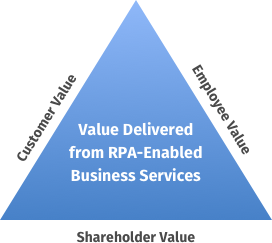
The research by Mary Lacity and Leslie Willcocks in Smart Service Automation: Benefits, Cases, and Lessons, outlined the RPA as “triple win” that comprised three values such as, Shareholder Value, Customer Value, and Employee Value. They explained, RPA benefitted shareholders by increasing the operational productivity, ROI, versatility, and enhance scalability. Customers are also benefited from RPA by boosting service excellence, 24/7 facility availability, personalize customer journeys. The employees are getting relief from everyday tedious assignments, they get to learn new skills and increase the job satisfaction level.

The robotic process automation (RPA) market — a space sometimes called the robotic digital workplace, among other names — would grow to $2.9 billion by 2021 from a base of $250 million in 2016.

-Forrester  

5 major advantages of Robotic Process Automation

There are a lot of benefits that RPA provides to an enterprise which includes delivering a competitive advantage to remain at the top and helping enterprises to excel in this digital era. Let us take a look at them.

Cost

Robotic Process Automation (RPA) has a potential to reduce the company’s cost roughly by 70-90%. Implementing RPA will automate the complete process, which means more work in less time, also it can operate 24/7 at a much lower rate. One major bulk of these savings arise from the diminution of full-time employees (FTEs).

According to the World Economic Forum, “5.1 MN jobs will be lost to automation by 2020 in 15 major countries, 2/3rds of which will be in the office and administrative sectors.”

For example, when an employee is hired, the company has to ensure that the employee gets his pre-fixed annual leaves each year and salary on time. But robots, they don’t go on any vacations nor they work on a salary basis. They work round-the-clock and have the ability to rapidly deliver results with efficiency.

Accuracy

Human employees after doing monotonous tasks all day, get exhausted which may lead to an error. They can enter wrong data, there can be a typo error, and with one wrong data entered, 100% accuracy from human employees is next to impossible which has always been a concern for a very long time. Sometimes the organization has to pay a huge cost for a single error.

Robotic Process Automation (RPA) implementation in a business process has enhanced services by eliminating the possibility of human error. The works are accomplished without breaks and with 100% accuracy. Software robots minimize the re-work pain and amplify the yield quality, which boosts the customer experience and helps an enterprise to multiply its organizational potential.

Enhancing Productivity

A human employee working for 9 hours in a day can perform limited given tasks. For instance, they take 10 minutes to finish one task, while the same task can be done by robots in less than a minute. Here, Robotic Process Automation (RPA) is doubling up the productivity plus saving a lot of production time for an enterprise.

Mckinsey Company estimated that automation could raise productivity globally by 0.8 to 1.4 % annually. Therefore, it becomes vital for an enterprise to embrace the opportunity from the productivity growth potential and encourage investment and innovation.

Employee Engagement

Robotic Process Automation (RPA) has the flexibility to simply adapt to the changes as and when business go through. RPA frees the employees from their tedious work and provides more hours to innovate. It helps an enterprise to emphasize on the areas which need more human touch, like, client and customer interaction, relationship management and focus on human-centered activities.

“Using robots to perform tax related activities in our shared service centre has not only resulted in a better work product, but also less frustrated people in the Tax department.”

— Joe Chirichella, Becton Dickinson

As per PwC, the key benefits from RPA to the employees are,

  • Scope to focus on higher order, more complex, intelligent tasks.
  • Outsourcing monotonous, manual and repeatable tasks.
  • Simplifying workflows and expediting processes.

Boost Customer Experience

Forrester predicted the RPA future in the digital world, “automation won’t destroy all the jobs, but it will transform the workforce. Humans will find themselves working side by side with robots. Infrastructure and operations (I&O) leaders must make sure these technologies not only cut costs but also drive customer value.”

Robotic Process Automation (RPA) has an ability to boost customer’s experience by producing high-quality tasks. RPA has cut down the customer’s file processing time period. For instance, if a customer met with a car accident and had to claim an insurance, the customer was asked to fill out multiple forms, submit required documents, and so on. Once the complete file was filled then it used to be sent for processing, which included investigation and approval or disapproval according to the insurance company policies. All these processes used to take roughly a month’s time for a customer to get the claim amount. With RPA implementation in the process, a software robot can complete the whole process in a few days or less.

Organizations will encounter enormous transformations where humans are going to interact more with robots. In near future, the entire operating models are going to be automated. HBR report says Commerzbank planned to digitize 80% of its processes within three years. It is estimated that robotization, digitization, digital self-service, distributed digital advice and sales, and robo-advisors could result in a 60-70% reduction in the workforces of service providers, from financial services to telecom.

5 Emerging Technology Trends To Consider In 2018

Technology Trends

“The intelligent digital mesh is a foundation for future digital business and its ecosystems. To create competitive advantage, enterprise architecture and technology innovation leaders must evaluate these top trends to identify opportunities that their organizations can exploit.” -Gartner

Technology has superimposed virtual world into the real world in such a way that it has created a massive disruption in all industries. The pace of this technology advancement is shooting up and it is designing absolutely new business models. This will, however, lead to a future that will be determined by connected devices delivering progressively thoughtful digital services worldwide. As a CTO of an organization, you must respond and keep yourself aligned to these digital disruptions and make intelligent strategies for your business.

“The continuing digital business evolution exploits new digital models to align more the physical and digital worlds for employees, partners, and customers more closely. Technology will be embedded in everything in the digital business of the future,” says David Cearley, vice president and Gartner Fellow in Gartner Research.

Gartner has grouped their top 10 strategic technology trends into three groups, they are; Intelligent, Digital, and Mesh.

  • Intelligent – This set of group will dig into how AI is soaking into virtually existing technology and building purely new technology categories. And if it is used perfectly it has a potential to deliver flexible, more insightful and more autonomous techniques to run your business.
  • Digital – This group emphasizes more on how to merge the real world with virtual to build a digital experience. Gartner stated, digital trends, along with opportunities enabled by AI, are driving the next generation digital business and the creation of digital business ecosystems.
  • Mesh – This group fully utilizes the link between people, businesses, and smart devices to pull out upshot for digital businesses. In order to respond to events across connections, the mesh requires in-depth security and functionalities that can decrease the friction to a certain extent.

Digital business has enabled rapid digital innovation and accelerated transformation in all industries. Now the question is, how prepared is your organization to undergo the impact of digital disruption?

Here are the 5 Emerging Technology Trends for 2018’ to watch out.

Digital Twins

A digital strategic technology, digital twins is a digital representation of the real-world system that provides information on the status of the real-world analog. It functions as a channel that connects the real world with the digital world by offering a strong way to monitor and respond to changes. In the coming year, digital twins are also going to add value in operational efficiency and usher business leaders to use and improve their products. According to a Gartner estimate, with 21 billion connected sensors and endpoints by 2020, digital twins will exist for billions of things in the near future.

It helps all the digital leaders to manage risks and maintain the manufacturing quality and enhance customer experience. “City planners, digital marketers, healthcare professionals and industrial planners will all benefit from this long-term shift to the integrated digital twin world,” says Cearley.

Blockchain

As the world is being disrupted by the technological innovation, blockchain is another disruptor that has a potential to shape technology advancements in emerging markets. It is an incorruptible digital ledger that generates multiple chained blocks of information where each block maintains cryptographically approved data which is impossible for an individual to break.

Besides the limitations, an enterprise can still extract value from the blockchain technology. With the clear understanding of the technology potential and the business opportunity, an enterprise can enable faster transactions, advanced durability, reduce transaction costs and improve cash flow.

Artificial Intelligence (AI)

Artificial Intelligence (AI) technology is going to be a game changer for the organizations to enhance their decision making and boost customer experience. Most of the organizations have already embraced AI into their business operations, whereas according to Gartner survey, 59% of organizations are still gathering information to build their AI strategies.

The technology is evolving and it’s transforming the entire business operations which makes it essential for all the digital leaders to focus and invest on the right skills and tools and include AI in their top investment priorities list. AI-enabled service is today’s reality and as it continues to emerge it is going to have a huge impact on the rapidly growing digital businesses.

Intelligent Things

AI and machine learning enable intelligent things to perform or interact in a more connected way with people and surroundings. AI has a potential to make existing things (i.e., a watch) intelligent (i.e., a smartwatch). It is the integration of computing, networking, and sensors into things to make them smarter. Amazon Echo is one of the best examples of an intelligent thing. A smart speaker by Amazon which is connected to the voice-controlled intelligent personal assistant service Alexa.

Likewise, there are multiple smart devices that are adding convenience and comfort to things by increasing safety and environmental benefits. Global Forecast published by MarketsandMarkets(TM), the Smart Home Market is expected to be valued at USD 137.91 Billion by 2023, growing at a CAGR of 13.61% between 2017 and 2023.

Immersive Experience

Immersive technologies such as augmented reality, virtual reality, and mixed reality have played a huge role in revolutionizing the way people interact with the digital world today. Digital business leaders are going to witness a continuous flow of investment on these immersive technologies. According to Gartner’s report, in 2016, there was a huge amount of funding ($2.09 billion) and this is projected to increase by 3% to $2.16 billion in 2017.

Though AR and VR are two different technologies, they both have disbanded the borderline between the real and digital world. Now, MR is becoming the immersive experience of choice where people can interact with both digital and real world at the same time keeping their presence active in the real world.

The technology trends and innovations are revamping the digital industries and have improved the way they do business. Blockchain, augmented reality, machine learning, virtual reality, digital twins are a major part of the technological megatrends list. The list is expected to keep growing and has remarkable disruptive potential in the coming years.

5 Key Enterprise Trends Driving Customer Experience

Customer Experience

“Your business results depend on your brand’s ability to retain and add customers. You must win at every interaction the customer has with your organization, whether that be a marketing campaign, a call to a contact center, an invoice or a delivery reliant on the supply chain. Every department must play its part in a coordinated fashion.”-Gartner

Technologies are transforming the digital arena at such pace which demands organizations to embrace smarter and innovative approaches to create and deliver a unique customer experience. Today, customers have a plethora of channels to navigate and multiple ways through which they can interact with the brands. The customers are empowered, and when it comes to delivering unique experience it becomes the most daunting task for an organization to keep up with their expectations.

Back in 2016, Forrester reported about 72% of businesses discovered, improving customer experience as one of their primary objectives. So what approaches businesses are employing to build customer-centric interfaces and enhance their customer experience. What are the major trends that are driving customer experience for your business?

Below are the key trends that are driving customer experience and creating a huge impact on all aspects of the business.

Accelerated Customer Interactions

Digital innovation is increasing the need for more personalized interactions between the customers and brands. Customers have raised their expectation bar higher and if a brand does not meet their expectation or if a company fails to comeback with quick resolutions to their queries, they will be replaced soon. Therefore, it becomes quite essential for business leaders to set a benchmark for their organizations and keep upgrading their approaches to meet their customer’s’ expectations.

Though the medium of interactions has been changed, the focus remains on customer interactions that drive value for both enterprises and customers. Artificial Intelligence (AI) is today’s technology that has enhanced customer experience to a great extent and transformed businesses from transaction-based to interaction-based customer relationship. CX network found, “36% of businesses are already at the beginning/planning phase of their AI journey. By 2020 more than 53% of organizations anticipate their AI operations will be established.”

Changing the game with Big Data

It is proven that company who uses data analytic are tended to deliver the more personalized experience and drive better customer engagement. Data intensifies the customer experience and most of the business leaders observed data analytics helped them to increase their revenue, reduce costs and deliver high-level experiences. According to McKinsey Global Institute (MGI) estimation, “retailers who are using data analytics at scale across their organization could increase their operating margins by more than 60%”.

Technologies like big data have made it easier for an organization to gather customer information. It helps digital leaders to extract meaningful directions and clear understanding with absolute accuracy that results in process improvements, product development and adds significant value to the organization.

Internet of Things Keyed Up Customer Experience

Internet of Things is today’s buzzword and a game changer in this connected world. This technology has a potential to connect multiple devices, make them smarter and improve customers’ interactions with brands. For example, a sensor is embedded in smart devices which can identify any problem or if there is any maintenance is required. They will then notify the users about the problem and send an alert to the service center notifying the same. And if there are any minor issues it will be fixed remotely even before it becomes noticeable by the users.

With such advancement, enterprises will have great opportunity to deliver personalized customer experience and improve their brand interactions. Gartner report says, “smart homes and smart commercial buildings grew to represent 45% of total connected things in use in 2015, due to investment and service opportunity and the research firm estimated that the figure will rise to 81% by 2020.”

Virtual Assistants

Virtual Assistants have bridged the gap between humans and gadgets to deliver competitive customer experience. Gartner research report says, “more than 30% of online browsing will be done through voice by 2020.” Virtual assistants are the applications designed for customer engagement such as Alexa, Google Now, Siri that helps users inquire about their ticket booking, and flight information.

Speech recognition system has helped contact centers to enhance their caller experience. According to Opus research report, “49% business leaders have deployed speech analytics and out of those respondents, 83% said they have achieved their expected return on investment within a year, with one-third receiving a return on investment in just 6 months.

Mobile Commerce

According to BI Intelligence, “mobile commerce will make up 45% of total e-commerce, equaling $284 billion in sales by 2020.” People are glued to their smartphones and life has become unimaginable without its presence. Jaime Toplin, a research associate with BI Intelligence said, “millennials use their phones as their primary device, and as they make more, they’ll spend more. And on the retailers’ end, they are going to create more opportunities for people to buy.”

As users spend most of their time on the mobile app, brands have focused more on ensuring a seamless experience to enhance their user’s loyalty. Customer engaging trend like a Bluetooth radio transmitter- Beacon, sends a quick notification onto the shoppers’ smartphone through their downloaded application, when they enter or come near a certain area. This notification makes shoppers aware about the ongoing sales or promotions in that particular brand/retail shop.

Gene Alvarez, managing vice president at Gartner said, “the best leaders design their customer experience from the point of view of the customers’ motivations and goals, and then they build their brand around the customer experience; not the other way around. However, customer experience projects vary in complexity. Understanding the different components will help organizations focus on specific efforts that, in aggregate, will help improve the customer experience.

Emerging technologies are enhancing customer experience and leading businesses with new and exciting strategies. It builds up the most effective user-centric experience where the customer gets what they want and the organization gets their desired outcome. These five trends are extremely essential for decision-makers to include in their strategy to endure in this competitive digital world.

5 Industries That Are Transforming With Gamification

Gamification

Enterprise gamification has transformed former dull customer acquisition methods into more engaging customer experiences. It has become a marketing trend which is loaded with new opportunities and boosting enterprise engagement with their customers. Every time you interact with customers it produces a feedback system that enhances your relationship, motivation and fosters long-term engagement with both customers and employees.

Companies who have embraced this gamification approach have secured high-level augmentation in the recent past, compared to those who didn’t. Experts say they have experienced 4 to 5 times significant growth in their annual revenue and remarkable enhancement in their customer profit margins. So, looking at what experts have mentioned, enterprise gamification propels companies to drive more sales, reduce costs and increase customer expenditure.

Business Wire, a media company research reported, “the global gamification market is expected to grow at a CAGR of more than 30% during the forecast period.

Gamification is not different!

Gamification applications provide real-time data about customer habits and help enterprises to focus on encouraging these habits through which routine behavior & tasks can be made measurable and then these are associated with gamification based rewards and badges. This allows enterprises to leverage their audiences’ market interest, help in decision-making potential and amplify customer experience as well increase productivity.

People often have mistaken gamification concept with playing video games. It’s not only about rewards points, trophies or leaderboards, enterprise gamification encompasses feedback system, writing a proposal, winning a contract, making a phone call, solving a customer problem. It involves game mechanics to the non-game environment to intensify engagement to excel performance management.

There are a lot of blog posts about gamification that talks about gamification elements and workplace gamification. Let’s spend some time on studying how different industries who have adopted this approach are transforming:

McDonald’s

McDonald’s annual Monopoly game – the concepts acquired from the classic game of Monopoly to boost their sales. The promotion is running since 1987 and it has been 30 years now McDonald is giving away more than $40 million worth prizes to the participants. Everytime customers buy certain items from McDonald’s they get tickets and each ticket represents a space that’s there on the monopoly board game. Participants are asked to assemble all the same color parts to win the prize. According to Yu-Kai Chou report, “In 2010, McDonald’s increased its sales by 5.6% in the USA through this campaign, with many people engaged in impulse buying just to get tickets.”

Nike

The personalized app, the Nike+Fuelband tracks user movements. The app has brought together over 17 million athletes and connected the brand through gamification elements. Nike introduced this app in January 2012 with an aim to gather customer information, drive sales and users engagement with their brand. The app allows users to track their workouts, check their achievements and provides an option where they can challenge their friends or family. Participants who meet certain goals get early access to Nike products, free shipping, customized training and many more.

eBay

eBay striked the eCommerce market when they brought the most historic gamification approach. They employed gamification in their bidding process to simplify the overall shopping process for their customers. Buyers not only purchase, like they do on any other site, they also undertake the challenge and when they finally purchase, they get the feeling of winning even though they are paying more than what the product is actually priced for. This gamification concept escalated the overall time spent on the site, more interactions, and new signups that enabled eBay to gather more users’ information.

As Yu-kai mentioned in the book, Actionable Gamification: Beyond Points, Badges, and Leaderboards “I did some research on eBay, and shortly after that sold my two tickets through the platform. That one transaction was surprisingly thrilling and fun for me. When I received my first bid from an anonymous stranger on the Internet, I almost jumped for joy, and I became obsessively glued to the screen when another bidder joined in, on the war.”

Mango Health

As per market research and strategy consulting firm Global Market Insights, “healthcare gamification market size is expected to exceed $40 billion by 2024.” Mango Health introduced a gamified app that allows patients to earn rewards up to $10 gift cards by taking their medications on time. The app keeps sending reminder alerts as per the set time and gives medication details to the patients. The app was aimed to motivate patients to control and regulate their medical schedule. Jason Oberfest CEO at Mango Health said, “Mango Health’s first app is made for the 4 out of 5 people in the U.S. who take a combination of prescription medications, nutritional supplements and over-the-counter drugs each week. The app helps patients check for dangerous drug interactions and uses game design principles to inspire them to stay with prescribed treatment regimens.”

Target

Target launched an app called Wish List app, a gamified approach focused on kids. This app allows kids to make their own holiday wish list which can be seen by their parents as well as manage and share the list. The app has a 3D animated game that enables kids to select toys they desire and add it to their holiday wish list and send it to Santa. The research report says the app got around 75,000 downloads, over 100,000 wishlists were made, along with 9,200 new registers. Target noticed million page visits in a week time frame and close to 1.7 million items were added to the wishlist with a sales potential of roughly $92.3 million.

Gartner predicts that gamification combined with other emerging trends and technologies will have a significant impact on innovation, employee performance, customer engagement, and personal development by 2020.

The gamification approach is a robust strategy that rapidly uplifts the firm’s sales while enhancing customer experience and their brand’s interactions. As it is the most effective approach it is essential for an enterprise to understand that gamification is not a magic bullet, they need to use the right technology in order to make this approach more effective, more business-like and manageable.

5 Key Considerations Before Adopting Enterprise Chatbots

Chatbots

“80% of new enterprise application releases will make reasonably strong use of chatbots by 2020.” -Gartner

An enterprise with its priorities and goals are very well aware of the benefits of bots. Digital leaders have come up with a roadmap that has raised the innovation level to bring digital transformation in their organization. Enterprise chatbots are exceptionally driving value at the workplace. It is a tool that enables the automation of regular support tasks while empowering the enterprise to emphasize more on intelligent design integrated machine learning. Markets and Markets research firm evaluated that, “AI market will grow to $5.05 billion by 2020, and Gartner reported that, “6 billion connected “things” will necessitate AI support by 2018.

AI has the potential to insert intelligence, automate business’s daily operations which save around 30% manpower costs and easier to measure. Chatbots today have become the most active, trusted technology that is used at home or at work and have remarkably enhanced the organizational ability to service customers, users and employees. This emerging technology is growing and as the study says, at present over 40,000 chatbots are existing, across various channels.

“More than 60% of the 2,500 consumers and business decision makers in the US, believe that AI can help provide solutions for many of the most important issues facing modern society, ranging from clean energy to cancer and disease. At the heart of the opportunity for businesses is the ability to turn data into intellectual property (IP) – more than 70% of business leaders believe that AI will be the business advantage of the future and currently analyzing how AI could enhance the quality, personalisation, and value of hundreds of different products and services across eight prominent sectors.”
-PwC Survey

With this huge potential chatbot can amplify the customer’s journey and acquire competitive advantage by simplifying the interaction process with a simple question. The bots then evaluate the need for the users and communicate with them using conversational interface.

Chatbots are now being adopted by many customer-facing organizations and it’s not about automating humans. It’s about revamping the user’s experience. Chatbot technology is rapidly emerging in this digital era. It offers reframing solutions for both consumers and enterprises as a whole. The study says chatbot industry is expanding at a compound annual growth rate of 24.3% and are expected to reach $1.23 billion by 2025.

However, in order to revamp the customer experience, the below 5 key considerations must be kept in mind before adopting enterprise chatbots.

  • Why chatbot?

It is the first and foremost key consideration of any digital leader before adopting chatbot for their enterprise. Building a concept — what is the purpose behind building chatbots? or which issues it is going to address? A chatbot is an element that drives larger engagement and it becomes essential for a business leader to put communication strategy into their frame of reference.

  • Chatbot Interaction

Once the enterprise is able to figure out the reason why to build chatbot the next step is to examine how it is going to interact with the users. Whether the interface is going to be voice-based or through chat? Or which conversational interface chatbot will use to communicate with the users? Business leaders need to figure out if their bot is going to serve their customers or internal systems to assist their employees as both entail separate framing and are going to add value to the business. The research says 80% of the interactions are going to be lead by chatbot in the next 3 years.

  • Chatbot Strategy

The third key consideration is to ensure that the chatbots have full support from the internal systems and are aligned properly with the processes. Choose the right internal systems like API integration so that the chatbots service are available effortlessly across multiple platforms and help users with their support queries. Having multiple-task chabot services will help the enterprise to automate the processes and facilitate both internal and external users for other productive work.

  • Chatbot Usage

A product is built with the intention to meet the objectives that are either to drive businesses, make money, add value, or deliver a great customer experience, as per the situation. And whenever a company is building an enterprise chatbot it requires plenty of time, money and effort. Therefore, it becomes the key point for a business leader to think how users are going to use it and customize it to their business goals before building a useful chatbot that will revamp all their users’ lives. As per ZeeBiz report, “integrating chatbots with transaction and payment options, companies can save money on customer acquisition costs and over the longer term, improve customer experience and retention.”

  • KPIs For Chatbot

Incorporating metrics to measure the performance and finding the accurate KPIs for chatbot is crucial. Acquiring thousands of users is not the main objective of the organization. The major concern has always been how many acquired users are actively using it and measuring such interactions will give a detailed image of the chatbot performance. Just like employees have metrics to measure their performance so that they have a clear idea where they stand in an organization. Apart from quantitative metrics like bot engagement, qualitative measures like employee satisfaction should also be kept in mind while implementing bots into future optimizations and improvements within the organization.

According to Business Insider survey, “business leaders and decision makers of an organization are turning to the broader umbrella of automation technologies, which includes chatbots, for things like sales, marketing, and customer service. 42% of participants believe automation technologies in these areas will most improve the customer experience. And 48% said that they already use automation technology for these business functions, with 40% planning to implement some form of automated technology by 2020.”

Having the best conversational experiences is very important for an organization to improve the relationship with their internal and external users. Before jumping into the fascinating world of chatbots, an organization must set up a simple conversational interface keeping these key considerations in their mind while framing the business strategies.

Map Your Customer’s Journey With Digital Transformation

Digital Transformation
Enterprises are rapidly transforming their businesses into a digital business. They are now in a competition to offer unique customer value concepts and products, break the stereotype business models with the new kind of potential and engaging different organizational designs. In a Gartner’s report, GE a multinational conglomerate company has said, “it will become a digital industrial company — developing on software and analytics to transform its customer value proposition and become a significant ($20 billion) annual revenue source.”

As the digital experience has eased the complexity, customer experiences have become the priority for all digital leaders. Customers’ expectations have revamped and this is the major reason behind the digital transformation. Encompassing customer experience in all the top strategies of enterprises, oblige digital leaders to empathize, identify each customer persona and their journeys, and embrace design thinking that boosts customer experience. Ford an American multinational automaker company has started investing hugely in technologies and target fully autonomous vehicles for use in ride-hailing and sharing models by 2022.

Redefining the Customer Experience Journey

In the coming future pricing will no longer be an issue, the wrangle will be on who delivers the best customer experience. Survey says, 44% of business leaders desire to improve the customer experience as a key foundational element of their digital transformation. It has become a priority investment for an enterprise to enhance their upshot systems with effortless engagement processes to deliver continuous and better experience. This helps an enterprise to be more enthusiastic and more approachable. It is very essential for an organization to know their audiences and at the same time it should be able to manage the experience in the entire customer journey.

Digital transformation has touched and reshaped every aspect of a business today. The profound transformation became vital for all enterprises, be it retail, healthcare, manufacturing, automation or the infrastructure that enables a reliable web throughout an organization. Offering a great digital experience to customers requires a network that facilitates real-time seamless collaboration with the aim to deliver flawless customer experience.

According to Forrester’s Prediction 2017, “Digital Transformation: In 2017”, digital business professionals will accelerate work to break down the silos between web, mobile app, and offline engagement. Omnichannel retail experiences like digital stores or click-and-collect, app+ strategies that transform smartphones into control panels for cars and home security systems, and wearables that feed health data to insurance firms will become increasingly mainstream, cross-touchpoint customer experiences.”

Digital Transformation Challenges

Well, it’s not easy to transform any business into digital. Digital transformation cannot be done overnight. Enterprises will have to take more substantial steps. The transformation will require more advanced steps, new strategies, ownership, finances, and so much more. Forrester analyzed if enterprises are yet to adopt customer journey mapping, this is the best time. All the c-suites need to focus on the role of each touchpoint in a wider customer journey and loyalty experience. They need to blur the boundaries between the web and apps, and find out multiple sources to reach the target audience by sending them notifications, messages, and connected devices and shift from product-centric to customer-centric.

Change equals pain: In any organization, only 20% of employees are willing for change. They are up for new challenges and always excited about learning new things. Change keeps motivating them. On the other hand, the rest 80% of employees think change equals pain. For them changes mean uncertainty. Once they find their comfort zone they are less willing to come out and let the good thing going. Encountering digital transformation is the paragon of inconvenience, the reason why 80% of employees say no to organizational change.

However, change is essential. For an enterprise’s long run in this digital era, change is required because if it fails to do so then soon it will bury like Kodak who designed the digital camera but was resistant to change. It becomes the responsibility of the digital leaders to ease their employees with consistency and transparency. Employees should know what they are doing and what is expected and involve them through the entire business process.

Creating a clear vision for the digital transformation journey: Enterprises who were able to successfully transform into digital business had a solid strategy. They had a clear vision of how to set goals, their customers’ expectations, what they want or need as they grow in the digital era.

The Digital Transformation journey needs digital leaders to take prompt action along with an absolute strategy for continuous enhancement down the road. Building a clear transformation vision is a key to drive successful digital transformation organization-wide.

Experts to Implement Digitization strategies: Emerging technologies have made it essential for an enterprise to see if they have right people in place to gather and leverage customers’ data. There are billions of customer interactions data out in the market, and the company must have a clear system to pull them together in order to transform their customer experience. So this needs experts who have the ability to bring the most effective way to gather and store customers’ data and make it accessible to everyone when needed via any touchpoint.

Tina Nunno, a research vice president at Gartner, said, “the secret to digital is analog and by analog, we mean people. It is about augmenting the people you already have and modernizing your talent for scale. There has been a 60% growth in technology skills required for non-IT roles in the past four years. Talents like being a customer empath, a skilled mentor, a process hacker and an app savant will all require a rich blend of digital and analog competencies at a broader workplace.”

Customer experience is one thing that helps the enterprise to successfully drive digital transformation and separate from the others. Although there are many challenges as ‘Digital disruption’ is omnipresent, it continues to accelerate, and explore new business models and technologies. These competitive pressures are pushing all digital leaders to smartly invest in the emerging digital transformation and put their focus on which business model to practice and how to connect their traditional methods with new digital capabilities to provide agility and surpassing experiences.

How Is Omnichannel Strategy Influencing The Banking Industries?

Omnichannel

It has come to no surprise that digitization has created a massive disruption in all industries. Customers are now more digitally focused so they expect more exceptional services across all platforms. Similarly, financial service providers are also looking out for more from all the channels they use for banking transactions. To keep up with the emerging customer expectations, banks have picked up omnichannel banking approach to develop a seamless process in order to meet their demands.

According to MIT Sloan Management Review, “we found that companies that had 50 percent or more of their revenues from digital ecosystems and understood their end customers better than their average competitors had 32 percent higher revenue growth and 27 percent higher profit margins than their industry averages.”

As omnichannel strategy has offered huge opportunities for bankers it is essential to build strategies that will enhance their service level as well as optimize their costs effectively. Identify customer preferred channel and the potential of banking technology and find a way to connect it to the omnichannel world.

What Is Omnichannel Banking?

Today emerging technologies have empowered customers to research and shop from multiple channels. This has compelled all the banking industries to adopt omnichannel approach so that they can supervise their customer’s journey while ensuring a seamless process from one channel to the other.

Omnichannel banking enables bankers and other financial service providers to provide secure banking services at all times and from anywhere. Customers keep shifting from one channel to the other. Therefore, banks are required to merge both physical and digital channels in order to have a grip on customer’s full history and offer multiple benefits to the customers like, mobile banking, online account opening, online loan applications, remote deposit, digital payment options, easy account management, and so much more.

According to PwC’s  banking 2020 survey, “a growing awareness to develop a more customer-centric business model, but a significant gap in preparedness remains. 61% of bank executives say that a customer-centric model is very important. 75% of banks are making investments in this area and only 17% feel very prepared.”

Omnichannel Challenges

  • As per the PwC’s survey, only a few percentage of bankers are fully prepared for omnichannel banking and rest are still in the process to adopt this approach. Most of the banks, however, are well ordered around products. They first interpret the product and wrap up with some particular capabilities and then the channels estimate the most ways to sell the product. But when it comes to customers, it is very important for banking organizations to segment their customers based on their behaviors not with products or channels.
  • Maximum time most of the bankers are unwilling to handover Profit and Loss (P&L) responsibility in the hands of their customer segment owners as it may usher to a huge entanglement in the organization.
  • Most of the time banks fail to communicate or deliver on present-day customer needs because they are not trained on how to sell products designed by the product owners and plus they don’t get paid.
  • Growing technologies have given customers the power to demand personalized services at a lower cost. This leads to a challenge for all the bankers to keep up with such unmanageable product development processes and expeditiously respond to the situations change.

Omnichannel Key Features

  • From transaction process to optimize customer interaction : McKinsey reports that 65% of consumers interact with their bank through multiple channels. Omnichannel has helped banking industries to shift their focus and funds to optimize their customers’ experience. The omnichannel strategy helped them understand how customer interactions can bring real value to their channels. It also helped banking organizations to simplify the process wherein the banking leader can put up more precise points in front of their customers and provide product or services as per their demand, therefore meeting their expectations and boosting customer experience.
  • Became more customer-centric: Where the 61% of bankers say it is very important for a bank to focus more on the customer-centric model, most of the banking industries have shifted their priorities. Earlier traditional branches used to have a personal relationship with an individual, where branch managers used to play a key role in understanding customer’s concerns and helping them with solutions. Now with so many technologies coming up, banking customers are now able to access their bank account from anywhere which is replacing the need to have a human interaction representing the bank. The omnichannel strategy has empowered bankers to provide unique and 24/7 customer experience which is leaving the traditional banking process far behind.
  • Big Data Connectivity: Proper use of customer data also needs to be on the bank’s priority strategy list as they adopt digitization. In this digital era, data allows all the organizations to have clear insights on what they are doing well and what services need to be improved. There are billions of customer data stored in the bank’s database and collecting this data is the only job. To manage or successfully run an omnichannel approach in a banking industry, the bank needs to be really fast in acquiring the data and delivering it into the hands who require it. According to the Financial Brand, “60 percent of financial institutions in North America believe that big data analytics offers a significant competitive advantage and 90 percent think that successful big data initiatives will define the winners in the future.”Jim Marous is co-publisher of The Financial Brand said, “building a positive omnichannel experience remains a work in progress for most banks and credit unions. Research shows that when done well, an omnichannel experience can strengthen relationships, streamline the experience and increase profitability. Unfortunately, most banks and many customers haven’t completely bought in.”While digital has become the main source of customers’ interactions in banking industries, it has a huge impact on their behavior and exceeding expectations. It is an opportunity for the banking industries to provide a bottom line upshot by driving meaningful insights into customers’ channel preferences. Omnichannel empowers banking industries to have a sophisticated, more efficient and more pleasing customer experience.

How Is Big Data Influencing Digital Marketing Strategy?

Big Data

Big data helps an enterprise to understand their customers. It steers a service provider to utilize the data in more innovative and stable way when designing a product for a potential customer. As the world becomes more digital, enterprises have enormous data to deal with. Big data pulls out all the valuable data that can trigger company’s benefits.

Enterprise who uses customer analytics on a large-scale is going to witness 126% profit upgrade over their competitors.

-McKinsey research,

The Role of Big Data In Digital Marketing

Enterprise management and maintaining big data are going to have more accurate and advanced strategic marketing decisions. This will allow digital marketers to acquire better insights and transparency in an organization.

Big Data plays a key role in digital marketing strategy. It is an immense group of data that is analyzed computationally to release conclusions and show the company’s ongoing discovery. It has transformed how businesses use to evaluate their customer’s behavior around the world.

Along with the potential of analyzing the past trends, it can also envision the upcoming customer behavior and unbar numerous new opportunities for an enterprise. Marketers are continuously focusing on predictive analytics as it provides significant insights into the end-consumer base, which helps them to keep a track on the demand flow. Also, it helps to plan how they can successfully engage their customers by using the data from their company’s database for achieving accuracy in demand forecasting, optimal fleet utilization and drive benefits.

According to the B2B Predictive Analytics Technology Report published by TOPO, there is going to be a rapid growth, with 36.8% of high growth companies investing in predictive analytics over the next 12 months.

The Impact of Big Data In Digital marketing

According to Research and Markets, “the market for global cognitive computing is expected to reach $12.5 billion by 2019.”

Personalized Targeting

As marked by the researchers one of the notable value brought by big data in the digital marketing is that marketers saw a decline in their expenses plus were able to increase their product development process. Besides the ability to engage the customer on a large scale, big data can also be used in creating personalized campaigns targeting individuals – marketers can recognize significant patterns of customer behavior which will help to engage audiences at the individual level. Therefore, knowing it’s potential and integrating it into the operations has helped organizations discover how to build an advanced branding for the long run of their business.

For example, all the e-commerce sites use big data to accumulate information from a simple online registration form to have a deeper insight into their customers’ shopping behavior. This marketing strategy is to have a tailored content and a personalized customer experience for all the shoppers based on their web searches and their shopping history.

Enhance Equipped To Target

Big data is powerful when it’s used with internal research and insights and it’s also equally essential for a company to look at various sources like third-party companies’ analytics. Human element also plays a major role to incorporate big data with insights gathered from outside sources like directly interviewing people, surveys, feedback from the target audience. This improves the research endeavor as well as secure the research to upgrade the relevancy to achieve the desired goals.

Once the marketer successfully gains an accurate and deep understanding of their audience’s behavior they can strategize how to make use of the existing data and insights and how to impart it into their digital marketing operations.

Uplift The Sales Chart

Big data has automated the entire sales activity and helped marketers to create more effective algorithmic marketing model for their business. The model uses self-directing and advanced data examination to establish an appropriate and valuable customer relationship.

This approach helps marketers to set campaigns targeting the right audience by using behavior match analytics. It also empowers digital marketing leaders to spot the prime time and different ways to reach their potential and existing customers. Besides each customer, their specific interactions are stored in the organization backend. This data can be used to retarget based on the purchase history and also enhance sales opportunities with cross-sell or upsell approach.

For instance, online retailers use big data to perform the effective pricing approach. Also, based on shoppers behavior they recommend them with the similar product they may find interesting and buy it.

Future of Digital Marketing with Big Data

Big data has transformed the way businesses use to spend and generate the revenues. According to International Data Corporation (IDC) report, “total revenues from big data and business analytics will rise from $122 billion in 2015 to $187 billion in 2019. And enterprises who invest in big data and obtain the power to quickly analyze the large-scale data and extract actionable information can get an additional $430 billion in terms of productivity benefits over their competitors.”

The enterprises are going to evidence lots of investment in big data in the coming year. Though the investments might vary from enterprise to enterprise, the investments on big data are going to discharge a higher return on investment (ROI).

McKinsey studied how different sectors will withdraw significant financial benefits from big data.

  • US healthcare will generate $300 billion value per year.
  • US retail will see 60% increase in their net margin.
  • Manufacturing industries will notice up to 50% decrease in product development and assembly costs.

Big data has raised the opportunities for organizations to use data to track benefits, customers’ and company’s activities across the world. According to NewVantage Partners Big Data Executive Survey, 48.4% of corporate executives say that their firm has achieved “measurable results” from their Big Data investments.

The question now for the digital marketers is how to affiliate such new potential into their performance strategies to build a meaningful insight and enhance their efficiency.

Use of Artificial Intelligence Technology In Customer Care

Artificial Intelligence

“Global GDP will be 14% higher in 2030 as a result of AI – the equivalent of an additional $15.7 trillion.”

-PwC

With an upswing of Artificial Intelligence (AI) technologies in customer care, the need of human participation in customer care has reduced significantly. AI-enabled service is today’s reality and as it continues to emerge it is going to have a huge impact on the rapidly growing digital businesses.

Gerard Verweij, Global Data & Analytics Leader, PwC, said, “no sector or business is in any way immune from the impact of AI. The impact on productivity alone could be competitively transformational and even disruptive. Businesses that fail to apply AI, could quickly find themselves being undercut on turnaround times as well as costs and experience, and may lose a significant amount of their market share as a result.”

Artificial Intelligence (AI) technology is going to be a game changer for the organizations who are moving towards automation to boost customer engagement and experience. Interestingly, 38% of enterprises are already using artificial intelligence (AI), and it is predicted to grow up to 62% by 2018.

How is Artificial Intelligence (AI) applicable to customer care?

There is a huge amount of data that is produced in a customer care center. What Artificial Intelligence system does is, it absorbs all the data, systematically organizes it and helps the contact center to enhance their customer experience in the same way as the computer uses natural language processing to recognize disorganized data like voice recordings. It uses a database of sounds which builds identifiable words, and algorithms that recognize caller’s intuition and reaction which is then compared with a human voice on a call.

There are few enterprises who have already incorporated AI system in their calling services. So when any caller contacts the service center a computer-generated voice asks them the intent of their call. With the help of natural language processing AI recognizes the caller, replies and directs the caller to the suitable department.

Speech analytics is an Artificial Intelligence model designed to help contact centers to understand their customers’ query and provide them with personalized experiences. For example, if a caller is unhappy or angry the AI recognizes the voice and assigns the call to the escalation call specialist who can deal with the angry customer with ease and provide appropriate solutions to the caller.

Following are the predictions made by Gartner;

  • By 2019, more than 10% of IT hires in customer service will mostly write scripts for bot interactions.
  • Through 2020, enterprises using cognitive ergonomics and system design in artificial intelligence projects will achieve long-term success four times more often than others.
  • By 2019, artificial intelligence platform services will cannibalize revenues for 30% of market-leading companies.

How is Artificial Intelligence benefiting?

Boost Representative Performance

AI eliminates the possibility of personal bias issues in the workplace. If the call monitoring is done manually then there is a slight chance of favoritism. It can keep QA staff from making a flawless evaluation of a representative performance. On the other hand, AI gives a rating based on the representative’s tone and how well they are handling the customer on call. If you have AI integrated into the framework, your representatives have a high chance to excel in their performance.

Quick Response

According to MIT Technologies Review 2017, 91% of companies with world-leading brand recognition and high levels of customer satisfaction use AI solutions to increase customer satisfaction. Customer satisfaction cannot be compromised at any level. It acts as a fuel that keeps your business run seamlessly. One of the key to satisfy your customer is a quick response. Failing to revert them quickly with a viable solution would cost you a replacement with your competitors. Artificial Intelligence (AI) helps you to design interactive contact center software that can assist your customers with detailed and error-free information in less time.

Personalized Customer Care

There is a large amount of data in the database and research says only 30% is of real value that too if it’s analyzed properly. AI can help contact centers to accumulate all the customer data to deliver unmatched personalized care throughout the customer journey.

Artificial Intelligence (AI) technologies are able to detect the caller’s emotion, tone and their expectations within a fraction of seconds. It creates opportunities for an enterprise to provide personalized customer care that meets the caller’s expectation on call. For example, AI technologies chatbots with the help of natural language processing can interpret the language and offer a customized reply to the callers. Also, if the representative handling the customer on-call needs any help, his/her supervisor is able to provide instant support.

Predictive Analysis

AI is the smartest technology in the digital era. Incorporating AI technologies in contact centers have helped the service provider to trace caller’s nature by using speech analysis. Data from each call is stored in the AI system, such as speech patterns, words, and phrases. When it detects callers with the matching keywords it quickly displays how to handle such caller and helps the contact center to predict the call expectations. This saves a lot of time and reduces the possibility of leaving the caller unhappy or angry.

Enhance Service Quality

With so much data and calls that get stored each day, care center can use AI technologies to monitor such calls and give proper feedback to the agents time-to-time. If there is any training required, managers can arrange training sessions for the agents where they are trained to provide first call resolutions by minimizing the call time. All the operational activities are recorded and supervised thus enhancing the service quality in the organization.

These key benefits are going to help contact centers to offer outstanding customer experiences and 24/7 customer engagement across channels such as chatbot, Interactive Voice Response (IVR), emails, messaging, and so on.

Artificial Intelligence technologies are transforming the complete customer care experience in numerous ways. With the major part managed by digital technologies, human agents will be free to focus more on other priority issues which may require human attention.

How Is Blockchain Technology Transforming Different Industries?

Blockchain

“Blockchain has the potential to leapfrog technology advancements in emerging markets, in both the public and private sectors. CIOs must plan and adopt blockchain wherever it has the potential to support business, economic and social objectives.”

-Gartner

As the world is being disrupted by the technological innovation, people are rapidly embracing the Internet of Things (IoT) gadgets in their day-to-day lives. However, data safety becomes the prime concern for everyone. In such cases ‘Blockchain Technology’ offers a convenient and virtual solution for connected devices.

The authors of Blockchain Revolution (2016) Don Tapscott and Alex Tapscott said, “the blockchain is an incorruptible digital ledger of economic transactions that can be programmed to record not just financial transactions but virtually everything of value.”

This emerging technology geared up soon after the Bitcoin and Ethereum raised their token value in the recent past. People are more fascinated and are more engaged in earning digital money, at the same time business leaders are occupied in using this technology to drive real value for their business. However, it’s going to be a huge challenge for an enterprise to lead business expectations for blockchain in this evolving marketplace.

“By 2020, new businesses and business models will emerge based on smart contracts and blockchain efficiencies.”

-Gartner

Enterprises have recognized the potential of the blockchain technology and how it can benefit their business in the future. Gartner has identified the benefits and cost of blockchain in the business.

Blockchain

-Gartner

How ‘Blockchain Technology’ secures your data?

It revises the conventional data distribution and storage methods. It generates multiple chained blocks of information and each block maintains cryptographically approved data which is impossible for an individual to break.

Each transaction is exclusive of the other. The database seals the file for editing but the multiple editing is not permitted. So, every time you write on a blockchain database it’s reviewed as a block. Seeing that all transactions are chained, all the transactions are unshakeable, which means any person can access the information, but they can’t change it.

It is not necessary to store your exact personal data into the network. It will automatically modify all the data, like your name, mobile number, email IDs and your other sensitive data into a numeric value of a set extent. Now the set of numeric value will uniquely identify the data, however, the user basically remains unnamed within the chain.

Let’s see how different industries are extracting benefits from the blockchain technology.

The technology has transformed the whole financial industry process, however, blockchain can be used in other companies in real time.

Retail

Though the technology will take some time to reshape the retail industry, retailers have already identified the power of blockchain and the impact it will have on this industry in the coming year.

Blockchain technology replaces the middleman requirement or any related fees and connects retailers and customers. Here the major concern of retailers is how to gain the trust of the audiences. A large amount of benefits can be acquired from this technology such as smart contract systems. These contract systems can help them earn trust and lower operational costs. It offers security of exchanges, and inbuilt relationship management systems. By integrating blockchain in their retail processes, retailers can deliver undeniable evidence of originality and excellence.

Real Estate

Real estate is also using blockchain as a tool to track the properties, verify ownership, ensure valid documents, and transferring property deeds. It has accelerated the deal process by minimizing the paperwork. Formerly, the real estate transactions used to take place in the presence of the buyer and the seller. Blockchain has modified the whole process by introducing smart contracts that enable real estate agencies to generate a  unique number that can be used as cryptocurrencies.

Cook County Recorder, County government office in Chicago, Illinois stated, “as soon as the counter received the data, it will be promptly scanned and transform into a digital report. The original documents are immediately sent back to the customer with a physical label placed on it indicating the time and date of receipt and its unique document number.”

Entertainment

The entertainment industry is also in the race to squeeze the maximum benefits from blockchain. The most engaging feature like smart contracts can be used to make content sharing fairer for creators, whereby the revenue on purchases of creative work can be automatically circulated according to pre-agreed licensing agreements.

Susan Wang of Goulston & Storrs explained Inside Counsel why blockchain in the entertainment industry needs our attention, she said, “most people probably first heard of blockchain as the underlying technology behind Bitcoin, a digital token payment system that in some ways is akin to cash. So, since every transaction is apparent on the blockchain and rules can be embedded for how the content is used or shared, the use of IP became trackable and controlled. As we experiment more with blockchain technology, we will gain a better understanding of its usefulness and limits.”

Healthcare

Healthcare industry has got the answer to interoperability and shield that can protect their confidential data. Blockchain technology secures the medical data, which can be accessed by only authorized professionals or the patient themselves. This has enhanced the data security system and offered accuracy and speed of diagnosis.

According to Forbes, “by 2020, an estimated 20-30 billion healthcare IoT connected devices will be used globally. Blockchain-enabled solutions have the potential to bridge the gaps of device data interoperability while ensuring security, privacy, and reliability around the Internet of Medical Things (IoMT) use cases.

Stock Trading

Stock trading operations are not so easy to manage. It takes a lot of time, cost, and the process is risky too. Blockchain technology has the potential to streamline all these processes and can offer automated and most secure solutions for buying, selling, and trading stocks.

The technology has revolutionized the stock market by pacing the complex transaction processes while reducing the risk involved in the trading with absolute transparency and efficiency.

Winding Up

All these new technologies have left us to think about our future. What’s next? Will these emerging technologies such as AI, Blockchain, Machine Learning, etc., continue to maintain the balance and add more value to this digital world in the coming year?

How Is Virtual Reality Bringing Reality In The Healthcare Industry?

Virtual Reality

You’re floating in nature’s paradise. You see a clear sky, the stars are shining bright and you feel like holding it all up in your hands. When you look down, you see peaceful waves hitting the sands. You’re walking on the seashore, and feeling the majestic waves crashing on your legs. Isn’t it a beautiful experience and sound like paradise? Now remove your virtual reality (VR) headset, where are you? You’re at your workplace and your manager is calling you for a meeting.

Virtual Reality is engaging many industries apart from gaming. Among the numerous industries such as retail, manufacturing, air, and space, travel, real estate; healthcare was the early adopter of this new technology. They have a clear vision of how virtual reality (VR) is going to add benefit and bring in untold opportunities to the healthcare industry. According to Key Market Insights, “the global augmented reality and virtual reality in the healthcare market are anticipated to reach $5.6 billion by 2022.

The healthcare industry is using ‘virtual reality’ technology in medical applications, educating, training new interns, and also treating patients. For example, immersion therapy is already under practice with the help of which patients are able to overcome their fears. Also, Emil Salazar, an analyst at Kalorama said, “the term ‘virtual reality’ is used in different contexts. Broadly, virtual reality is the means or capability to visualize and manipulate, or otherwise interact with, digital data representative of a real-world entity or environment. These digital data representatives are called virtual environments or VEs. VEs in healthcare could be an operating room, surgical site, patient anatomy, or therapeutic simulation.”

The extension in the use of virtual reality (VR) in healthcare is unstoppable. As per Kalorama Information, “the US market for virtual reality in healthcare has seen a growth from $525 million in 2012  to an estimated $976 million till the present day.

VR in the Healthcare Industry

Beating Phobias

We all fear something like water, heights, snakes, open or crowded spaces, dogs and the list goes on. This is one of the most inveterate forms of VR therapy to help patients overcome their fears. The therapy like graded-exposure therapy, where the doctors help their patients to discover their anxiety and slowly allow them to grab control over their anxiety problems one step at a time.

Virtual reality is the best way to beat any kind of phobia as it can be adjusted accordingly and the treatment can be done anywhere as per the preference. Let’s say the most common spider phobia. The medical center has introduced an application called Spider World, the very first medical application that is used by doctors to treat people who have this phobia.

VR Fitness Insider interviewed Maples-Keller, Ph.D. of the University of Georgia who explained, “Virtual reality is potentially a powerful tool for the psychiatric community. It allows providers to create computer-generated environments in a controlled setting, which can be used to create a sense of presence and immersion in the feared environment for individuals suffering from anxiety disorders.”

Training Healthcare Professionals

Virtual reality has also drawn the interest of healthcare professionals. Doctor’s job is not an easy one, it requires years of study and mainly proper training from experienced professionals. It has always been challenging plus a time-consuming process, however, VR technology allows trainees to learn human body structure, create a real-life situation to help them practice and guide professionals to become a successful surgeon.

It has taken the classroom training to the next level. It gives a real control, the trainee can rehearse on it as many times as he/she gets their hands on and ofcourse, it involves less cost as it doesn’t require expensive trainers, equipment, etc. trainees can just put on the VR headset and start practicing.

Control Pain

Virtual reality has played a major role here by helping the patient to control their pain. David Patterson designed the first method of applying VR for pain control in 1996. SnowWorld was the first VR application introduced to minimize the pain caused due to burns.

Augmented on a mirror therapy, surgeons can trick the patient’s brain by placing a VR headset and distract them from physical pain such as operating amputee. VR applications excellently aid to relax and divert the patients from distress situation to a pleasant place that allows patients to tolerate their pain or uneasiness.

Physical Therapy

Patients can do their physical therapy by using virtual reality technology and proofed as the most effective treatment method in the healthcare. It adds fun and motivates patients to do movements. It traces the body movements and gives instant feedback to the patients. For example, physiotherapist uses VR headset to boost their patient’s confidence to do therapy exercises. The patient will be given virtual things which they are asked to touch by lifting their hands or legs. While doing the exercise, the patient will also be given feedback if they are doing it correctly or need improvement.

Future of Virtual Reality Technology

As per the PwC survey report, 86% of healthcare CEOs see technology reshaping their industry in next five years.

As more innovation moves forward, virtual reality technology will span in all spaces of medical and patient treatment. The technology has revolutionized the entire healthcare sector by increasing the doctor-patient engagement and amplify their digital experiences. This technology has the potential to grow even more in future, where there will be multiple healthcare applications to help doctors and patients.

The technical director of Ready Set Rocket, Gareth Price predicted, “VR is going to witness the biggest reach in training and virtual surgery. Virtual reality opportunities are going to revolutionize the healthcare industry with its post-traumatic stress disorder and phobia treatment. VR is estimated to have a high impact on the medical field.”

With so many opportunities of VR in healthcare, this is just the beginning. You need to keep an eye on VR healthcare solutions to amplify, investigate, invest and integrate VR technology to enhance users interactions.

Gamification Elements That Can Boost Employees’ Engagement

Gamification

The global gamification market is expected to touch $22,913.0 million by 2022.

-P&S Market Research

Gamification upshot into a prompt success. Organizations whose strategies include gamification techniques are going to sustain their employee participation for the longer period of time. It increases organization’s productivity, employee adherence, and customer satisfaction. The Gamification Research Network says “Gamification primarily aims at increasing users’ positive motivation towards given activities or use of technology, and thereby, increase[s] the quantity and quality of the output of the given activities.”

There are various industries who have embraced this concept and used this game mechanics to increase their efficiency. Gartner recognized how the “UK Department for Work and Pensions” had implemented the mechanics in their most recent report. According to Gartner, “The Department for Work and Pensions created an innovation game called Idea Street to decentralize innovation and generate ideas from its 120,000 people across the organization. Idea Street is a social collaboration platform involving game mechanics that includes points, leaderboards, and a “buzz index.” Within the first 18 months, Idea Street had approximately 4,500 users and had generated 1,400 ideas, 63 of which had gone forward for implementation”.

The primary focus of a company should be to engage their employees and customers efficiently and rest everything will fall in place. These techniques take actions and perform the most solid way to secure the feedback of their employees and customers. Incorporating game elements such as rewards, badges, trophies, rules, target, feedbacks, etc., can aid your enterprise to untangle the real-time challenges. And of course, using the right technology makes gamification more effective, more efficient and easier to deploy and manage.

Karl Kapp, Gamification analyst and consultant said, “originally, gamification was mostly about points, badges, and leaderboards, but it has changed to include additional game elements such as story, feedback loops, and the freedom to fail.”

Let’s see how implementing gamification can benefit your business.

Effective training

One of the basic elements that you get by integrating game mechanics into your workforce is effective training. It will turn your normal everyday training into a fun, more engaging and more interactive activity for your employees. The benefits are indicative of how gamified training has inspired employees, enhanced their productivity while growing their knowledge. Forbes report states, according to The Federation of American Scientists (FAS), games are a powerful learning tool, resulting in 20% increase in player confidence, 90% improvement of learning retention, and 300% lift in task completion.

Focused behavioral change

Employee experience is a foremost priority of every enterprise. It’s often mistaken by leaders that competition is the most powerful process to motivate their employees. When you look into the bigger picture this isn’t the correct motivation process. Maybe to some extent presenting your employees’ performance in the leaderboards will motivate some of your employees but others will not. You’re simply running a campaign which is driving sales for your company.

Therefore it imparts an additional inspiration for an organization to have a focused behavior. So, when you have gamified behavior throughout the enterprise and if you’re able to measure them, you can make the toughest assignment into an easy one for your employees. Gabe Zichermann, an author, and CEO of Gamification Co. said, “the last mile is getting the consumer and employee to change their behavior. Gamification gives us a roadmap for how to do that. If you can engage, inspire and delight people, they will feel more empowered to make changes at work and in the world.”

Better engagement

What is the real game behind gamification? Game mechanics that are used in a business operation to encourage employees, manage behavioral change, and drive effective training leads to a better engagement.

Gamification design is focused on a more personalized employee experience, that gives employees a fair opportunity to evaluate and improve their performance. And when they see their individual performance improvement it drives better engagement in the workplace. As per LiveOps study, adding gamification increased 8% of their sales, reduced call times by 15% and increased their customer content by 9%.

Ford Canada Gamification Success Story

Brian Burke, a consultant with the Gartner Group and author of Gamify, defines gamification as the use of game mechanics to engage and motivate people to achieve their goals. Gamification is one husky approach employed by a company which is still in its introductory phase in the digital world and we are yet to explore its potential. Automobile manufacturer and seller Ford Motor Company of Canada initiated gamification for their employees in the training system to upskill them about the advanced technologies, current models, sales, and so on. Gamification approach boosted their employees’ engagement to 47% and the actions per user by 100% within 5 weeks, as per Yu-Kai Chou report.

Implementing gamification in a workplace has changed the entire work culture of an organization. Also, it has helped employers to build a healthy environment by energizing employees to stay fit, such as wearables tracker. The device allows employees to initiate health-related activities for themselves plus employers can offer healthcare benefits like insurance as per the data received from the tracker.

By 2020, 40% employees can cut their healthcare costs by wearing a fitness tracker.

-Gartner

Although it is enhancing productivity, you must always be willing to experiment even if you don’t get the desired outcome. Everything has its limitations and deadline, and this includes gamification too. Gamification originality can also fade away like Pokemon Go or any other trend in the market. But for now, it makes sense to invest in gamification, so, have a solid design prototype, as Gartner predicted 80% of corporate gamification efforts will fail because of poor design. Identify your constraints and your objectives before starting with gamification for your enterprise. You need to be prepared to control inflation and we believe that every enterprise in the next street will have an element of gamification in their business systems and in their company’s vision. This will be straight away chained to employees’ performance.

How Chatbots Are Driving Value At Your Enterprise?

Chatbots

Disruptive Technology like Artificial Intelligence (AI) has raised the customer experience to another level in most of the enterprises across all industries and is flooded with emerging opportunities. While the enterprises have perceived the potential of AI, chatbots, for instance, have become a key feature of all digital industries.

“AI platform services will cannibalize revenues for 30% of market-leading companies by 2019.” -Gartner.

Chatbot has enhanced the company’s reach and helped them to engage their customers by providing the best experience. Bots have introduced an unmatched operational efficiency be it in product designing or manufacturing, delivering or even consuming.

Let’s say your customers are having some issues that need quick attention and want to get in touch with your business. Nobody wants to sit on a call for an hour to discuss their problem. 50% of them wish to get a reply within an hour and if you fail to resolve their issues then you’re not meeting their expectations. This means you are losing out on that 50% who will take action to express their dissatisfaction. Implementing chatbots in your business will help you drive customer experience at a lower cost compared to the human manpower. As per Ubisoft’s survey report, 45% of consumers say they would choose messaging apps over email to get in touch with a business.

How is it driving value?

Today’s buzzword ‘Chatbot’ engages users via auditory or textual methods to provide digital services. A digital service that has an ability to indulge in natural-language interactions with the customers. The interactions may include answering questions or assisting customers to place their order. Gartner estimated, by 2019, 40% of enterprises will be actively using chatbots to facilitate business processes using natural-language interactions.

Contacting customer care is old school now, today we prefer faster resolution to our queries. This has necessitated the need for chatbots. Now, we have 7 out of 10 customers who prefer to use messaging app to interact with their service provider.

Where chatbots empower customers to better interact with your business, it also enables your employees to excel in their interactions with the company’s systems. Chatbots have served buffet service where employees can obtain answers to their questions easily and drive value for the workplace.

According to Gartner, “Chatbots are entering the market rapidly and have a broad appeal for users due to efficiency and ease of interaction.”

Chatbots

-Gartner

How are chatbots empowering digital workplace?

Chatbots as virtual assistants

You simply can’t have a personal assistant for everyone in your company. It would be a non-viable investment for your company as it requires more space and involves more costs and thus have zero return on investment (ROI).

This technology can work as a virtual assistant in your digital workplace, enabling your employees to prioritize their task, stay focused and simultaneously work together to run a seamless workflow. For example, setting reminders for the priority work, organize meetings, hotel or travel reservations for the business trip, and so much more can be done with the help of chatbots.

Effortless Internal Communications

Chatbots have a huge potential in facilitating internal communications while offering interactive features to customers. It has the ability to access the company’s internal data to provide employees with immediate responses. For example, HR portal or the intranet where employees can have a live chat with their HR to ask their query and quickly get an acknowledgment.

Mary Brodie, UX Magazine content contributor expressed, “the user could ask the bot to show the projects that someone is working on, or ask to show projects in a particular department. The bot could then list the project names and you could request access to a specific project and the bot would arrange it. Or the bot may proactively suggest related projects that complement your work, or there may be a way to find a document that you need.”

Enhance Productivity

Irrespective of the technology used in your business process, at the end it should yield an increased productivity.

Apart from assisting and communicating with your employees, chatbot can upskill your employees about the most trending technology and help them with relevant operation management.

Chatbots have a potential to show a clear insight to your employees and manage multiple tasks at the same time. This will help you to ensure that everyone in your company is updated with what’s trending in the digital arena and you will not have to personally follow up with each individual. As per experts, the ability to manage multiple tasks by a single chatbot helps your organization to cut down on the production cost and enhance 40% productivity in the organization.

Analyze & Secure Data

As an enterprise you have to deal with enormous data daily and to keep a track of all can be very challenging. Especially, when you have a CRM system to manage your customers’ data you have to be very careful with the data security.

Here, chatbots can help you overcome these challenges. Chatbots can customize user interactions based on their initial interaction. You just have to give text instructions to flip across your data and get quick responses. With the ability to comprehend your customers’, employees’ and business’s internal data, it can automatically analyze your data for you and come up with a quick resolution in very less time. For example, if there is any change in your employee’s contact details, chatbots can cross-verify the details and make the appropriate changes accordingly. This will help your enterprise to have a well-organized and clean data thus maximize user engagement.

Chatbots are promptly overtaking every corner of the market and seizing business hype, however, do you know what impact can chatbots have on your enterprise? Digital leaders are required to embrace this technology in their business strategies to keep up with this trend or it will twist the order of employees’ interaction with no enterprise involvement. Regardless of the department that uses the chatbot, it’s has a huge potential to transform both digital world and your workplace.

How Internet of Things Is Impacting Omnichannel Enterprises?

“IoT devices connected to the Internet will more than triple by 2020, from 10 billion to 34 billion. IoT devices will account for 24 billion, while traditional computing devices (e.g. smartphones, tablets, smartwatches, etc.) will comprise 10 billion.
”–Business Insider

Our digital world is connected with internet and it has changed the way we live and work. As the technology of Internet of Things (IoT) progressed, it has made the devices smarter and changed the way consumers interact with the products or service providers.

We are experiencing prime digital engagements in our personal lives which has led enterprises to focus more on customer experience strategy. To furnish a consistent experience & engagement across multiple channels, the omnichannel experience has become the key to business strategy and success.

There are some companies who have already restrained omnichannel customer experience and embraced IoT technology to enhance connectivity of their devices with their customers. The concepts of IoT technology and omnichannel are focused on designs that help them to escalate relevant notifications and create personalized experiences that are accessible over all devices at their convenience. Also, this concept assists them to deliver smart marketing solutions that identify each customer as an individual, at the same time drive the company’s bottom line.

By 2018 there will be around 500 smart connected devices in the home via Internet of Things. Therefore, enterprises who are still in a dilemma, now it becomes essential for them to embrace these two concepts in their customer engagement strategies.–Gartner

Though the integration process may appear complex, it has added twofold advantage to the organizations. Sandy Carter, CEO, and founder of Silicon-Blitz says, “IoT’s impact will be felt in the marketing world. Omnichannel has been a hot topic owing to its focus on a single face to the customer. With IoT, presenting a single view of the data becomes easier whether you are a B2B or B2C company. The convergence of digital and physical worlds across multiple channels has created opportunities to measure and influence customer behavior beyond traditional purchasing cycles. Sensors, beacons, subscriptions, and digital capabilities have dramatically changed how businesses reach and manage customer relationships. This results in a transformation of marketing.”

Let’s see how the Internet of Things (IoT) is going to whack omnichannel service providers.

Smart Offerings

At present most of the companies follow the traditional way where they focus on problem and incident resolution. Internet of Things (IoT) offers smart services to the service provider by sending them a real-time notification in advance even before the issue arises. For example, all the hospitality industries are using smart devices that are connected to video and audio. This empowers them to take preventative action and at the same time, customers will have a favorable insight of the service/product that they are offering. By adding a high chunk of resolutions online and fixing the issues prior to the customer’s notice drives more traffic, deliver the extraordinary experience and boost the company’s growth.

Acquiring and Retaining customers

Spending enormously in customer acquisition and retention has always been a challenge to all the organizations. Internet of Things (IoT) allow CMOs to have an absolute visibility of their customers, they can use their customer’s data for the complete lifecycle of the customer and work towards enhancing their offerings.

Omni-device has built a fantastic connection between the consumer and the service providers. It has become a channel for the marketers to promote, cross-sell or upsell their services or products in the market to engage more customers. Omnichannel has given seamless shopping experience and no doubt shoppers are loving it! The multichannel approach has empowered them to pick what they like and what they want. Now the challenge is how service providers are going to keep up with the shopper’s expectations and stand success.

For example, 4G LTE connected cars notify the drivers when their car needs maintenance and provide a sensor feedback to the manufacturers to know their customer’s preference.

Sales Opportunity

Internet of Things connected devices has created huge opportunities in the sales division. An organization can keep a track of a product status through IoT technology and whenever the product expires or not in the usage condition, there the sellers have an opportunity to make an offer before the customer switches to another provider.

Also, imagine this, your smart refrigerator is synced with Amazon pantry app. Your smart fridge scans the content of your fridge and detects that you’re running out on the groceries for the next week. The fridge will automatically add all the items in your Amazon Pantry app and you will get a notification saying you have items in your cart please proceed for the payment. You quickly check the items and make the payment and you’re done. Your order will be delivered to you the very next morning.

Takeaways For Omnichannel Service Providers From IoT Solutions

  • Enhance visibility and ensure precise data.
  • Real-time data validation.
  • Easy access to systems and can interact from any part of the world.
  • On time delivery and improve customer experience.

Omnichannel and Internet of Things (IoT) has a huge potential to drop-ship best selling opportunities and customer experience for your organization. Celent, experts in financial services says, “IoT takes contextual commerce to an entirely new level, as connected devices start facilitating customer orders, orchestrating commerce transactions, and ultimately acting as independent economic agents.”

Internet of Things (IoT) technology is going to take this omnichannel approach to a next level by customizing and adding up the skills to promote service/product via this emerging channel. Consulting company McKinsey & Company estimates the economic impact of those IoT things will be between $3.9 and $11.1 billion annually by 2025, and Juniper Research has predicted 160 trillion mobile and online messages will be sent each year by 2019, and omnichannel messaging will drive a significant amount of these. Different communication channels will be brought together, with new approaches to manage this technology and more simplified methods of integration introduced.

Aimed at providing a personalized experience, digital disruption has changed the way consumers are interacting with the brands as well as enterprises utilizing customer’s data. This has made Internet of Things (IoT) as a massive game changer in an omnichannel equipped business.

Revolutionizing The Future Of Retail With “Amazon Go” Technology

E-commerce giant Amazon has been steadily expanding and this isn’t its first brick and mortar expansion. Physical stores can learn a lot from how Amazon is successfully bringing the digital experience into the physical realm. The new store “Amazon Go”, is all set to eliminate checkout lines and allow customers to shop at their convenience using a new mobile app.

The super techy store allows customers to pick up their groceries and just walk out without having to queue up and pay at the checkout. You just need to scan your smartphone upon entering the store, and the store’s “just walk out” technology will detect when products are taken off shelves (or returned to shelves) and keeps track of what is in your virtual cart through these smartphones. When you’re done shopping, and you leave the store, the company will charge your Amazon.com account. This grab-and-go retail experience of Amazon Go has not only grabbed the attention of consumers but also left techies & retailers mesmerized with its cutting edge technology.

The grocery shopping experience is more about finding the right product easily, at the right price and finishing the purchase seamlessly. There are a couple of technologies that have been put to work to get this advanced shopping structure in place. Amazon describes its technology as a combination of sensor fusion, computer vision, deep learning and AI. Let’s take a look at few of the technologies involved…

Artificial Intelligence: AI is the simulation of human intelligence processes by machines, especially computer systems. These processes include learning (the acquisition of information and rules for using the information), reasoning (using the rules to reach approximate or definite conclusions), and self-correction. Particular applications of AI include expert systems, speech recognition and machine vision.

Computer Vision: Computer vision is concerned with the automatic extraction, analysis and understanding of useful information from a single image or a sequence of images. It involves the development of a theoretical and algorithmic basis to achieve automatic visual understanding which in turn enables to automate tasks that the human visual system can do.

Deep Learning: Deep Learning is a subfield of machine learning concerned with algorithms inspired by the structure and function of the brain called artificial neural networks. It is already driving innovation at the cutting edge of artificial intelligence by enabling data scientists to crack a number of difficult cases which had proved challenging for decades. It helps in functions such as speech and image recognition, and natural language generation.

Sensor Fusion: Sensor fusion is the aggregation of data from multiple sensors to gain a more accurate picture of the sensors’ subject or environment than can be determined by any one sensor alone. This is being employed to detect the placement and movement of items on the shelf.

Bluetooth Network Technology: Bluetooth wireless technology is a short range communications technology intended to replace the cables connecting portable unit and maintaining high levels of security. It is used to send/stream audio, transfer data and broadcast information between devices, which enables the store to gain a widespread access to all the areas.

Combining these technologies with the shelf cameras, image recognition software, and weight sensors to interpret what items are on the shelves, the store can deduce who is taking items off the shelves in real-time.

This self driving grocery store is a fusion product of computer visioning , artificial intelligence, automated decision making and deep learning. The amalgamation has given rise to “Just Walk Out technology” which is intended to make customers happy with a checkout-free shopping experience.

Amazon’s incredibly groundbreaking retail store has left many mouths wide open and many retail chains awestruck. Initially there were supermarket shelves, then came in barcode scanners, then self-checkout lines, then online shopping. Currently the trend is such that the grocery checkout counter is completely out of the picture. Retailers are being compelled to work on ways to streamline grocery shopping, using automation and robotics. And the competition to diminish the brick-and-mortar retail experience could heat up quickly.

How To Stay Ahead In This Race?

The contradictory side is the “how” of the execution. According to a report on Geekwire,

“The top challenge for brick-and-mortar retailers will likely be the technology itself”–Tom Caporaso, CEO of Clarus Commerce

The trick is to adopt and adapt Amazonian innovations that enhance your value proposition as a retailer. Retail CIO’s need to keep a check on the pilot development and determine how this technology could be implemented to meet the needs of their customer base. Retailers who want to get ahead in this technology race, need to create a huge impact on the entire retail supply chain, be it any industry, manufacturing, distribution or inventory management.

Unfortunately, traditional retailers are not really aware enough to identify accurately what customers value. In order to create that impact, retailers must have a hands-on experience on the cutting edge technologies currently trending. According to experts research, majority of them don’t have the technical know-how or the resources to create or install it themselves.

They should know how these technologies or other digitization efforts could enhance the customer’s life, experience, and transaction. To be able to do this they’ll need to rely on external firms to pursue a similar, completely in-house operation in their organization. This might seem to be unrealistic and cost-prohibitive for retailers, but those who are reluctant to evolve over the next decade will inevitably become less and less relevant to their ever-evolving customer base.

Gear-Up To Transform From Retailers To E-tailers

As per Gartner

“The competitive advantage traditional brick-and-mortar retailers have over online retailers (e.g., convenience of fulfillment) would be disrupted if Amazon’s Go stores prove to be successful.”

As the technology becomes more widespread , enterprises realize the need for transformation into a more digitized platform, providing the best of customer experience. The biggest value is created when multiple technologies are combined to drive real operational efficiency and a streamlined customer experience. The best “technology thing” you can do to match the pace of digital disruption is to invest in digital transformation consulting services that leverages technology creatively to solve some of the tough business problems. Such businesses and brands are geared towards enabling enterprises to innovate, build awesome products and transform customer experiences.

There are a plethora of technologies that these digital transformation companies are experimenting with, like using AI for making smart shopping lists, personalized offers based on the physical location and shopping behavior of customers, in-store navigation, and leveraging AR/VR for queue busting, among others. Amazon and newer e-commerce startups have pushed traditional grocers to incorporate more of these technologies into their customer experience. The Amazon Go concept represents a broad threat to the retail model as we know it, because it could combine the convenience of online with on-premises retail to possibly provide the best of both worlds. Retailers need to collaborate with marketing and customer insights leaders of digital transformation agencies to understand and learn from Amazon’s innovation, see what works, and implement their own digital programs accordingly. Brick-and-mortar retailers have the potential to not only to follow Amazon’s innovation, but build and perfect it to create an even better experience.

Driving Customer Engagement With Gamification

Gamification

“The market for gamification is expected to reach the $5,500 billion mark by 2018.”

-eLearning

The digital innovation has transformed the marketing technique to encourage their customer’s engagement by adding elements of the game into it. New tools are being tried out in order to drive maximum customer engagement for the longest time. Among the various new tools, gamification has pulled the maximum buzz in the technology by the digital leaders.

The term gamification was coined by Nick Pelling in 2003. It embraces game mechanic to non-game frame basically to engage users with the company’s brand. The main objective of this technique is to make the engagement fun, challenging and entertaining. Kevin Werbach, the author of “For the Win: How Can Game Thinking Revolutionize Your Business”, said you shouldn’t forget that gamification isn’t about building a full-fledged game. It’s just about using some elements of games, and because it operates at the level of elements, using gamification offers more flexibility than using a game.

“Brands that successfully engage their customers through gamification realized 63% lower customer attrition and 55% higher share of wallet.”–Gallup

GamificationAn American multinational footwear manufacturing company, Nike fueled gamification in their customer engagement strategy to gear up their marketing and sales operations around the world. They introduced their first gamified app Nike+ in 2006 to track the user’s running, speed, and time. The app stores the user’s data which are useful for the user to track progress. The app also allows users to view other Nike+ users status and can compete with their friends. The app has leaderboards for different time frames which is updated weekly or monthly where app users can see who is on the top. The aim of this app is to keep the user fit and active by implementing gamification to secure a controlling portion of the sports shoe market.

By implementing the game elements, Nike was able to control 57% of the market by 2007 and 61% by 2009. The bar kept increasing and in 2013, there were 11,000,000 Nike+ members and it’s still counting.

-Source: Gamification Co

Enhancing your business should be a continuous process and incorporating gamification into the process will escalate your conversion rate, brand awareness, and raise your customer loyalty. As per the TechValidate’s report, “30% of companies using gamification improved registration conversion rates by 50%.”

Here are the four different industries that have infixed gamification in their business process to transform their customer engagement:

Gamification In Retail

Gamification“Gamification” is not an alien word in the retail industry. Although it isn’t a new concept, long before retailers have been running campaigns with exclusive deals or loyalty programs to drive new customers and retain their existing ones. At the same time technology is a game changer in the retail industry. It has ushered retailers to transform their process from simple purchase transactions to an intense customer centric engagement.

Using game mechanics like, scratch cards, gift cards offers that create a fun shopping experience into the retail operation will enhance the customer engagement by satisfying every customer and raising the sales bar. Boston Retail Partners surveyed & found that around 87% retailers are willing to use gamification methods in the next five years and 46% of those retailers identified that a loyalty program incorporating these elements is one of their top priorities.

Badgeville founder, Steve Sims, says, “for consumers, gamification might just mean fun, but for brands and retailers, it means collecting crucial customer data, while increasing engagement and conversion rates. Fundamentally, gamification is taking techniques and the psychology behind games, and using it to get more people to do more stuff more often, and for longer periods of time. It can help your salespeople to be more productive, or it can boost engagement for your social channel or loyalty program.”

Gamification In Healthcare

GamificationTechnology has transformed every aspect of the healthcare industries. Now we don’t have to go to a doctor every time we fall sick. We can stay fit or have a home consultant with the healthcare app available today, like Fitbit. The company was found in the year 2007. An American company launched their first product called “Fitbit Tracker” that tracks the user’s daily activity, calculates data like heart rate, exercise, sleep and weight. Such gamified tools are helping healthcare service providers to engage more patients in a healthy lifestyle.

Meticulous Research reports, “the global healthcare gamification market is expected to grow at a healthy CAGR of 54.7% from 2017 to 2022 to USD 3,780.6 million by 2022, driven by the growing technological advancements, rising use of smartphones, changing lifestyle, increasing digitalization, and growing focus on wellness at workplace.”

Gamification In Hospitality

Hospitality industries were the early adopters of  gamification in their marketing strategy. They used game mechanics to upgrade loyalty programs, promotions, and increase customer engagement by offering reward points to their customers on their spend per visit.

Best Western Hotels & Resorts, headquartered in Phoenix, Arizona are trying to arrange Augmented plus Virtual Reality devices for their guest as well as for their staff. They believe this will open up new opportunities for them to increase their productivity and profit margins while making the guest experience more fun.

Gamification has become an essential Key Performance Indicator (KPI) in hospitality industries. As it emphasized on fun experience, hospitality providers are discovering and surveying new sets of data. Gamification is a hotelier’s new approach to win over their competitors and amaze their guests every time they visit.

Gamification In Banking

Digital Technology is acquiring the banking world as we know it and transforming people’s interaction with the banks. Now with the launch of mobile banking, people can take their bank with them wherever they go and access their bank benefits from anywhere. Research says, mobile transactions will increase by five times in 2022.

Gartner predicted in 2011, “that more than 50% of organisations that manage innovation processes will gamify those processes by 2015.” and here we are! Banks have incorporated gamification into their processes which they offered to customers in order to drive more loyalty and revenue. Mobile-banking apps allow users to check their account status, pay bills, transfer money, instant transfer, and so much more. Here with the great innovation idea, Banco Bilbao Vizcaya Argentaria (BBVA)a multinational Spanish bank added points to the user’s account each time they finished a transaction. The user will be given some challenges and missions which they have to clear to get their rewards. The rewards can be in form of medals or badges which can be shared on their social networking site.

Organizations are integrating gamification techniques into their business processes to become more customer-centered. It’s not about just playing games, gamification includes play rules, ideas, and more game-like features to increase customer engagement and boost retention with the brands.

Is Immersive Technology Revolutionizing Fintech Companies?

Immersive Technology - [x]cube LABS

“The majority of global financial services companies plan to increase FinTech partnerships as 88% express concern they will lose revenue to innovators.”

-PwC

Immersive technologies such as Artificial intelligence (AI), Virtual reality (VR), Machine Learning (ML), Augmented reality (AR), and so much more are already transforming almost all industry sectors. Immersive technologies have played a gigantic role in revolutionizing Banking and Fintech industries.

Fintech term is a combination of two words “Financial” and “Technology” that is focused towards driving the new operating model in the financial services. Fintech has evolved significantly over the past few decades where technology has played a crucial role in driving innovation and evolution into the business model.

“A large majority of global banks, insurers and investment managers intend to increase their partnerships with FinTech companies over the next 3-5 years and expect an average return on investment of 20% on their innovation projects.”

-PwC

PwC survey report: The potential impact of FinTech in the Financial Service Sector:

As per the recent article published in Forbes, “Credit cards were introduced in the year the 1950s to ease the burden of carrying cash. ATMs were placed to substitute tellers and branches in the year 1960s. In the 1970s, electronic stock trading began on exchange trading floors. The 1980s saw the rise of bank mainframe computers and more sophisticated data and record-keeping systems. In the 1990s, the Internet and e-commerce business models flourished. The result was the introduction of online stock brokerage websites aimed at retail investors, replacing the phone-driven retail stock brokering model.”

According to PwC estimation, “Fintech companies have embraced this outlook wholeheartedly, becoming a dominant force in the global startup ecosystem. The cumulative investment in fintech globally could vastly exceed $150 billion within three to five years.

Immersive technologies are designing an advanced business that is going to lift fintech companies with billion of dollars in coming years. The conflux of Big Data, Virtual Reality(VR), Machine Learning (ML), Artificial Intelligence (AI) has produced a progressive environ for smart and automatic software that are built on data analytics, model identification, picture and natural language processing.

Immersive technologies pursue to grow at its surprising pace and it has been already predicted by the market experts that around two billion population are going to use mobile banking for their financial transaction by 2019. Most of the financial companies have already realized the importance of the immersive technologies and begin engaging and retaining customers by providing personalized customer service.

“Fin-techs are startup technology providers that deliver emerging digital technologies that approach financial services in innovative ways or can fundamentally change the way bank products and services are created and distributed and generate revenue. The term may also refer to the technologies these providers offer.”

-Gartner

Here are the four technologies that have dramatically revolutionized fintech

1. Virtual Reality (VR)

Now financial service providers have digitized every process and have already started experimenting with technology like Virtual Reality. It has opened a new opportunity to blend extraordinary interfaces with the ability to provide an immersive experience for the customer.

VR with its data visualization products is helping the financial companies to analyze the huge bunch of data. Financial leaders are able to comprehend complex concepts using VR and are able to recognize new model visually. Also, customers can ingress a wide picture with virtual reality headsets into extreme areas and act personally with a bank staff member.

2. Augmented Reality (AR)

Recently augmented reality (AR) has already escalated and built an enormous impact in the financial sector. There are so many AR mobile apps launched which help bank’s customer to scan and draw data on their way. For example, there are this “Home Finder” apps helps users to find properties for sale, rent and open houses around them. The Application uses AR technology that allows users to customize their search and show them the details with the photos of the properties in their smartphones. Users can contact the property dealer using the app and find a direction to the properties.

3. Machine Learning (ML)

There are many risks involved when we do financial transactions. Decision makers have to be extra careful when they are dealing with everyday credit management, fraud detection, and so much more. It requires technologies that can rapidly refine all the data and deliver the authentic result.

Machine learning uses algorithms that allow machines to acquire knowledge from data and accordingly identify the framework to supply actionable understanding. As per the recent report, almost 40% of the time has been cut down by the tax issue by using ML technology in tax filing process. All data works are done by this machine learning technology in almost all financial companies.

4. Block chain

Financial companies have seen a huge possibility in block chain for their future. Block chain has helped financial service providers to retain all sorts of digital operations in a concealed and tamper-proof manner. There is no chance for any fraudulent activity to occur as block chain only supports data that are encrypted and verified by each block. That means any corrupted data is easily identified and makes it impossible for hackers to break the chain.

The key feature of the blockchain technology enables the bank to eliminate all the third-party payment systems like NEFT and build their own means of processing the payments. The technology has helped fintech companies to establish “Know Your Customer” (KYC) process to recognize and verify the identity of its customers.

PwC reports, “81% of banking CEOs are concerned about the speed of technological change, more than any other industry sector.”

“There are many large forces sweeping the society, from demographic and social changes to shifts in global economic power. But one force in particular – namely, technological breakthroughs – is having a disproportionate affect on financial services”

-PwC

Fintech companies have truly recognized the potential of the immersive technologies in enhancing their business with new opportunities. It is impossible to imagine how financial service providers used to secure their customer’s sensitive data. With the high-end technologies available today, fintech companies are able to secure the sensitive data and can easily communicate with their customer from any part of the digital world. Immersive Technologies are going to create an enormous impact on fintech companies and hence, keep rolling out new opportunities across the board.

4 Pitfalls To Avoid In Digital Product Development

Digital Product Development

We all agree that digital disruption has created urgency. Every engineer, product designers, or developers have flipped towards this urgency by pursuing opportunities throughout the design process of any product to make a significant impact in their digital product development process.

Designing a product is not easy. It requires a clear roadmap that aligns closely with the business objectives and strategies. The whole digital product development process is headed by the Product manager. They set up roadmaps, plan, coordinate and organize the entire development process by executing their ideas in digital business innovation.

Shifting from manual to digital product development process is indicative that the firm has to tackle with challenges. Challenges that involve numerous stages each business has to go through while designing their strategy for digital product development. Here are the four major challenges encountered by an organization when developing a digital product:

Identification & Correction Of Problem Component

  • Challenge: As per the survey taken by the market experts, around 50% product managers agree that their major challenge is to be able to perform a complete market research to identify the actual needs of what they are building. The role of the product managers is to ensure that they are manufacturing the right product for the right people. They are responsible for the strategy, roadmap, and quality for that product or product line. However, the majority of them say that they don’t have enough time to do a complete market research because it is a time-consuming process plus they have to put in a lot of money and efforts too.
  • Provision: It is essential for an organization to identify their problem component and come up with a perfect strategy to fix it in order to meet user’s expectations. According to McKinsey large enterprises like Amazon, Facebook, and Google inspire their product managers to build a strong strategy to optimize their customer interaction through digital. It is the most effective approach to keep the key business assets and customer base intact. Though Digital Product Development is new to many enterprises, it requires a potent outlook to be at the top. You need to pick a product that is right for digital in order to meet your user’s expectation which keeps changing day in-day out.

Product Management

  • Challenge: The second challenge soon after knowing your user and their expectation comes to the product management. It happens mostly when you are busy solving your user’s problems, it’s easy to stack on inessential features. Features that will disorganize your user’s experience, clog development process and eventually it will lead to delay in product delivery. If you fail to manage your product development process it will hold your entire business operation to launch your digital product in the market.
  • Provision: You must have a clear understanding and a well-defined approach that outlines the overall experience for your digital product. Start with a solid plan, set realistic objectives with a rock-bottom profit margin from a new digital product. As a product manager, this will help you and your organization to be positive about the project period estimations, required resources and build a strong framework for the successful product development process.

Extracting End Product

    • Challenge: As a product manager, you are trying hard to put your entire focus on the digital product development process to maintain the top market position without analyzing the sales process. Failing to review the key components in the development process can insanely influence the outcomes from the product.

Drafting a plan, setting realistic objectives, testing, and post-launch surveys are the key components in marketing and sales of the product, which cannot be overlooked by the product managers in the entire digital product development process.

  • Provision: Each enterprise has its own technique to run their business which at the end should sync with the company’s mission and vision. Hence, one must do a complete and proper research before processing a new digital product. The new product development research is divided into two clear stages,(i). A truth-seeking early stage: Mainly focused on estimating new products, prospects and separating bad bets.(ii). A success-seeking late stage: The research here is largely focused on enhancing the value of products that are ready for development.

Continuing The Growth

  • Challenges: Once the digital product is ready, it will be your biggest mistake if you think the digital product development process is complete. Well, you have just entered the race and you have to keep recapitulating your product and push it forward in order to grow and meet your user’s expectations.
  • Provision: You can keep the growth cycle running by keep adding new features in the digital product. After launching the new digital product in the market you will start receiving user’s feedback. High-priority needs to be given to apprehend the user’s feedback and try to implement it in the digital product development process. Align your development process with continuous product growth and enhancement.

Christian Bonilla, a product manager and founder of UserMuse published his survey in the “Mind the Product” page to identify the biggest challenges of product managers. Christian says, “my advice to all the product managers is to ask the market directly for feedback and just do it – right now. If your website gets significant traffic, website polls can be a great way to get quick feedback on user needs. If you want to talk to people who aren’t customers yet, Google Consumer Surveys lets you spin up a survey fast and collect results for as little as $0.10 per response. If you have an email list, you can ping them too with any number of tools. Ask for forgiveness rather than permission and just start doing it.”

Always have a clear vision of what is appropriate for digital to build a successful digital product and keep creating a first-hand experience for your users. So, you can turn these major challenges into the opportunities.

Driving Innovation In Enterprises Through Bimodal IT

Bimodal IT

Information technology (IT) has turned out to be innate to the evolution and success of every enterprise. The idea behind embracing Bimodal IT into the company’s processes is to differentiate the traditional IT team and the agile IT team. It has been long since we witnessed the rise of the technologies and their delivery methods with enterprises intensely focusing on digital transformation.

Use of technologies like Big Data and software like DevOps to meet the delivery challenges has transformed the whole IT from a conventional cost core to a radically life-changing and unconventional element in an organization.

As the burgeoning of the innovative technologies became a significant part of the business, leaders, and resources also needed to cope with the transformation. According to Peter Sondergaard, senior vice president at Gartner and global head of Research, “CIOs can’t transform their old IT organization into a digital startup, but they can turn it into a Bi-modal IT organization. 45 percent of CIOs state they currently have a fast mode of operation, and we predict that 75 percent of IT organizations will be bi-modal in some way by 2017.”

What Is Bimodal IT?

“Bimodal IT“ originally coined by Gartner, is a term drafted to have the agility that can support the business with exploratory (new) digital innovation mode, and at the same time operate in the traditional mode. It is also referred as “two-speed IT” that develops and executes customer-facing applications.

Both have different structural and management principles. Traditional mode emphasizes on safety and accuracy,  and exploratory mode highlights agility, non-sequential workflow, and speed. Where traditional mode deploys sequential approaches to run IT operations, while in Exploratory mode, customer experience and business outcomes are kept in the front and agile workflow is applied, e.g., scrum techniques.

Why Enterprises Need Bimodal IT To Succeed In Digital World?

Enterprises have embraced the two different kinds of management and development processes in order to have a superior connectivity with the digital world. If the traditional and exploratory mode is perfectly linked, then, as an enterprise, you will have a digital environment where you will be able to brace the whole management transformation and obtain high-quality performance.

“IT leaders must recognize the equal importance of both modes in delivering the digital strategy. The bimodal capability that marries the renovation of the IT core with the exploratory approach to developing new digital products and services is essential for an enterprise to survive and flourish in the digital era. Both modes will play a crucial role in innovation and in the digital transformation.”–Simon Mingay, research vice president at Gartner

Help Enterprises In Supply Chain Optimization

Bimodal IT can help you enlist the collective brainpower from various categories and help enterprise select from the right audience such as employees, customers, partners, suppliers or the public.

Bimodal IT helps your organization to have a separate funding option based on fear, fact and faith-based categories of spending, as explained by Gartner. As in today’s digital world, we need to be always ready to grab new opportunities and mitigate threats. Here, the sole ROI-based viewpoint will not work to get funding approval.

It can help enterprises to have separate metrics to estimate the value of the business and the supply chain. This is essential for an enterprise to know how they are performing.

Schneider Electric Case Study

Adoption of Bimodal IT for remodeling the supply chain
A French multinational corporation, Schneider Electric (SE) is a global specialist in energy management and automation which is spread across more than 100 countries. Their approximate revenues were counted to be €24.7 billion and have 1,44,000 plus employees worldwide.

Schneider Electric designed a key transformation component strategy to globalize its supply chain and usher innovation along with the six regional operations to monitor the uninterrupted enhancement. Bimodal IT adoption hit Schneider Electric with a perfect balance in the supply chain process. Over 1,70,000 plus employees were a part of this project covering 230 factories and processing 1,30,000 orders every day.

It is a 3-year project plan where all the action plans are listed down in their objectives, which are put at two levels. To ensure all the objectives are met, the annual improvement plans are put within that by dedicated teams. To speed up the tempo of the transformation team, Schneider’s supply-chain leaders needed to do a monthly inspect of betterment in pushing innovation for the company.

Rajara, Chief supply officer at Schneider said, “The CSO participates every month for this particular reason to strategize what is important. Where do we need to invest money, is it going right, and what needs to go into Mode 1 in terms of deployment, or do we need to cancel? This is really the key area where the innovations are tested with the regions and the communication happens. This is an important step because every month we have this regular follow-up.”

Supply leaders ensured that all the appropriate useful skills are put together in one place. As per the Schneider’s ROI report, the company reinvested around 10% of its productivity gains back into transformation projects.

How It’s Helping Enterprises Structure Agility?

As per Gartner, “traditional IT is focused on “doing IT right” with a strong emphasis on efficiency and safety, approval-based governance and price-for-performance. Agile IT is focused on “doing IT fast”, supporting prototyping and iterative development, rapid delivery, continuous and process-based governance, and value to the business (being business-centric and close to the customer).”

According to Lydia Leong, Gartner analyst, “the organizations which have two modes of IT with different people, processes, and tools supporting each, are most successful. And someone can’t just simply add a little agility to get full-on agile IT as it requires fundamental transformation.” She adds, “at some point in time, the agile IT mode becomes strategic and begins to modernize and transform the rest of IT, but it’s actually good to allow the agile-mode team to discover transformative new approaches without being burdened by the existing legacy.

GE Case Study

Recognition of Bimodal IT Needs of a Start-Up
As per the Gartner report research by Bruce Robertson,  General Electric (GE), a 125-year-old American multinational mix corporation designed FastWorks. Their approach was to render ‘Lean Startup’ principles and other disruptive strategies across its ecosystem. It included experiments to test Minimum Viable Products (MVPs) with customers early in the process. The team is able to simply modify the project based on what they learn with the customer, which is opposite to the traditional method. FastWorks motivates early customer discovery and collaboration, frequent testing of critical assumptions to validate or invalidate them, and making adjustments based on these customer-validated lessons.

From the time FastWorks was initiated, GE focused more on driving better & faster upshot for customers, in a situation that is unpredictable.

According to Johanna Wellington, CEO of GE-Fuel Cells, “MVP was a key data sheet that is validated by customers before significant development could commence. This is reminiscent of the Amazon approach called “Working Backwards,” where you create the customer-facing sales materials and press releases first. A related technique is “postcards from the future.”

As per the Gartner’s Report, business leaders at GE took actions to implement bimodal IT in their business transformation. They are:

Pushed for the business-level adoption of MVP and other lean startup techniques immediately for investment opportunities and projects already underway and those about to start.

Allocated time and resources for this type of experimentation to prove to your own enterprise that this new approach can work and then scaled it out widely as a new enterprise culture or mindset.

Established an enterprise capability to fasten up scaling the new techniques across the enterprise.

The FastWorks approach brought speed, experimentation, and scale of validated customer needs, markets and business models in the organization.

Bimodal IT concept is all based on cloud computing and other allied tools like agile development and DevOps to support the concept. By ignoring Bimodal IT, you are going to lose what you already have, which means you are letting your competitors devour your business. In order to avoid that, digital leaders need to embrace new processes and tools continuously and keep delivering faster, better and more flexible support to the new changes in their organization.

Tina Nunno, Research Vice President at Gartner said, “In digital business, you must change your relationship with risk. The digital risk is not something to mitigate. Instead, embrace risk. Taking risk is a conscious leadership decision. Treat your ability to manage specific risks as a competency and capability. Focus, so you can see what risks are worth taking. Accepting risk is okay; ignoring risk is tragic.

Why Should You Transition IOS App From 32-Bit To 64- Bit?

iOS App Update From 32-Bit To 64- Bit?

In the age of the fast moving technology world, where world’s leading smartphone makers are racing to make mobile phone’s processors faster, Apple leaps forward with another declaration of mandating all the iOS 7 and core apps to be ported to 64-bit. Apple smartphone devices account for around 17.9% of the global market share, according to Gartner’s most recent quarterly sales report. This has saved them a top spot although they have a compact variety of phones as compared to their competitors.

Apple has updated the pop-up warning in the iOS 10.3 beta to say that the 32-bit app you’re running “will not work with future versions of iOS.” This is indicative that the ability to run a 32-bit app is coming to an end.

Apple has required all new iOS apps and app updates to be submitted to the iOS App Store to support 64-bit . Since then, Apple has begun phasing out support for 32-bit apps, and plans to stop supporting them all together with iOS 11.

iOS App update from 32-Bit To 64- BitSource: www.aivanet.com

What Does This Mean?

The switch to 64-bit only support means that older iOS devices built on 32-bit architecture will not be able to upgrade to the new iOS. This includes the iPhone 5, 5c, and older, the standard version of the iPad (so not the Air or the Pro), and the first iPad mini. 32-bit and 64-bit, in simple terms, refers to the amount of data a processor can handle. Since a 64-bit processor processes more data at a time than a 32-bit processor, you get a faster performance. You’re not affected, if your app is built in June 2015 or after. Particularly apps that have not seen an update before June 2015 or at all, or anything built prior to that, could be on the butcher’s board.

Ideally the best practice is to update each of your apps at least once a year. This should preferably be done towards the end of the year or start of the next year, in order to coincide with the release of a new iOS version in September. This ensures eradication of any bugs in the new system before you update your app. If this is followed, you should not experience any problems, and your business will continue along happily with an app that can be used by the vast majority of Apple iPhone users.

Why To Transition?
Businesses whose apps have not been recently updated or overhauled are taking a serious risk. You won’t be able to upgrade to the next major version of iOS, if you’re using an older device. It should not come as a surprise to you as Apple has a history of cutting off support for older computers and devices in its new operating systems.

If you’re using older 32-bit apps on newer devices, you’ll need to upgrade your apps to make sure you can still use them. Businesses not ensuring an upgrade during the switch to 64-bit development, might miss out the new version because some developers released new versions of their apps that you may have to buy instead of updating the old ones.

How To Transition?

Apple has included a tool in iOS 10.3, to check when an app was published or last updated.  Go to Settings, General, About, Applications. A list titled “These apps may slow down your iPhone and will not work with future versions of iOS if they are not updated” will show you the apps that are not currently 64-bit.

The app will need to be updated, rebuilt or be scrapped. In some cases, the app may be so out-of-date that it is more economical to start from scratch than to update the original. You will need to decide accordingly.

Impact On Developers

Since the launch of  iPhone 5, Apple deliberately decided to replace its less advanced but cheaper 32-bit counterpart with 64-bit processors. As soon as Apple ushers in the new version of its operating system, iOS 11, around September this year approximately 200,000 iOS apps will be rendered useless.

The pioneer step of Apple has created ripples in the market, but there is nothing illustrated like existing apps with 32- bit architecture will be removed or its performance will be affected, if they don’t comply with 64- bit.

Apple wants to make life easier for itself and push for use of newer technology. It looks to streamline its codebase and exterminate support for apps built for 32-bit systems. Due to the backward compatibility apps built for 32-bit systems could run on a 64-bit system but would often suffer from sluggishness. Even, after porting to 64- bit, the app will run in both 32-bit and 64-bit.

Earlier developers had the choice to submit only 32-bit apps or universal binaries, but it will no longer be an option. To enable a project, default Xcode build, setting of “Standard architectures” can be used to build a single binary with both 32-bit and 64-bit code. So, it is logical that the developers need to be updated with the 64-bit support. All newly released games, will need to take advantage of iOS 8 and 64-bit ARM chips in newer iOS devices.

Benefits Pertaining To The IOS Upgrade

  • Customer Engagement: It is an excellent opportunity to captivate large consumer base with latest iOS 8 SDK. Apple device fanatics are quickly adopting the new version of operating system. Due to the marvelous sale of new devices and impeccable performance of the new upgrade iOS 7 adoption has diminished.
  • High Execution Speed: The demands of present era are better performance and best graphics in apps. The 64-bit processor is twice as fast as the 32-bit processor. It provides CPU boosts 42 times faster than the original iPhone, with graphics up to 56 times faster.
  • Latest Device Support: Apple’s recent declaration enables developers to use X-code 6.1.1 version, which makes apps support almost for all devices. Those iOS apps are having just 32-bit support are not compatible to run on Apple’s latest offerings of such as iPhone 5, iPhone 5s, iPhone 6, iPhone 6+, iPad and iPad mini.

Peroration

Many considered it as an Apple’s aggressive rollout., however, Apple’s transition to a comprehensive 64-bit app store is commendable. Accommodating Apple’s requirement will improve the performance of iOS application and becomes a way to reach large consumer base.

Apple has created a big bang in the industry by including iOS 8 and 64-bit architecture in apps. This incredible move of Apple is a great opportunity for the developers to delight their users by making the app more dynamic & robust with 64-bit support incorporation.

Transforming The Retail Industry With Big Data Analytics

Big Data Analytics in Retail

Information is the oil of the 21st century, and analytics is the combustion engine.”–Peter Sondergaard, Senior Vice President, Gartner Research.

Every industry has absorbed data in real-time, customized it and are in the modern digital landscape. This change necessitates retail industries to join the race to optimize services of business processes and their customer expectations. Digitization has given power to consumers and today they are called ‘digital-customers’ or ‘omni-customers’. They don’t care what channel it is as far as it’s convenient and matches their expectations. In order to survive or keep running in the race, retailers must stop selling only the things and start selling the experience along with the thing.

“Cross-channel retail sales in the U.S. will reach about $1.8 trillion by 2017.”–Forrester

With the evolving digital technology, there has been a plenty of operational changes in the retail industry. Big data analytics has played a critical role in helping smart retailers to manage valuable data. The e-commerce platform is one of the best examples of big data user and has acquired the most benefits.

For example, Amazon, the world’s largest electronic commerce company is the massive adopter of big data analytics. Whenever a user browses their website, based on the user’s behavior, it starts sending recommendations of the similar products on which the user has shown interest or based on an algorithm prediction of what the user may like. Research says around 30% of their sales are from the recommendations. Therefore, big data is helping  Amazon to increase their sales percentage immensely.

What Is Big Data?
Big data is a huge information set. Big data analytics helps enterprises to obtain tie-ups and resolution from the large data using powerful tools to extract conclusions from both systematic or nonsystematic data to provide insights. It provides a reliable vision and an enormous opportunity to the enterprises. Big data analytics provides three major benefits, they are;

  • It can be used in company’s strategic planning.
  • Help the company to enhance their decision-making skills.
  • Reduce company’s costs and refine the efficiency of performance.

How It’s Transforming The Retail Industry?

The acquisition of big data analytics helped retailers to better interpret their customer or potential customer’s behavior. It’s cost-effective technique has helped both online and offline retailers to embrace analytics solutions to effectively target their audience and upgrade their supply chain operations.

The retail industry has come a long way and this analytics helped them to not only identify their customers but also know their customers inside out. Leveraging the fast transforming digital world, retail industries are now able to grab a deeper insight using big data analytics. This is only possible if you have the appropriate tools, a flawless strategy, and manpower who can extract most benefits from the Big Data Analytics.

“Retailers that embrace big data analytics yield a 60% boost in margins and a 1% improvement in labor productivity.”–Mckinsey

How Is Big Data Helping Retail Industries?

Price optimization is no more a choice, it’s a need: Big data analytics plays a vital role in price control. Algorithms provide a deep insight on the demand flow, inventory status and help retailers to have a smart peep on their rivals. Depending on the data, price optimization helps them to decide when to drop and when to raise the price. Earlier most of the fashion retailers used to change their merchandise prices depending on the change of the season. Like at the end of any season, having the assumption of less demand, they used to reduce the prices. However, after implementing big data, retailers will have informations that are data-driven and prices that are optimized based on the real time demand. Now with the updated and analyzed big data, prices can be changed any minute as per the demand.

Prediction for future trends and demand: Big data helps retailers to weigh the present situation and envision the future. Advanced machine learning algorithms are used to predict the upcoming trend with the help of social media and web browsing pattern. The gathered customer data will help retail industry to forecast the product demand and target their users accordingly in a particular category.

According to KPMG 2017 Retail Survey report, Millennials choose social media to collect information about trending fashion, products or brands that toll with them. All these information are used by the retailers to leverage a digital gateway which helps them to create a database of customer preferences. With the right data and analytics retailers will have the ability to predict and set a campaign to target their users based on demographic, gender and user’s behavior.

Offer smart experience to the customers: Retail industry’s competition is warming up and customer experience is on their priority strategy list. Each transaction or the activities that the customer does will be recorded and will have a unique ID, which can be accessed by the retailers. Big data analytics plays an essential part here to ensure which customer showed interest in what product. With the accumulated data, the retailer can create a smart shopping experience on every interaction with their customers.

Retailers determine which product has more demand in the market, using data analytics and ensure that there is no shortage in the stock. They are able to regulate the product price, send relevant promotions to the customers to have pleasant shopping experience. As per the Harvard Business Review research, retailers who are able to provide the smart shopping experience to their customers are likely to increase their ROI from 5 to 8 times and raise their sales up to 10%.

The key to enabling a better customer shopping experience in retail industry is to integrate high-end technologies to gather data. Augmented Reality and Internet of Things (IoT) are the two emerging technologies that have a huge scope in the future for the retail industry. It was already predicted by Juniper in 2015 that retailers are going to spend $2.5 billion on connected devices by 2020.

A retailer’s real assets to run his retail business are the customers and the data. Therefore,  to better understand their customer’s behavior, all smart retailers are going to use big data analytics to ensure an efficient customer experience.

Exploring Digital Twins: Bringing Innovation To Enterprise

Digital Twins

“The emergence, adoption, and hype around digital twins are growing. Digital leaders should drive discussions with their business unit peers on the potential business value of digital twins, and their limitations in IoT and digital businesses, while driving policy on their architecture and use.”

-Gartner

The Rise of Digital Twins

A term coined by NASA, “digital twins” refers to a virtual model of a physical product, process, or a service. NASA introduced digital twin to solve huge complicated challenges they were facing in their early days of space exploration.

The major challenge was how can they operate, monitor or repair systems which were impossible and beyond their engineer’s ability to physically monitor or modify. Pairing technology helped NASA during the hapless Apollo 13 occurrence. The innovation of mirrored systems rescued engineers and astronauts from the problem that occurred in the space from the earth.

NASA’s innovation “digital twin” utilizes data from sensors that are installed on real objects. Now, this technology is being used to develop a new direction, roadmaps, and next-generation aircraft and vehicles.

John Vickers, NASA’s leading manufacturing expert and manager of NASA’s National Center for Advanced Manufacturing, said, “the ultimate vision for the digital twin is to create, test and build our equipment in a virtual environment. Only when we get it to where it performs to our requirements do we physically manufacture it. We then want that physical build to tie back to its digital twin through sensors so that the digital twin contains all the information that we could have by inspecting the physical build.”

How Do Digital Twins work?

The idea of a digital twin has already existed for the past decades. With the evolving technologies, it has successfully pinned fifth on Gartner’s Top 10 strategic technology list for 2017.

Digital twin is a technology that pairs physical objects and virtual model to monitor systems and analyze data. It uses sensor data to find and fix the problems in advance, predict and plan for the future. And that brings in a new opportunity for enterprises to stay ahead in this digital world by utilizing simulations. According to Gartner, there are four core elements of digital twins:

  • Model of the physical object
  • Data from and about the thing
  • Unique one-to-one alignment
  • The ability to monitor the specific object.

“By 2020, there will be more than 21 billion connected sensors and endpoints, and digital twins will exist for potentially billions of things.”

-Gartner

PwC report says, according to Colin J. Parris, Vice President of Software Research at the GE Global Research Center, digital twin uses sensors to gather the data first. He describes digital twin models perform in three stages:

  • See. The model constantly updates itself with new information about individual assets, the system, and external data sources. It analyzes data using machine learning and other AI techniques.
  • Think. Users can ask the digital twin questions. Based on this input, the digital twin runs simulations looking at historical data, current data, and forecasts. The model then considers what might happen, as well as the relative risk and confidence level associated with each option.
  • Do. The digital twin proposes a course of action for a person to review. The person, or even the twin, can then take action.

Digital Twins Transforming Enterprises

Digital Twins

Source: Gartner

Digital Twins are raised amongst a history of innovations and insights. Digital modeling such as computer-aided design (CAD) is designed for enterprises to pull key benefits from complex assets. The technology allows enterprises to trace their products throughout their development period. The technology helps them in the decision-making process that is affiliated with physical products.

Gartner predicted, “billions of things are going to have digital twins in the next five years because the number of devices will be able to interface data keeping Internet of Things as the base.

Enterprises foresee the significant value that digital twin technology can add to their business operations by optimizing assets and minimizing defects. Gartner described a digital twin is that it provides physical objects digitally within the appropriate software tools, so it can instantly monitor and perhaps even control them.

Digital twins have taken the modeling to a whole new level. It renders a real opportunity to the enterprises to understand customer’s needs and boost customer experience.

Imagine the fusion of a smart upshot specialist paired with advance device tracking abilities that bring out the advance business models to drive revenue and help enterprises in various aspects to enhance their business. For example, the designer can inspect and monitor which part of the design needs replacement keeping the safety matter on the priority list that may occur in the future, without being in physical proximity to them.

The idea behind creating digital twin technology is to make everyday decisions about the physical world. However, we see few industries started using this technology and among them, one of the adopters is manufacturing industries. But, International Data Corporation (IDC) predicted that by 2018, enterprises investment on digital twin technology will see 30% rise in cycle times of their critical processes.

Manufacturing industries such as vehicle manufacturers can mock-up the model into 3D visualizations. This will help them to monitor which parts need attention if it requires any replacement. Once they find it, fix it or notifying their relevant team to repair and review the quality of the vehicles. Digital twins can be used to plan preventative maintenance that will help manufacturers to eliminate problems before it arises. Other benefits from digital twin technology are that they enable operators to minimize their company’s production costs, downtime and evolve insights to perform better and faster at low cost.

Gartner has envisioned new business models emerge, facilitated by digital twins. Artificial Intelligence (AI) and machine learning are the means of injecting intelligence into new and existing apps to form the smart digital network. They are shortly progressing to be embedded into everyday equipment such as appliances, speakers, and hospital equipment. This phenomenon aligns with the emergence of conversational systems, the expansion of the IoT into a digital network and the trend towards digital twins.

Well, this is just the tip of the iceberg, there’s still a lot more to explore and test its potential. When digital twins – the digital portrait of physical systems is integrated properly it allows you to have a better understanding of ongoing operations. Also, it helps you to predict the future to improve your business performance.

How IoT Is Providing A Smart Infrastructure For Remodelling A City?

IoT

The concept of the IoT was drafted in the 1980s in a Coke machine at Carnegie Mellon University. That’s right, it was the first Internet-connected machine to check its inventory and if the drinks were cold. As the technologies evolved we saw rapid discoveries in the innovations and Internet of Things are the base of the technology on which all digital businesses rely today. It’s a network that has bloomed from connecting laptops to connecting wearables, cars, smart homes, smart cities and so on.

“By 2020 connected devices across all technologies will reach to 20.6 billion.”

-Gartner’s Report

The buzz technology ‘Internet of Things’ is enhancing the quality of urban life, has a huge impact on our lifestyle and perhaps the major contributor to the rise of smart cities. It is one of the most powerful applications of IoT which includes smart surveillance, self-moving transportation, smarter energy administration network, water conveyance, urban safety and environmental examination. It’s an ecosystem that includes transmission, applications, data, and analytics to unlatch the competence of the IoT and has certainly made the gadgets around us more smart and intelligent.

Gartner report says, “smart homes and smart commercial buildings grew to represent 45% of total connected things in use in 2015, due to investment and service opportunity and the research firm estimated that the figure will rise to 81% by 2020.” It’s a huge rise!

Smart City Technologies

Having the potential to decode essential muddles, Internet of Things can accelerate the urbanization process by utilizing all smart city technologies. How? Here are the few technologies that are bringing change

  • Smart Infrastructure: The smart technology has the ability to examine the larger amount of raw data and convert them into useful information. So, the collected data can help the city to stay alerted for the future uncertainty and plan the city’s sustainable development future well in advance. According to Gartner’s forecast, “about 20%, or 1.39 billion, of IoT units shipped into smart city applications by 2020 will be utilized for sustainability and climate change use cases, especially in transportation and smart buildings, as well as homes.”
  • Smart Data: It is the technology that provides quick analyzed data available for public use in the city. It is a digital information that can help citizen to find out free parking place even before the data is sent to an analytics platform to be analyzed. For example, the self-driving car requires immediate analysis by the automobile’s processors and quickly send it to the operator that control the brakes, steering and so on. Here, we can’t have the data sent to an analytics platform and wait for the output.
  • Smart Mobility: Smart Mobility help Smart Cities to find sustainable transport options. Director of Principal Engineers, UL, Tom Blewitt said, “mobility refers to both the technology and the data which travels across the technology. The ability to seamlessly move in and out of many different municipal and private systems is essential if we are to realize the promise of smart cities. Building the smart city will never be a project that is “finished.” Technology needs to be interoperable and perform to expectations regardless of who made it or when it was made. Data also needs to be unconstrained as it moves between systems, with all due attention to intellectual property, security and privacy concerns. For this, public policy and legal technology need to be state of the art.”
  • Smart Energy: Energy- saving is the major focal point of the smart city. The smart energy technology collects the data and Cisco the research says, the cities that run on the information can improve their energy efficiency by 30 percent within 20 years. By using renewable energy sources, manage water supply and have a waste management system, cities can reduce pollution and use less energy.

IEEE Experiment In Padova

Tools connected to the Internet has a potential to quantify the anonymous and convert them into some practical insights that can boost the comprehensive standard of life. In 2014 there was an experiment conducted by the Institute of Electrical and Electronic Engineers (IEEE) in the city called Padova. The city’s streets light were connected to the internet through different sensors which help them to watchdog the street lighting, estimate the carbon monoxide levels, air temperature, and humidity.

According to the IEEE report, “the collected data was analyzed to detect anomalies and events that may occur in the monitored area, to profile the user’s behaviors, and to gain insight into the use of city resources, which may serve to optimize or create services for the community.”

Analysis of these results led to a variety of potential uses of the information. Real-time information such as those pertaining to weather, traffic or lighting etc can be shared and fixed accordingly in no time. This information could be used to inform public administrators of similar problems immediately, rather than problems going unsolved for days, weeks or even months causing disruption to citizens.

(Source: Dublin Tech Summit)

A Sneak Peek To The Future Smart City

IoT

Source: Gartner

Likewise, there are multiple cities around the world who have adapted to the smart city to improve the standard of life. For instance, as per Business Insider information, €365 million is assigned for the expansion of smart cities like Denmark, France and the United Kingdom by the European Commission.

As the Internet of Things is evolving, smart cities are no more a dream project now. The future of Internet of Things will be more enchanting, we are going to witness millions of things talking to each other and making cities smarter and bring a phenomenal difference to our life.  Mckinsey research predicted that “by 2020, the smart city industry is projected to be a $400 billion market, with 600 cities worldwide. These cities are expected to generate 60% of the world’s GDP by 2025.”

Well yes, this is just the beginning of a technological transformation, there is much more to explore it. What Internet of Things can literally do for us? Until then users are going to keep extracting and enjoying from these smart amenities, on the other hand, developers are going to keep innovating and experimenting the ability of Internet of Things.

Virtual Reality: Strategies To Shape Your Learning Environments

Virtual Reality - [x]cube LABS

“Virtual reality technology is maturing at an unprecedented rate. Well-designed content is now required to drive adoption of the platform.”

-PwC

Virtual Reality, Games, immersive fantastical universes– we’re all thrilled by the idea of experiencing such magic.

But isn’t just about entertainment and games; it has the potential to make us more productive, more efficient, and more empathetic. And perhaps the most powerful manifestation of this potential is in the field of training and education, where VR is all set to introduce a whole new paradigm. It’s not hard to see why Immersive learning in healthcare, manufacturing, or in the retail industry offers an engaging, and contextual learning experience. Virtual Reality (VR), a computer-generated simulation that creates an immersive experience for users in a digital environment, has certainly become a popular method of knowledge sharing, and this has led to a huge investment in VR products. If numbers are your thing, let’s be clear: the numbers involved are big; anticipating a multi-billion dollar business. Goldman Sachs Group, Inc. an American multinational finance company, predicts that hardware sales from virtual and augmented reality devices will reach $80 billion by 2025. And that’s just the hardware.

Still wondering where exactly VR can help on the education and training front? Let’s begin with a few examples:

  • Oil and Gas: The oil industry can use VR for operational training as well as safety and emergency related training
  • Aviation: Immersive learning or VR training for flying a plane, flight simulators are used to train pilots by providing the virtual experience before actually flying a real plane.
  • Healthcare: Simulated surgeries help medical professionals to have an effective hands-on training

Which is why many organizations are adopting VR technologies to offer the great immersive learning experience and create a realistic framework to train their professionals for real-life scenarios.

In general, VR can help with on-the-job training and operational training in almost any domain. VR stands out as a differentiator in this regard as it can replicate reality in great detail, offering the opportunity to learn hands-on with clear spatial awareness, leading to a more engaging, effective, and memorable learning experience. Additionally, in many real life scenarios, live on-site training be dangerous as well as expensive. In order to reduce these risk factors and costs, virtual reality training is the perfect solution.

Benefits Of Virtual Reality (VR) Learning

The only way learners can have unquestionably immersive learning experience is if there is an element of interaction. Virtual Reality is a technology that creates a three-dimensional image simulation for an immersive experience to have exceptional upshot in learning and development. It simply blurs the lines between the real and digital world that allow learners to have the 360-degree view and ability to interact with the training environment. VR-based learning has opened countless opportunities for many professionals, not restricted to only gaming or entertainment world. Per Gartner’s prediction, by 2020, 50% of the 50,000 largest businesses globally will have piloted or integrated immersive head-mounted displays (HMDs) for enterprise and customer use.

  • Benefiting Corporations: Companies are offering VR-based training to their employees. In addition to being cost-effective, VR also boosts the employee confidence and increases their efficiency and skills. Particularly for new employees, the initial training and onboarding can leverage VR effectively in many cases.
  • Participant Engagement: It is the most innovative model of learning which has made the whole learning process or experience more entertaining. Virtual Reality technology helps create a sensational experience that helps learners comprehend complex concepts and also boosts their interest and motivated them to participate in the training sessions.
  • More Personified Experience: Virtual Reality has the ability to create an intense participation in a virtual world. This high-quality interaction to touch or move the objects has always left the users dazzled. Evolving technology has enhanced the whole training experience by creating a more personified experience. For instance, architects are using VR to turn 3D modeling into virtual reality and quickly walk around the project plans envisioned.

Walmart Using Virtual Reality To Train Its Staff

Walmart, one of the world’s largest retailers in U.S. is hunting opportunities in the virtual reality world to train its staff. They have begun with a 360-degree video that offers a real-life scenarios experience to the staffs in their training initiatives.

Staffs are asked to wear Oculus Rift headset which is linked to a video screen that can be seen by the trainer to guide the trainees and ask employees to make decisions based on the situation. This allows the instructor to deliver training at scale and has a potential to personalize each Walmart staff. Therefore, helping them to stay prepared for any kind of situations say like dealing with holiday rush crowds or cleaning up a mess in the store.

The VR training program was launched this year in January and so far they successfully expanded to 30 Walmart Academy training centers and are targeting 200 Walmart Academy training centers by the end of 2017. Walmart also anticipates that around 150,000 of its employees to go through this Walmart Academy training this year.

Industries Leveraging Virtual Reality For Training

We have talked about the benefits and the potential of Virtual Reality in learning and development. Now that the VR technology has developed so much, it has become accessible and affordable for more training purpose.

“Based on the increasing “range of devices such as a mobile handset or a fully immersive headset, 171 million people will use virtual reality in 2017 and it is estimated that the sector could see more revenue than the television industry by 2025.”

-PwC

There are many industries that are trying to extract the best that they can from Virtual Reality and some of them are already specializing in this field. To name a few, industries like healthcare, retail, manufacturing, education, automotive, and so on. Watch this space for updates on detailed information about how different industries are benefiting from VR technology. We’ll soon be back with all the new kinds of technology upgradations that VR would be offering us in near future.

The stage is all set for some sensational transformation in the industries utilizing Virtual Reality, and the world at large. Get ready!

Leveraging Next-Gen Operating Models To Enhance Customer Experience

Customer Experience Transformation - [x]cube LABS

As technology continues to emerge, digital transformation is no more just a popular buzz phrase. It is the most robust trend that is transforming the whole digital ecosystem by gently stirring the technologies, business strategies, culture and the process to drive digital innovation. As per Gartner’s survey report, CEOs consider digital transformation as their top priorities and already 56% of them state that it has increased their business revenue and efficiency.

Being digital necessitates enterprises to reinvent and align their customer experience by creating innovative upshot that can meet customer’s demands. Besides driving revenue, technologies have also changed the customer engagement models as a whole. To stay competitive in the evolving digital world, meeting customer expectations has become a focal point for every organization. Gartner’s 2017 research says, “the next-gen operating models will furnish massive opportunities for digital business to meet customer’s new demands. Along with a lot of advancement in the technologies, it is also going to cause a huge disruption in the most of the business process.” It also said enterprises which can transform rapidly to meet customer’s demand, deliver the experience and bring out disruptions will not only win the digital race but also apprehend the new sources of value.

Technologies have touched everyone. Being accessible to everyone (customers and employees), technology has amplified the level of expectation for every interaction between an enterprise and people. For an enterprise to outperform it is essential for them to focus on customer experience as well as on employee experience to sustain. As technologies have empowered users, they demand more and share far more about their experiences at home and in office. Therefore, every business leader should consider making the customer experience the top priority in their strategic planning. The strategic planning should include two major points, understanding the customer’s value and the challenge to put it into the business process for the improvements. While keeping the experience at the center of the plan, CX leaders also need to understand the ‘Post-Millennials’ and the impact they are going to make for the future organization.

“By 2025, the number of consumer goods items (SKUs) that consumers can choose from will increase by 30%” –Gartner

Next-Gen Operating Models

Strategizing company’s future is not simple as it sounds, designing and digitizing customer journeys also create challenges for an enterprise. They have to manage operations, keep a track of omnichannel performance and thus coordination becomes a big task. The conventional operating models had a downside of focusing only on the internal capabilities whereas, next-gen operating models are designed to focus more on customer’s need. Of course, there are challenges, but next-gen operation models can usher huge opportunities for an organization to increase the speed and develop agility in the business process.

Customer Experience Transformation - [x]cube LABS

-Gartner

As customer experience remains on the priority list of the business leaders, Gartner’s 2017 research report has two different perspectives for the future organization.

  • How enterprises will execute technology to enhance CX in the future: Customer analytics, web content management, business process management and master data management are going to increase technology investments in the next 12 months. Technologies such as Internet of Things (IoT) 3D printing, Virtual Reality (VR), Augmented Reality (AR) and wearables are set to entirely restyle many sectors over the following five years. It is predicted that the connectivity is likely to change enterprise’s view of customers. In the long term, the use of scenario planning reveals that a trend to use algorithms, in contrast to experts as a means of value creation, when mapped against a trend toward subscription access rather than ownership will create new business models based on differing CX types.
  • How the customer experience will change with the use of technology in specific industries: The retail, consumer goods, high-tech, and telecommunications sectors have long invested in technology to improve the customer and brand experience. Their focus is on Generation Z. Although media and market research companies have labeled them as “screen addicts” with short attention spans, in reality, they are a financially conservative and research-oriented group, and keen to maximize their impact on a global scale. Insurers, universities, utilities, government departments, and healthcare companies are now also facing similar challenges, but each industry faces unique technical and organizational challenges.

This research result will help all the C-suite to comprehend the importance of customers and how to use technology to pull customer experience into their operations. Once the C-suites are able to comprehend all these, implementing it into the process to satisfy all the customers is not going to be a cake walk. Remember! Even though you have satisfied your customer at multiple touch points but in the end, it’s not enough to ‘wow’ them. To create a significant customer journey, customer’s needs and their preferences should become the company’s objectives.

Customer Experience-Customer journey at the individual touchpoints by McKinsey & Company.

It’s no more a secret that technology has created a huge impact on all the business models. We saw a drastic change in customer’s behaviors as the digital world continues to evolve, which is where we have seen enterprises changing their focal point in order to understand their customer’s need. With these adoptions, monitoring, and examination of new technologies, digital leaders recognize how these new technologies can be used on the CX of the future and how it can improve the CX for their organization.

Digitization has brought so much value and opportunities for the enterprises to gain the experience from. It has helped them to create a great customer journey and delight their customer’s experience. Already 41% of enterprises are expecting to increase their investments in customer analytics in 2017, which is higher than any other technology type as per Gartner research. Understand your customer’s need and build a customer journey map by keeping the customer experience at the top on your strategy list. Your business performance depends on the how well you can retain your customers by using new technologies like bots, Internet of Things (IoT), Artificial Intelligence (AI), Virtual Reality (VR), Augmented Reality (AR), and so many more and create a ‘wow’ moment in every interaction with your organization.