1-800-805-5783
  GET A QUOTE
![Blog-[x]cube LABS](https://d6fiz9tmzg8gn.cloudfront.net/wp-content/uploads/2016/06/blog_banner.jpg)

By [x]cube LABS
Published: Mar 12 2026
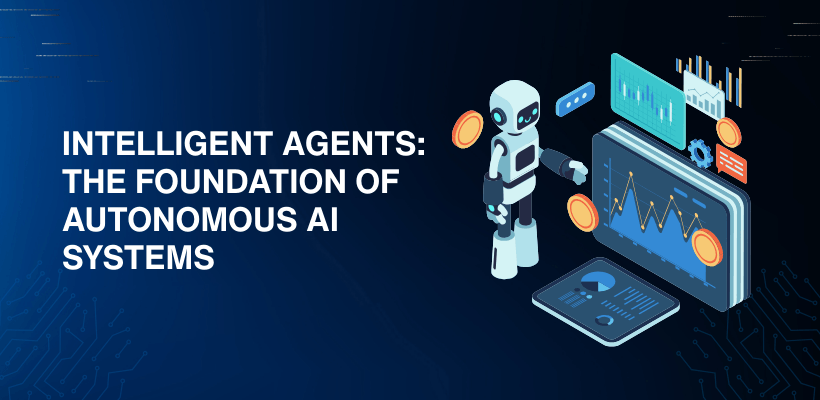
AI has moved far beyond simple automation. Modern AI systems can learn, adapt, make decisions, and perform tasks independently with minimal human intervention. At the heart of these advanced capabilities lies a critical concept: intelligent agents.
These agents form the foundation of autonomous AI systems, enabling machines to perceive their environment, analyze data, and take actions that help achieve specific goals.
From self-driving cars and virtual assistants to recommendation engines and healthcare diagnostics, intelligent agents power many of the technologies shaping our digital world.
Their ability to operate independently while continuously improving their performance makes them central to the development of next-generation AI solutions.
An intelligent agent is a system or entity that can perceive its environment, process information, and take actions to achieve defined objectives.
These agents operate autonomously and can make decisions based on the data they receive.
In simple terms, an intelligent agent acts as a decision-maker within an AI system.
It observes the environment through sensors, interprets the information, and responds through actuators or actions.
To be considered “intelligent,” an agent must satisfy three core criteria:

Every intelligent agent typically consists of the following elements:
Sensors collect information from the environment. For instance, cameras in autonomous vehicles or microphones in voice assistants.
The environment is the context in which the agent operates. It could be a digital environment, such as a website, or a physical environment.
The agent processes the collected information using algorithms, rules, or machine learning models to determine the best action.
Actuators execute the actions decided by the agent. In a robot, actuators may control movement, while in software systems, they may trigger notifications or recommendations.
By continuously sensing, analyzing, and acting, intelligent agents can operate independently and optimize their behavior over time.
A crucial distinction in AI theory is between the Agent Function and the Agent Program.
Not all agents are created equal. They vary in complexity based on the “intelligence” of their internal logic and the complexity of the environment they inhabit.
These are the most basic forms of IA. They operate on the condition-action rule: if condition A is true, then action B is performed. They ignore the rest of the perceptual history and focus only on the current state.
These agents maintain an internal “model” or state of the world. They track parts of the environment that aren’t currently visible to their sensors. This allows them to handle partially observable environments.
Intelligence is often defined by the ability to look ahead. Goal-based agents don’t just react; they act to achieve a specific target state. They use “search” and “planning” algorithms to find the best path to a goal.
Sometimes, reaching a goal isn’t enough; you want to reach it in the best way possible. Utility-based agents use a “utility function” to measure how “happy” or successful a particular state is. They choose actions that maximize expected utility.
This is the pinnacle of modern AI. Learning agents can operate in initially unknown environments and become more competent over time. They are divided into:
What separates a standard script from a true Intelligent Agent? It comes down to several defining traits:
Autonomous AI systems rely heavily on intelligent agents to perform complex tasks without human intervention. These systems combine multiple agents that collaborate, share data, and optimize outcomes.
In retail and e-commerce, agents analyze user behavior in real time to adjust interfaces, suggest products, and even dynamically adjust pricing based on demand and user history.
In manufacturing, agents monitor sensor data from heavy machinery. By “understanding” the normal operating state, they can predict failures before they occur, autonomously schedule maintenance tickets, and order the necessary parts.
Modern cyber threats move too fast for human intervention. Autonomous agents live within the network, identifying anomalous patterns (such as data exfiltration) and instantly isolating compromised nodes without waiting for human admin approval.

Intelligent agents serve as the building blocks of modern AI systems, enabling machines to perceive environments, process information, and make autonomous decisions.
By combining sensing capabilities, decision-making algorithms, and learning mechanisms, these agents enable AI systems to operate with greater independence and intelligence.
From simple rule-based systems to advanced learning agents, each type plays a crucial role in addressing different levels of complexity in real-world applications.
Their defining characteristics, autonomy, reactivity, proactiveness, learning ability, and social interaction, make them essential for building scalable and adaptive AI solutions.
As organizations continue to adopt AI-driven technologies, intelligent agents will become even more important in powering automation, improving efficiency, and delivering personalized experiences.
Whether in healthcare, transportation, finance, or digital platforms, these agents will remain at the core of autonomous AI innovation.
An intelligent agent is a system that perceives its environment, processes information, and takes actions to achieve specific goals. It operates autonomously and adapts its behavior based on inputs and outcomes.
Intelligent agents work by collecting data through sensors, analyzing it using algorithms or models, and performing actions through actuators. This cycle allows them to continuously interact with and respond to their environment.
The main types include simple reflex agents, model-based agents, goal-based agents, utility-based agents, and learning agents. Each type differs in complexity, decision-making ability, and adaptability.
Intelligent agents act as decision-makers within AI systems. They enable automation by analyzing data, making choices, and executing actions without constant human intervention.
Key characteristics include autonomy, reactivity, proactiveness, learning ability, and social interaction. These traits allow agents to operate independently and adapt to changing environments.
At [x]cube LABS, we craft intelligent AI agents that seamlessly integrate with your systems, enhancing efficiency and innovation: