1-800-805-5783
  GET A QUOTE
![Blog-[x]cube LABS](https://d6fiz9tmzg8gn.cloudfront.net/wp-content/uploads/2016/06/blog_banner.jpg)


By [x]cube LABS
Published: Dec 24 2025

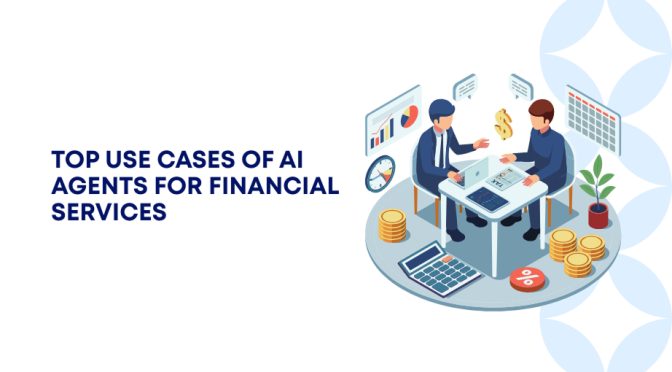
Financial services firms are increasingly treating Agentic AI in financial services as a strategic priority rather than an experimental tool.
Google Cloud data shows more than 50% of financial institutions are already deploying AI agents across core functions, from customer engagement to fraud detection and risk management, and that nearly 49% plan to allocate 50% or more of future AI budgets to autonomous agent technologies. This shift highlights how agentic AI in financial services is becoming essential for competitive differentiation in an AI-driven market.
Agentic AI refers to autonomous, goal-oriented artificial intelligence systems capable of planning, decision-making, and executing actions with minimal human oversight. In the context of agentic AI in financial services, these systems can perceive their operating environment, interpret vast datasets, initiate tasks, adapt to new information, and optimize outcomes at scale.
What sets Agentic AI apart from traditional AI (including generative models that only respond to prompts) is its ability to act independently on defined objectives rather than merely generate content on command.
For example, instead of merely answering “What is my credit score?”, an Agentic AI system could analyze your financial profile, detect trends, and recommend or even initiate actions such as applying for a loan, refinancing, or suggesting portfolio adjustments in real time.
The financial services industry is inherently data-driven, process-heavy, and highly regulated.
Making it both a fertile ground and a challenging environment for technological innovation. These characteristics make agentic AI in financial services especially transformative.
Financial institutions generate and process vast amounts of data daily from transactions and investment portfolios to risk models and customer profiles. Agentic AI can continuously monitor, interpret, and act on this data without human delay.
From compliance reporting to transaction reconciliation and loan processing, many finance workflows are repetitive yet complex. Agentic AI systems can autonomously manage these with higher consistency and lower cost.
Customers now demand personalization, real-time engagement, and convenience in financial services. Agentic AI delivers these through proactive insights and autonomous digital experiences that were previously impossible with legacy systems.
One of the most immediate impacts of agentic AI in financial services is the automation of operational workflows that traditionally required extensive human intervention.

Financial crimes, including fraud, money laundering, and insider trading, continually evolve, making static detection models less effective. Agentic AI transforms risk management in these ways:
Agentic AI transforms the customer experience from reactive support to proactive, personalized engagement:
In capital markets, speed and precision are everything. Agentic AI is already game-changing:

The regulatory environment for financial institutions is complex and constantly shifting. Agentic AI brings several key improvements here:
By automating complex, data-intensive tasks, Agentic AI reduces processing times, minimizes errors, and drives cost savings.
Continuous monitoring and adaptive response improve fraud detection and risk management effectiveness.
Hyper-personalization and real-time advice improve retention and deepen relationships.
Agents can support rapid scaling of services from digital advisory to autonomous trading without proportional increases in human staffing.
Early adopters gain an edge in delivering sophisticated service models while reducing their reliance on legacy systems.
Agentic AI represents a fundamental shift in how financial services can operate, innovate, and deliver value. By enabling autonomous decision-making, real-time responsiveness, and adaptive actions, it ushers in new levels of efficiency, personalization, and competitive advantage.
From risk management to personalized financial guidance and compliance automation, Agentic AI is transforming banks, insurers, and investment firms from traditional service providers into dynamic, AI-powered organizations ready for the future of finance.
Financial institutions that embrace Agentic AI responsibly with proper governance, data integrity, and ethical frameworks stand to redefine the industry and unlock unprecedented opportunities for growth and customer satisfaction.
Agentic AI refers to autonomous AI systems that can plan, decide, and act independently rather than merely generate insights or responses. These systems help automate complex workflows like fraud detection, customer service, and compliance.
Traditional AI often reacts to queries or analyzes data, while Agentic AI takes autonomous actions, such as executing multi-step tasks or workflows without constant human input.
Agentic AI is used for fraud detection, customer onboarding, loan processing, risk management, and 24/7 virtual assistance, boosting efficiency and accuracy across operations.
It can drive faster processing, cost savings, reduced fraud, and improved customer service, with many institutions planning significant investments in agentic systems.
Agentic AI continuously monitors transactional and behavioral data in real time, enabling adaptive threat detection and proactive risk mitigation beyond the limitations of fixed rule-based systems.
At [x]cube LABS, we craft intelligent AI agents that seamlessly integrate with your systems, enhancing efficiency and innovation:
Integrate our Agentic AI solutions to automate tasks, derive actionable insights, and deliver superior customer experiences effortlessly within your existing workflows.
For more information and to schedule a FREE demo, check out all our ready-to-deploy agents here.