Managing people has always been at the heart of business success. However, traditional HR processes such as manual scheduling, repetitive paperwork, and delayed employee support low down productivity. In 2025, organizations are reevaluating their approach to workforce management. At the center of this shift are AI agents for HR.
Unlike basic automation that only follows fixed rules, AI agents in HR act with context and autonomy. They don’t just process data, they make decisions, predict needs, and support employees in real time. This new approach is changing how companies recruit, engage, and manage their people.
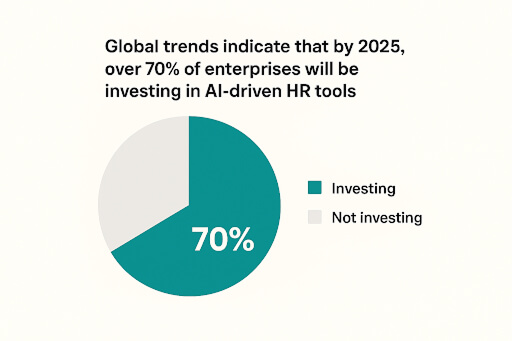
Global trends indicate that by 2025, over 70% of enterprises will be investing in AI-driven HR tools. Companies see AI agents for HR as more than cost savers; they’re becoming employee experience boosters. Let’s explore how AI agents for HR are shaping the future of workforce management.
Why Workforce Management Needs AI Agents for HR
Modern workforces are complex. You’re dealing with remote teams, hybrid setups, high turnover, and rising employee expectations. Manual HR systems simply don’t keep up.
- Employees expect instant answers to policy questions.
- Managers want real-time visibility into performance and engagement.
- HR teams need accurate data to plan, not outdated spreadsheets.
Agentic AI in HR steps in here. Unlike static tools, AI agents for HR monitor, learn, and respond dynamically. For example:
- If an employee appears disengaged, an AI agent flags the issue before it leads to attrition.
- If scheduling errors occur, the agent automatically reallocates shifts to ensure continuity.
- If recruitment lags, the agent screens resumes 24/7 to speed up hiring.
This isn’t futuristic, it’s already happening in leading organizations.
Key Use Cases of AI Agents for HR
1. Intelligent Recruitment and Onboarding
Hiring is one of HR’s most resource-heavy tasks. AI agents for HR streamline the entire pipeline.
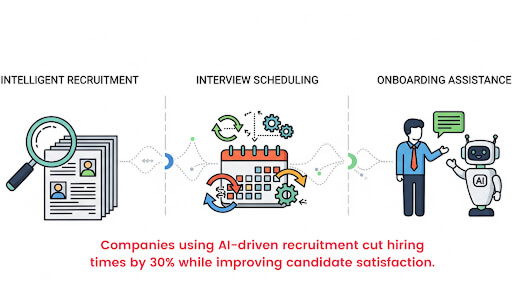
- Resume screening: Agents filter candidates in seconds, focusing only on qualified profiles.
- Interview scheduling: They coordinate calendars automatically, eliminating the need for back-and-forth emails.
- Onboarding assistance: New hires get AI-driven chat support, guiding them through policies, benefits, and role setup.
According to SHRM (2025), companies using AI-driven recruitment cut hiring times by 30% while improving candidate satisfaction.
2. Personalized Employee Support
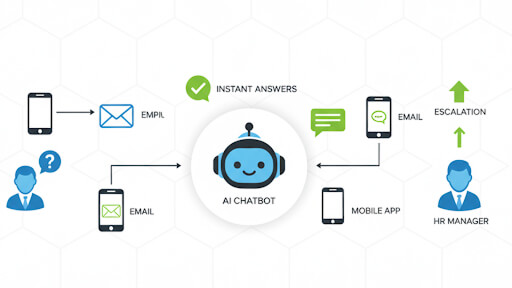
Traditional HR helpdesks are slow. AI agents for HR provide always-on support.
- Employees ask policy, payroll, or benefits questions and get instant answers.
- Agents can escalate complex cases to a human, ensuring a faster resolution.
- Support becomes multilingual and accessible across chat, email, or mobile apps.
This creates a workplace where employees feel heard, without having to wait days for a response from HR.
3. Performance Management and Development
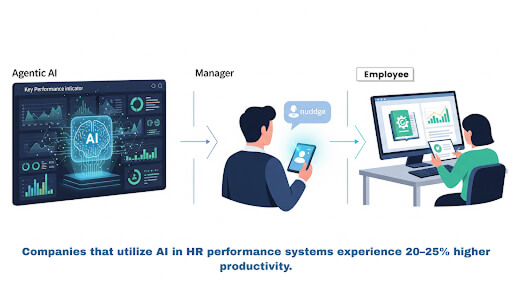
Managing performance often feels reactive. AI agents for HR turn it into proactive.
- They track KPIs in real time.
- They give managers nudges when productivity drops.
- They recommend personalized learning resources tailored to individual career goals.
For example, if an employee struggles with leadership skills, the AI agent suggests targeted training programs that align career growth with organizational goals.
McKinsey reports (2025) that companies using AI in HR performance systems see 20–25% higher productivity.
4. Smarter Workforce Scheduling
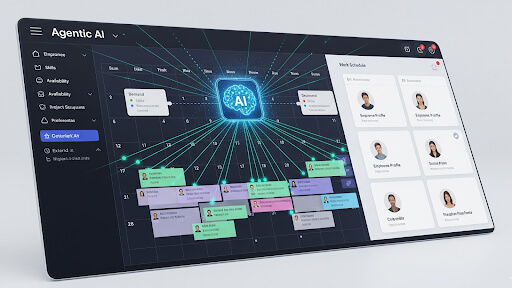
In industries such as healthcare, retail, or logistics, scheduling is crucial. Mistakes mean understaffed shifts and employee burnout.
AI agents for HR automate workforce allocation by analyzing:
- Employee availability
- Skills and certifications
- Overtime limits
- Predicted demand
The result? Balanced schedules, reduced absenteeism, and higher employee satisfaction.
5. Predictive Attrition and Retention
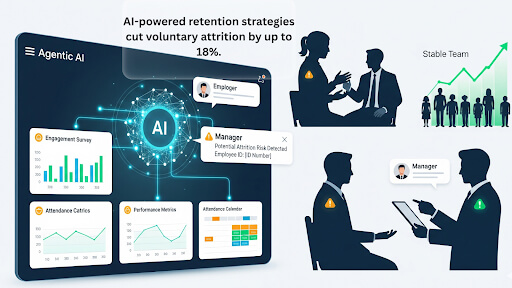
High turnover hurts companies, traditional HR notices attrition only after resignations. AI agents for HR predict it earlier.
By analyzing engagement surveys, attendance, performance, and sentiment, AI agents for HR forecast who might leave. Managers can step in with interventionssuch as mentorship, workload adjustments, or compensation reviewsbefore it’s too late.
A 2024 Gartner study found that AI-powered retention strategies cut voluntary attrition by up to 18%.
6. Diversity and Inclusion Insights
Bias in hiring and promotions is a long-standing HR challenge. AI agents for HR help reduce it.
- They anonymize resumes to focus on skills rather than demographic details.
- They monitor promotion and pay equity patterns, alerting HR about disparities.
- They suggest fair candidate pools for leadership roles.
By running unbiased data models, agentic AI in HR helps companies build fairer workplaces.
Benefits of AI Agents for HR
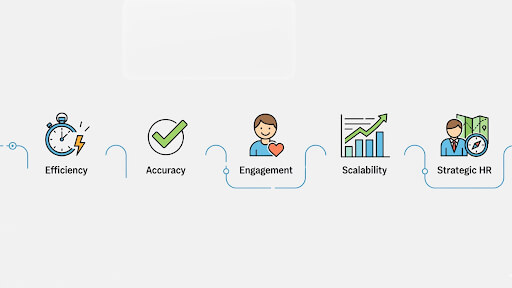
Let’s be clear AI agents for HR don’t replace HR teams. They augment them. Here’s how they improve workforce management:
- Efficiency: Automating routine tasks saves HR staff hours every week.
- Accuracy: AI reduces human errors in payroll, scheduling, and compliance.
- Engagement: Employees get personalized support and faster responses.
- Scalability: AI agents for HR handle thousands of queries at once something no HR team can do alone.
- Strategic HR: With admin tasks handled by AI, HR leaders focus on strategy and people growth.
Challenges and Ethical Concerns
Adopting AI agents in HR isn’t without challenges. Companies need to manage them carefully.
- Bias in algorithms: AI is only as fair as the data it learns from.
- Privacy concerns: Employee data security is a non-negotiable priority.
- Over-automation risks: Employees must feel supported by humans, not only machines.
Companies that strike a balance between automation and empathy will succeed.
The Road Ahead: Workforce 2025 and Beyond
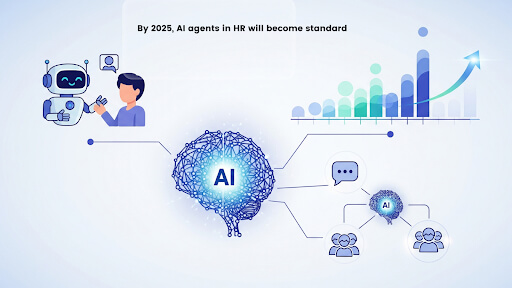
By 2025, AI agents in HR will become a standard feature. HR leaders won’t ask if they should adopt AIthey’ll ask how fast they can scale it.
We’ll see:
- AI-powered virtual HR partners for employees.
- Predictive analytics guiding workforce planning months ahead.
- Seamless integration of AI agents for HR into collaboration tools like Slack and Teams.
Companies that adopt AI agents for HR early will gain a competitive edge, offering faster, fairer, and more engaging workplaces.
Conclusion
The future of workforce management is not about replacing people, it’s about empowering them with AI agents for HR. These agents handle repetitive tasks, deliver proactive insights, and make HR more human by freeing staff to focus on high-value work.
If your organization wants to stay ahead in 2025, it’s time to bring the best AI agents into your HR strategy. The payoff is clear: happier employees, stronger retention, and a more innovative workforce.
FAQ
1. How does agentic AI improve employee experience?
It gives instant answers, proactive insights, and personalized recommendations, making HR support faster and more relevant.
2. Are AI agents replacing HR professionals?
No. They automate routine tasks, allowing HR teams to focus on strategy, engagement, and human-centered initiatives.
3. Can AI agents reduce bias in HR decisions?
Yes. By anonymizing data and analyzing equity trends, AI agents help organizations reduce unconscious bias.
4. What’s the ROI of using AI in HR?
Companies that utilize AI-driven HR tools experience faster hiring, 20–25% productivity gains, and lower employee attrition rates.
5. How do AI agents handle employee privacy?
With proper governance, encryption, and compliance frameworks, AI agents secure sensitive employee data.
How Can [x]cube LABS Help?
At [x]cube LABS, we craft intelligent AI agents that seamlessly integrate with your systems, enhancing efficiency and innovation:
- Intelligent Virtual Assistants: Deploy AI-driven chatbots and voice assistants for 24/7 personalized customer support, streamlining service and reducing call center volume.
- RPA Agents for Process Automation: Automate repetitive tasks like invoicing and compliance checks, minimizing errors and boosting operational efficiency.
- Predictive Analytics & Decision-Making Agents: Utilize machine learning to forecast demand, optimize inventory, and provide real-time strategic insights.
- Supply Chain & Logistics Multi-Agent Systems: Enhance supply chain efficiency by leveraging autonomous agents that manage inventory and dynamically adapt logistics operations.
- Autonomous Cybersecurity Agents: Enhance security by autonomously detecting anomalies, responding to threats, and enforcing policies in real-time.
- Generative AI & Content Creation Agents: Accelerate content production with AI-generated descriptions, visuals, and code, ensuring brand consistency and scalability.
Integrate our Agentic AI solutions to automate tasks, derive actionable insights, and deliver superior customer experiences effortlessly within your existing workflows.
For more information and to schedule a FREE demo, check out all our ready-to-deploy agents here.