1-800-805-5783
  GET A QUOTE
![Blog-[x]cube LABS](https://d6fiz9tmzg8gn.cloudfront.net/wp-content/uploads/2016/06/blog_banner.jpg)


By [x]cube LABS
Published: Jan 06 2026
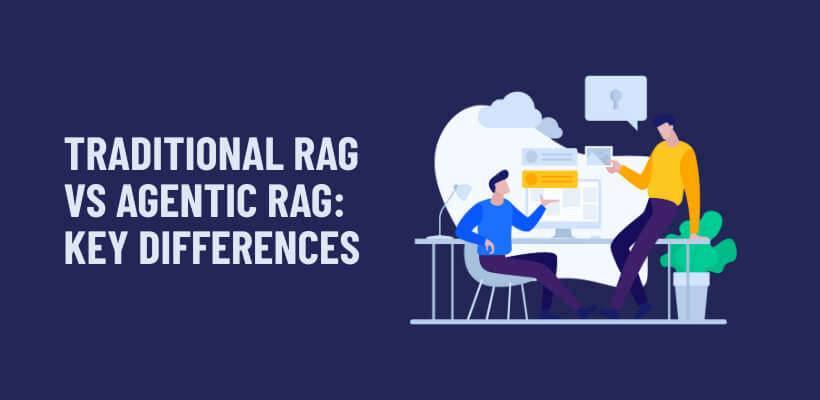
Just a year ago, in 2025, the artificial intelligence industry was buzzing about the ability of Large Language Models (LLMs) to read your private data.
This was the era of Traditional RAG (Retrieval-Augmented Generation). It solved a massive problem: LLMs were hallucinating because they didn’t know your specific business context.
However, as businesses began deploying these systems, they hit a ceiling. Traditional RAG systems are rigid. They are excellent librarians but terrible researchers. When asked a complex question, they often stumble, offering surface-level summaries rather than deep insights. A new approach has begun to unlock even greater potential: Agentic RAG.
In this blog, we will dissect the critical battle between RAG and Agentic RAG, exploring how adding “agency” to retrieval systems is transforming mere information fetching into autonomous problem-solving.
To understand the difference between traditional RAG and Agentic RAG, we first need to look at the baseline.
Retrieval-Augmented Generation (RAG) is a technique that optimizes an LLM’s output by referencing an authoritative knowledge base outside its training data before generating a response.
Traditional RAG operates on a linear, “one-way” street. It follows a predictable pipeline, often called “Retrieve-Read-Generate.”
While revolutionary compared to standard LLMs, Traditional RAG is fundamentally passive.
In the debate between RAG and Agentic RAG, Traditional RAG is the “processing pipe”, it moves data from A to B without thinking.

Agentic RAG introduces a layer of intelligence, an “agent” on top of the retrieval process. Instead of a linear pipeline, Agentic RAG creates a feedback loop.
The LLM is no longer just a text generator; it serves as a reasoning engine, or a “brain,” orchestrating the process. It has access to tools (such as a search engine, a calculator, or an API) and the autonomy to decide when and how to use them.
When a user asks a question in an Agentic system, the workflow is dynamic:
The agency transforms the system from a parrot into a researcher. An Agentic RAG system can handle ambiguity, correct its own mistakes, and persevere until it finds the correct answer.
| Feature | Traditional RAG | Agentic RAG |
| Architecture | Linear Pipeline (Input → Retrieve → Generate) | Cyclic / Loop (Plan → Act → Observe → Refine) |
| Decision Making | Hard-coded rules. The system always retrieves, regardless of the query. | Dynamic reasoning. The LLM decides if it needs to retrieve and what to retrieve. |
| Error Handling | None. If retrieval fails, the answer is poor (Hallucination or “I don’t know”). | Self-correction. If retrieval fails, the agent retries with new parameters. |
| Query Complexity | Best for simple, factual Q&A (Single-hop). | Best for complex, analytical tasks (Multi-hop reasoning). |
| Latency | Low latency (Fast). | Higher latency (Requires multiple thought steps). |
| Cost | Lower token usage. | Higher token usage (due to iterative loops). |
In Traditional RAG, the human must craft the perfect prompt to get the correct answer. In Agentic RAG, the “Agent” mimics the human behavior of refining search queries. It acts as an autonomous intermediary, bridging the gap between a vague user request and the specific data needed to fulfill it.
Traditional RAG is a pipeline, it flows like water through a pipe. Agentic RAG is an orchestration; it is like a conductor leading an orchestra.
The agent might call the “vector search” tool first, then realize it needs math, call a “code interpreter” tool, and finally use a “summarization” tool. The RAG vs. Agentic RAG distinction concerns static flow vs. dynamic orchestration.
To truly appreciate the power of Agentic RAG, we must examine the specific failures of traditional systems that agents address.
Implementing Agentic RAG requires a more sophisticated stack than the simple vector databases used in traditional setups. Here are the components that make it work:
This is the traffic controller. When a query comes in, the Router decides where to route it. Does it need a vector search? Does it need a web search? Or can the LLM answer it from memory?
For complex queries, the Planner breaks the request into a sequence of steps. This is often achieved through techniques such as ReAct (Reason + Act) or Chain-of-Thought (CoT) prompting. The model explicitly writes out its thought process before taking action.
This is the quality control layer. Once an answer is generated, the Critic evaluates it against the original documents. If the answer is not grounded in facts, the Critic rejects it and triggers a re-generation loop.
Despite Agentic RAG’s superiority, it isn’t always the right choice. The “RAG vs Agentic RAG” decision depends on your constraints regarding latency, cost, and complexity.
The industry is moving decisively away from static retrieval. We are entering the age of Agentic Workflows.
In the battle of RAG vs Agentic RAG, the winner is determined by the complexity of the problem you are solving. Traditional RAG was the “Hello World” of using LLMs with private data, a necessary first step.
However, as user expectations rise, the need for systems that can reason, plan, and self-correct is becoming non-negotiable.
Agentic RAG represents the shift from search to research. It moves us closer to the holy grail of AI: systems that don’t just answer our questions, but understand our intent and work autonomously to fulfill it.
If you are building AI applications today, mastering Traditional RAG is the baseline. Mastering Agentic RAG is the competitive advantage.
Traditional RAG retrieves relevant documents and augments the model’s response in a single, fixed pipeline. Agentic RAG adds autonomous agents that dynamically plan, refine, and manage multi-step retrieval and reasoning.
Agentic RAG is better suited for complex, multi-step queries because it can break tasks into parts, iterate retrieval, and adapt strategies. Traditional RAG works well for straightforward questions with simpler retrieval needs.
Yes, Agentic RAG typically uses more compute and may be slower due to iterative planning, multiple retrieval steps, and potential tool calls. Traditional RAG is more straightforward and more cost-effective.
Agentic RAG is ideal when accuracy, adaptability, and the ability to handle complex reasoning are required. Traditional RAG is sufficient for standard QA tasks and static knowledge retrieval.
At [x]cube LABS, we craft intelligent AI agents that seamlessly integrate with your systems, enhancing efficiency and innovation:
Integrate our Agentic AI solutions to automate tasks, derive actionable insights, and deliver superior customer experiences effortlessly within your existing workflows.
For more information and to schedule a FREE demo, check out all our ready-to-deploy agents here.