1-800-805-5783
  GET A QUOTE
![Blog-[x]cube LABS](https://d6fiz9tmzg8gn.cloudfront.net/wp-content/uploads/2016/06/blog_banner.jpg)


By [x]cube LABS
Published: Jan 19 2026
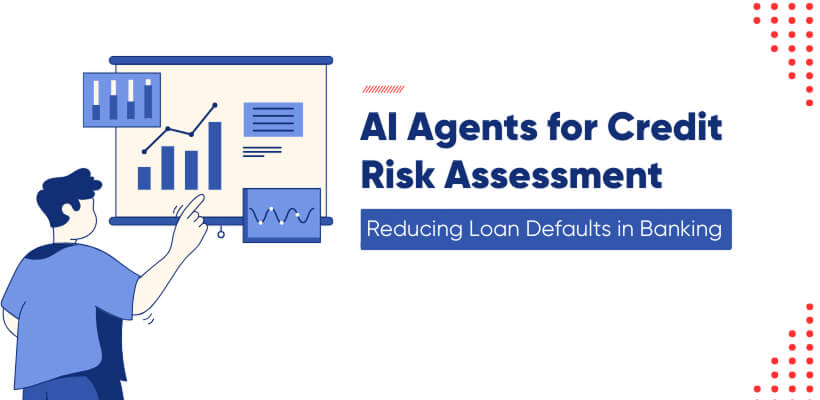
Lending has always been about managing uncertainty. Banks want to grow loan portfolios, but even small blind spots in credit risk assessment can quietly turn into rising defaults, stressed balance sheets, and regulatory pressure.
What’s changing now isn’t just better analytics; it’s the rise of AI Agents that can actively manage risk across the lending lifecycle. Instead of treating credit risk assessment as a one-time decision at approval, banks are beginning to run it as a continuous, operational process.
Most banks still rely on a mix of bureau scores, static rules, analyst judgment, and periodic reviews. This approach works in stable conditions, but struggles when borrower behavior shifts quickly or when applications don’t fit clean templates.
Modern credit risk assessment needs to be faster, more adaptive, and operationally scalable. That’s where AI in credit risk assessment becomes critical, not just to predict risk, but to act on it.
Financial institutions using AI-driven approaches for risk and lending decisions have achieved 20–30% reductions in default rates and up to 40% faster loan approvals. These gains come from stronger execution of credit risk analysis, not relaxed standards.

A traditional credit risk assessment model scores risk. An AI Agent manages the work around that score.
This turns credit risk assessment into a connected system rather than a single approval step.
Underwriting delays often stem from coordination issues, missing documents, unclear income proofs, or policy exceptions awaiting manual review. AI Agents in banking orchestrate these steps by validating inputs, identifying anomalies, and preparing analyst-ready summaries.
As a result, credit risk assessment becomes more consistent, explainable, and audit-ready without sacrificing turnaround times.
Thin-file customers, gig workers, or borrowers with irregular income often fall into gray areas of traditional credit risk analysis. Static scorecards struggle to capture the full picture.
In AI-driven credit risk assessment, agents combine bureau data with transactional behavior, account history, and verified documents, then clearly explain how each signal influenced the outcome. This improves fairness while protecting portfolio quality, especially when a credit risk assessment model alone isn’t enough.
Defaults rarely happen overnight. Risk builds gradually through early signals such as delayed salary credits, rising utilization, missed mandates, or sudden spending shifts.
Here, AI Agents in credit risk operate post-disbursal, continuously monitoring accounts, detecting changes in risk, and triggering interventions before delinquency sets in. 43% of global banks have already deployed internal AI systems, primarily across risk, operations, and back-office functions, highlighting a broader shift toward continuous, system-driven credit risk assessment rather than periodic reviews.
Collections teams often struggle with prioritization and a fragmented borrower context. AI Agents in banking compile a unified risk view, recommend the right outreach strategy, and ensure compliant engagement.
In markets where AI-driven credit workflows have matured, lender surveys indicate that 93% of institutions reported improved loan approval efficiency after adopting AI and machine learning, alongside better portfolio performance. When collections and credit risk assessment are tightly linked, outcomes improve on both ends.
A practical setup usually involves multiple coordinated agents:
Together, they create an end-to-end credit risk assessment workflow that is explainable, scalable, and regulator-ready.
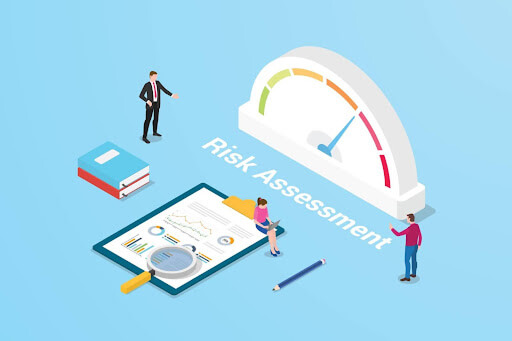
Credit decisions carry real financial and regulatory consequences. That’s why governance must be built into AI Agents in credit risk from day one.
Effective controls include:
When designed this way, AI in credit risk assessment strengthens control rather than weakening it.
The future of lending isn’t about replacing analysts or trusting a single model. It’s about using AI Agents to make credit risk assessment continuous, coordinated, and measurable.
By connecting underwriting, monitoring, and intervention, banks can reduce defaults, improve efficiency, and scale credit responsibly.
Institutions that treat credit risk assessment as an operational system rather than a one-time decision will be better positioned to manage risk in an increasingly dynamic lending environment.
That’s the real promise of AI Agents in credit risk: fewer surprises, stronger portfolios, and smarter growth.
1. What is Credit Risk Assessment in banking?
Credit risk assessment is the process banks use to evaluate a borrower’s ability to repay a loan by analyzing financial data, behavior patterns, and risk indicators before and after loan approval.
2. How do AI Agents improve Credit Risk Assessment?
AI Agents automate and coordinate credit risk workflows by validating data, applying policy rules, monitoring risk signals, and providing structured risk insights to analysts.
3. What role do AI Agents play after loan disbursement?
After disbursement, AI Agents in credit risk continuously monitor early warning signals and trigger timely interventions to help prevent potential loan defaults.
4. Are AI Agents replacing human credit analysts?
No. AI Agents in banking support analysts by handling repetitive tasks, while humans retain control over high-risk decisions and policy exceptions.
5. Can AI-based Credit Risk Assessment comply with regulations?
Yes. When designed with human-in-the-loop controls, audit logs, and explainability, AI in credit risk assessment can strengthen compliance rather than weaken it.
At [x]cube LABS, we craft intelligent AI agents that seamlessly integrate with your systems, enhancing efficiency and innovation:
Integrate our Agentic AI solutions to automate tasks, derive actionable insights, and deliver superior customer experiences effortlessly within your existing workflows.
For more information and to schedule a FREE demo, check out all our ready-to-deploy agents here.