1-800-805-5783
  GET A QUOTE
![Blog-[x]cube LABS](https://d6fiz9tmzg8gn.cloudfront.net/wp-content/uploads/2016/06/blog_banner.jpg)

By [x]cube LABS
Published: Dec 09 2025
Imagine this: you type a request, “get me the compliance report, clean the data, build a slide-ready summary, and notify the team,” and a digital coworker executes the entire workflow before you return to your desk. No follow-ups. No switching between tools. Just completed work.
That is the promise of agentic AI. It is not another chatbot or a reactive assistant. It is a proactive system that understands intent, takes initiative, and completes tasks from beginning to end. The shift is significant because it is already reshaping how work gets done within modern organizations.
Forecasts show that the global market for autonomous AI and agents is expected to surge to USD 28.5 billion by 2028, growing at a 43% CAGR.
Meanwhile, more than 80% of enterprises will have used generative AI APIs or deployed AI-enabled applications in production by 2026.
This is the turning point. Companies are moving beyond experimentation and building real workflows around agentic AI. The competitive question is no longer “should we adopt agents?” but “how quickly can we scale them?”
Traditional AI answers questions. Agentic AI gets things done. It can read, reason, call tools, loop through logic, and complete tasks end-to-end. Think of it as a digital coworker rather than a tool: it sees a goal, plans, executes, checks results, and adapts if things go sideways.
This is why the most valuable use cases of agentic AI are showing up where reliability, speed, and accuracy matter most. When designed well, agents transform complex manual processes into dependable automated systems.
Finance moves fast, and any delay introduces risk. Agentic AI adds precision and continuity where it matters most.
In high-volume onboarding scenarios, agents extract documents, validate identity and risk data, fill forms, and flag anomalies, streamlining KYC/AML compliance with far less manual work.
Agents monitor markets, holdings, and risk parameters around the clock. If a threshold is crossed, they draft alerts for advisors or even suggest potential actions such as rebalancing or hedging. This ensures timely decisions without delays.
These agentic AI use cases in banking deliver immediate value by reducing friction without compromising accuracy or compliance.

Healthcare workflows are often fragmented and overloaded. Agentic AI helps unite them.
Agents parse clinician notes, track lab results, schedule appointments, and send reminders. This improves patient continuity by preventing anything from being lost between visits or departments.
Agents monitor recruitment, check data consistency, flag deviations, and create real-time summaries for trial managers.
These agentic AI use cases in healthcare do more than automate admin tasks. They increase safety, reliability, and oversight in high-stakes environments.
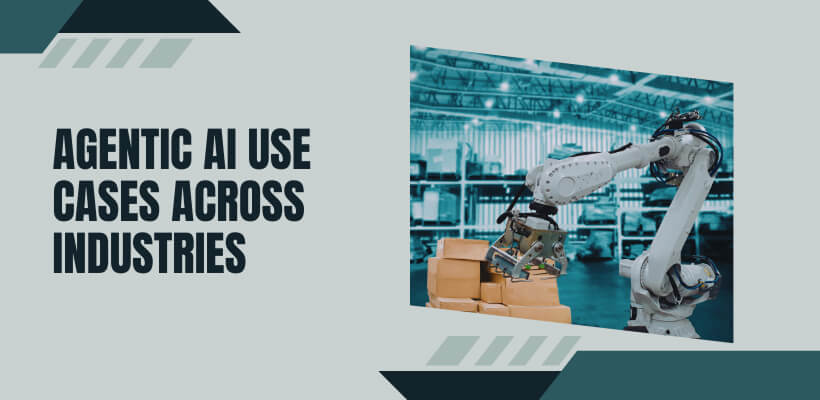
Production floors depend on consistency, precision, and uptime. This is why agentic AI use cases in manufacturing have an immediate operational impact.
Agents monitor sensor data, detect anomalies early, and automatically trigger maintenance workflows to prevent downtime.
Agents compare output against quality criteria, flag defects, and log corrective actions.
Even small improvements in throughput or defect reduction translate into significant cost savings in manufacturing environments.
Agents support retailers by personalizing shopping experiences and improving operational decisions.
Agents recommend products, track restocks and price changes, and help customers build curated carts based on preferences and behavior.
Agents monitor SKU trends, demand shifts, and return patterns to suggest pricing updates or replenishment needs.
These agentic AI use cases in retail help reduce stockouts and improve margins.
Agentic AI brings precision and predictability to farming operations.
Agents analyze soil data, weather patterns, and field imagery to recommend irrigation, fertilization, and crop timing.
Agents track equipment conditions, livestock health, and potential disease risks to guide timely interventions.
These agentic AI use cases in agriculture help farmers make faster, more informed decisions.
Supply chains require constant adaptation to unpredictable conditions. Agentic AI bridges that gap by delivering real-time analysis and proactive adjustments.
Agents track demand, supplier timelines, and risk signals, recommending order adjustments or redistribution before issues escalate.
Agents simulate disruptions, reroute shipments, and adjust delivery schedules to maintain service reliability.
These agentic AI use cases in the supply chain improve resilience by ensuring operations remain stable even when external conditions change.
Some of the most mature agentic AI applications already live in service and IT environments.
They handle routine requests end to end, escalate only when needed, and maintain full context across channels.

Agents watch logs, system health, and performance, detect anomalies, run diagnostics, and propose or execute remediation.
These operational use cases reduce downtime, lighten workloads, and improve service quality across the organization.
Successful adoption relies on a few practices:
When these elements align, agentic AI moves from pilot to production, becoming a scalable engine for business transformation.
Agentic AI is redefining how work gets done. By turning AI into an active contributor capable of planning, decision-making, and task completion, organizations gain faster execution, fewer errors, and stronger operational resilience. The agentic AI use cases across banking, healthcare, manufacturing, and supply chain all reveal the same pattern: agents remove friction and elevate performance.
When adopted thoughtfully, with clear goals and appropriate guardrails, agentic AI applications free teams to focus on strategy and innovation while agents handle repetitive and time-sensitive work. As this technology matures, it will not simply enhance workflows. It will reshape how modern businesses operate and how teams work together.
What is agentic AI?
Agentic AI refers to systems that go beyond generating outputs. They plan, act, use tools, make decisions, and follow through on tasks autonomously, functioning like digital coworkers.
Which industries benefit the most from agentic AI use cases?
Banking, healthcare, manufacturing, supply chain, customer service, IT operations, and logistics are prime beneficiaries. Anywhere there are repetitive, rules-based, or high-volume tasks, agentic AI adds value.
How is agentic AI different from traditional automation or RPA?
Unlike rigid script-based automation, agentic AI reasons, adapts, handles exceptions, and uses context. It is far more flexible, scalable, and suited to dynamic real-world workflows.
Are there risks with agentic AI?
Yes. Without proper governance, human oversight, data quality controls, and observability, agents may make poor decisions. That is why combining autonomy with strong monitoring and human review is vital, especially in sensitive industries.
At [x]cube LABS, we craft intelligent AI agents that seamlessly integrate with your systems, enhancing efficiency and innovation:
Integrate our Agentic AI solutions to automate tasks, derive actionable insights, and deliver superior customer experiences effortlessly within your existing workflows.
For more information and to schedule a FREE demo, check out all our ready-to-deploy agents here.