1-800-805-5783
  GET A QUOTE
![Blog-[x]cube LABS](https://d6fiz9tmzg8gn.cloudfront.net/wp-content/uploads/2016/06/blog_banner.jpg)

By [x]cube LABS
Published: Apr 16 2026
There is a lot of noise in the tech world right now, and much of it is confusing. You’ve likely heard about Generative AI, chatbots, and automation, but most of these tools still require a human to hold their hand.
We are stuck in a cycle of “prompting and waiting.” But a quiet revolution is underway beneath the surface, shifting the conversation from Generative AI to Agentic AI.
The Agentic Enterprise isn’t about another shiny chatbot for your website, it’s about autonomous, purposeful, and goal-oriented systems that finally deliver on the promise of the autonomous business.
It’s time to move past the hype and look at the actual utility.
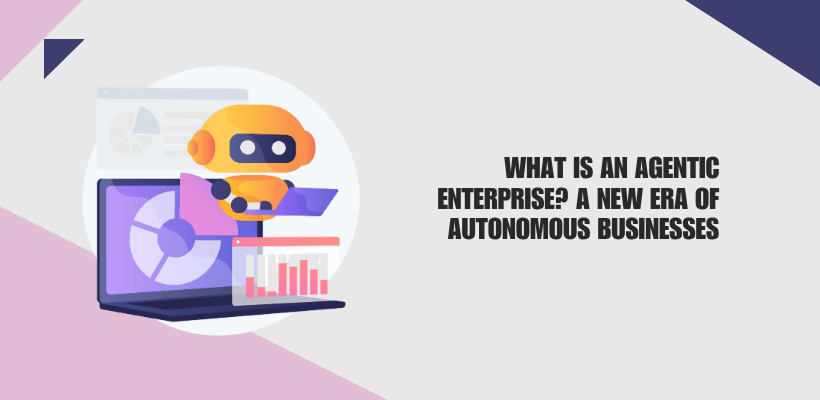
An agentic enterprise is an organization that deploys AI agents, systems capable of autonomous goal-directed behavior, as core operational infrastructure.
These agents don’t wait for explicit instructions for every micro-decision. They are given objectives and the tools to pursue them, adapting their strategies in real time as conditions change.
The term “agentic” derives from the concept of agency: the capacity to act independently within an environment.
In an agentic enterprise, this capacity is distributed across multiple specialized AI systems that collaborate, self-correct, and operate continuously, even while the human workforce is offline.
Think of it less as a company using artificial intelligence tools and more as a company where AI agents are active participants in workflows, decisions, and strategy execution.

There is a meaningful distinction between a business that uses AI software and one that has become a true agentic enterprise.
The difference lies not in the sophistication of individual tools, but in the degree to which autonomous agents are woven into the organizational fabric.
Four characteristics define a genuine agentic enterprise:
Persistent autonomy: Agents operate continuously without requiring step-by-step human direction for every action.
Multi-agent coordination: Specialized agents collaborate, delegate subtasks, and synthesize results to complete complex objectives.
Adaptive reasoning: Agents reason through novel situations rather than pattern-matching against fixed decision trees.
Human-in-the-loop governance: Humans set objectives, review consequential outputs, and maintain meaningful oversight of agent behavior.
To understand the agentic enterprise, one must consider the architectural organization of multi-agent systems.
Typically, an orchestrator agent receives high-level goals from human stakeholders. After receiving these goals, it decomposes them into subtasks and then routes each subtask to a specialized subagent.
Examples include agents for research, drafting, and validation. The orchestrator integrates their work into a coherent result and surfaces decisions that genuinely require human judgment.
This architecture mirrors how high-performing human teams operate a senior leader delegates to specialists, each expert handles their domain, and the team produces outcomes no individual could achieve alone.
The agentic enterprise essentially digitizes and accelerates this model, allowing a relatively small number of humans to manage operations at a scale that would previously have required far larger headcounts.
Agentic enterprise adoption is not uniform across sectors. Some industries are moving faster because their workflows are information-dense, their environments are highly structured, and they have a higher tolerance for AI-driven decision-making.
As a result, financial services, legal, healthcare administration, software engineering, and logistics are at the frontier.
In each of these sectors, agents are already performing functions that were once firmly in the domain of skilled human workers.
Software development provides perhaps the clearest current example. Agentic coding systems can now plan implementation strategies, write code, run tests, interpret failures, revise their approach, and open pull requests, all without continuous human prompting.
The human engineer shifts from author to architect and reviewer, dramatically compressing the time between idea and deployed feature. This is not science fiction; it is happening in production environments today.
In legal services, agentic systems are conducting due diligence reviews, identifying relevant precedents, flagging contractual risk clauses, and drafting summaries, work that previously consumed hundreds of billable hours.
In supply chain management, agents monitor global disruptions, model alternative routing scenarios, and autonomously reroute shipments within pre-approved parameters.
The agentic enterprise, in each case, is defined by this expansion of the AI system’s operational footprint.
Human employees are often bogged down by “swivel-chair” tasks, moving data from one system to another, copying information from an email into a spreadsheet, or manually checking statuses.
Agentic systems perform these tasks 24/7 without fatigue. This doesn’t just save time, it creates a “continuous execution” model where business processes never sleep.
In the past, you could offer high-quality service or high-scale service, but rarely both. The agentic enterprise solves this paradox. By analyzing customer data in real-time, agents can tailor marketing messages, support responses, and pricing strategies for every single customer simultaneously. It is the end of the “average customer” era.
In a traditional enterprise, decisions move up the chain of command, gather dust, and come back down weeks later. In an agentic enterprise, data-driven decisions are made at the edge.
If an anomaly is detected in server performance, an IT agent fixes it before a human manager even receives a notification. This speed provides a distinct competitive moat.

A transformative shift is occurring in organizations as agentic enterprises redefine the relationship between AI and human workers.
One of the most persistent misconceptions about agentic enterprises is the notion that they are destined to replace human workers en masse.
The reality is more nuanced and, arguably, more interesting. The agentic enterprise does not eliminate human roles, it transforms them.
The work that humans do becomes more consequential, strategic, and creative because AI agents absorb the high-volume, low-judgment tasks that previously consumed the majority of working hours.
Humans in an agentic enterprise act as goal-setters, boundary-definers, and exception-handlers. They choose objectives, set boundaries, and intervene in complex cases, requiring more critical thinking and expertise than procedure.
An Agentic Enterprise is an organization that leverages autonomous AI agents to perform tasks, make decisions, and optimize workflows with minimal human intervention, improving efficiency and scalability.
Traditional automation follows fixed rules, whereas agentic systems are adaptive, goal-driven, and capable of learning, reasoning, and making contextual decisions.
AI agents are intelligent systems that can independently execute tasks, interact with data, and collaborate with other agents or humans to achieve specific business outcomes.
Not entirely. While AI agents handle many tasks independently, human oversight remains essential for governance, ethical decision-making, and strategic direction.
Start by identifying high-impact use cases, integrating AI agents into workflows, ensuring strong data infrastructure, and gradually scaling automation with proper governance.
At [x]cube LABS, we craft intelligent AI agents that seamlessly integrate with your systems, enhancing efficiency and innovation:
Integrate our Agentic AI solutions to automate tasks, derive actionable insights, and deliver superior customer experiences effortlessly within your existing workflows.
For more information and to schedule a FREE demo, check out all our ready-to-deploy agents here.