1-800-805-5783
  GET A QUOTE
![Blog-[x]cube LABS](https://d6fiz9tmzg8gn.cloudfront.net/wp-content/uploads/2016/06/blog_banner.jpg)


By [x]cube LABS
Published: Jan 02 2026
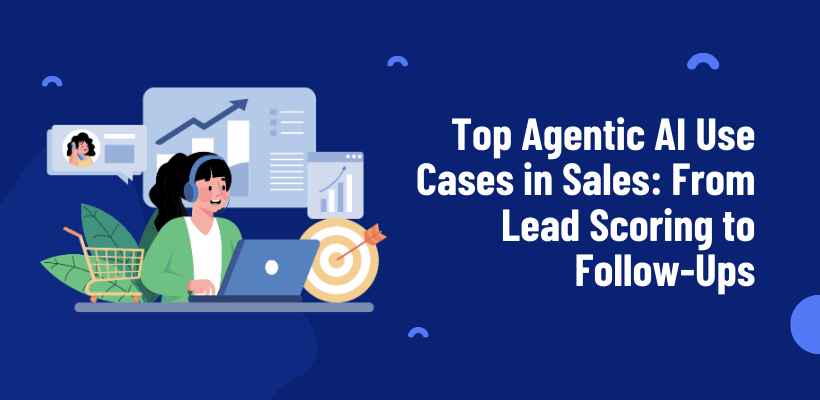
The modern sales floor is facing a quiet but critical challenge. Despite access to an expanding suite of digital tools, sales representatives are spending less time on what matters most — selling.
A significant share of their workweek is consumed by administrative tasks, data entry, and repetitive outreach, leaving precious little time for strategic engagement or relationship building.
This is where agentic AI in sales emerges as a truly transformative force.
Unlike traditional generative AI, which only responds to prompts or generates content, agentic AI comprises autonomous agents that can observe, reason, and act toward goals with minimal human supervision.
These advanced systems don’t just create insights; they execute tasks autonomously across the sales lifecycle, from lead scoring and qualification to personalized outreach and follow-ups.
In this blog, we explore the top agentic AI use cases in sales and demonstrate their tangible business impact.
One of the foundational use cases for agentic AI in sales is lead scoring and qualification.
Traditional lead scoring models rely on preset rules or basic point systems, often manual and static. In contrast, agentic AI continually analyzes multiple behavioral and contextual signals from CRM activity, website engagement, email interactions, firmographics, and intent data. This allows the system to assess each prospect’s actual buying readiness in real time.
Here’s how agentic AI in sales enhances lead scoring:
The most challenging part of a salesperson’s job is often not the initial contact, it’s keeping the conversation alive. Agentic AI brings contextual, personalized follow-ups to the next level.
Rather than sending generic drip campaigns, Agentic AI in sales can:
For example, AI can pull in a recent company announcement or a shift in prospect behavior to make a follow-up email more relevant and impactful.

Updated and clean CRM data is the lifeblood of an effective sales process. Agentic AI agents can enrich lead records with verified contact details, firmographic data, technographic intelligence, and interaction history – all in real time.
Key capabilities of Agentic AI in Sales include:
In addition to scoring and outreach, agentic AI in sales can monitor sales pipeline progress and help manage opportunities more effectively.
These intelligent agents can:
This level of pipeline supervision helps avoid stalled deals and keeps sellers focused on closing.
Today’s buyers interact with brands across multiple touchpoints — email, LinkedIn, SMS, chatbots, and more. Agentic AI supports cross-channel orchestration by aligning messages and timing across all channels.
For instance, the agent might:
This multi-channel approach ensures prospects receive a cohesive, relevant experience, boosting engagement and driving conversions.
Autonomous AI chatbots, a form of agentic AI, serve as digital sales assistants interacting with site visitors around the clock. These chatbots can:
Unlike static chatbots, agentic chatbots understand context, can remember past interactions, and execute follow-through actions. This transforms a typical website visitor into a measurable sales pipeline opportunity.
Small but tedious tasks like scheduling follow-ups or updating tasks often bog down sales reps. Agentic AI in sales automates these tasks by:
By relieving reps of these administrative chores, AI enables them to focus more on strategic conversations and deal closures.
Experienced sales coaches are expensive and not scalable. Agentic AI systems can act as on-demand sales coaches, offering suggestions to improve conversations and follow best practices.
These AI agents analyze calls or communications and provide:
This helps reps improve performance over time, a capability that scales beyond individual mentor availability.
Beyond execution, agentic AI can help forecast outcomes and recommend prescriptive actions to improve win probabilities.
Using historical data and predictive modeling, Agentic AI in sales can:
This level of insight can reduce guesswork and align sales strategies with quantifiable signals.
While agentic AI in sales offers transformative benefits, adoption is still maturing. A Gartner report predicts that over40% of agentic AI projects will be scrapped by 2027 due to unclear business outcomes and high operational costs, underscoring the need for thoughtful implementation and for measuring ROI.
However, Gartner also forecasts that15% of daily business decisions will be made autonomously by agentic AI by 2028, and that 33% of enterprise software applications will incorporate agentic AI, a significant jump from less than 1% today.
To ensure successful adoption, consider these best practices:
Agentic AI in sales is no longer a futuristic concept, it’s already redefining how sales teams operate by automating core workflows and enabling smarter, faster, and more personalized prospect engagement.
From lead scoring and qualification to automated outreach and CRM enrichment, these intelligent agents free sellers to focus on building relationships and closing deals.
As adoption continues to grow and technology matures, sales organizations that embrace agentic AI early will gain a substantial competitive edge, driving higher conversions, shortening sales cycles, and delivering exceptional customer experiences.
Agentic AI in sales refers to autonomous AI systems that can observe data, make decisions, and execute tasks such as lead scoring and follow-ups with minimal human intervention. Unlike traditional AI, it proactively acts on high-level goals.
Agentic AI continuously analyzes behavioral and CRM data to prioritize leads, making scoring more accurate, dynamic, and aligned with buying intent than rule-based systems.
Yes, agentic AI in sales can send personalized follow-ups and reminders based on engagement history and prospect behavior, helping prevent leads from going cold.
Agentic AI automates repetitive tasks to boost efficiency, but it doesn’t replace humans. It augments sales teams by handling routine workflows, allowing reps to focus on strategic selling.
Challenges include ensuring data quality, aligning AI actions with business goals, and avoiding premature deployment without a clear ROI. According to Gartner, many early agentic AI projects may be scrapped due to unclear outcomes.
At [x]cube LABS, we craft intelligent AI agents that seamlessly integrate with your systems, enhancing efficiency and innovation:
Integrate our Agentic AI solutions to automate tasks, derive actionable insights, and deliver superior customer experiences effortlessly within your existing workflows.
For more information and to schedule a FREE demo, check out all our ready-to-deploy agents here.