1-800-805-5783
  GET A QUOTE
![Blog-[x]cube LABS](https://d6fiz9tmzg8gn.cloudfront.net/wp-content/uploads/2016/06/blog_banner.jpg)


By [x]cube LABS
Published: Mar 26 2026
The way we interact with software is starting to change, and it’s happening quietly.
For a long time, tools have been built to respond to inputs. You ask, click, or trigger something, and the system follows through. But today, that dynamic is shifting. Systems are beginning to anticipate needs, suggest actions, and support decisions in real time.
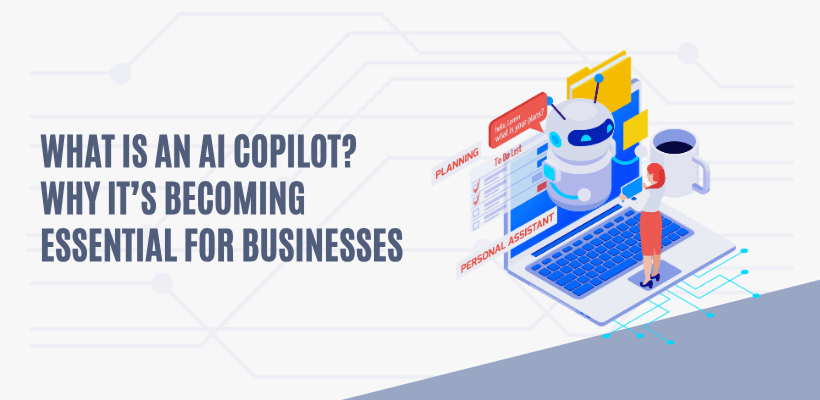
This is where an AI copilot comes into the picture. Instead of functioning as just another feature or tool, an AI copilot works alongside users, helping them navigate tasks, reduce effort, and move forward with more clarity. It brings intelligence directly into workflows rather than leaving it outside, similar to how a more advanced virtual AI assistant operates, but with deeper contextual understanding.
As businesses deal with increasing complexity, tighter timelines, and growing volumes of data, this shift is becoming less of an advantage and more of a necessity.
Most software was built to execute. You provide an input, the system processes it, and an output follows. It’s structured, predictable, and limited to what you explicitly ask for.
What’s changing with generative AI is not just capability, but behavior. Software can now interpret intent, generate possibilities, and contribute to the task itself. This is where the AI Copilot begins to take shape, not as a separate tool, but as an intelligence layer within the tools people already use.
Instead of interrupting workflows, it works within them. Instead of waiting for instructions, it supports progress as it happens. And that shift from execution to collaboration is what’s redefining how modern software is experienced.
An AI Copilot is an intelligence layer embedded within applications that supports users in real time, guiding tasks, improving accuracy, and simplifying complex workflows. It goes beyond traditional AI assistance by not just responding to queries but actively contributing within the flow of work.
Its value lies in how naturally it fits into ongoing work. Instead of requiring repeated prompts, it interprets context and provides relevant suggestions at the right moment. This allows users to move forward without constantly switching between tools or searching for information.
An AI Copilot for business extends this capability across enterprise environments, helping teams handle tasks more efficiently while maintaining process consistency.

The difference between AI Copilot and AI Assistant becomes clear when you look at how each system engages with the user.
AI assistants operate on request; they respond when prompted and complete specific actions, much like a conventional virtual assistant.
An AI Copilot functions within the workflow itself. It observes activity, identifies patterns, and contributes suggestions as work progresses.
This distinction changes the system’s role from a tool that reacts to one that supports ongoing decision-making.
The increasing relevance of the AI copilot reflects a broader shift in how work is structured, moving beyond traditional AI assistance toward more integrated and context-aware systems.
Teams today manage multiple systems, proc ess large volumes of information, and operate under tighter timelines. Copilots help streamline this environment by reducing friction and improving clarity.
An AI copilot for business enhances tools that teams already rely on, rather than introducing entirely new platforms.
This approach minimizes disruption and allows organizations to improve efficiency without overhauling their workflows. Solutions like Microsoft AI Co-Pilot demonstrate how intelligence can be layered into familiar environments.
Traditional automation handles repetitive tasks based on predefined logic.
An AI copilot introduces Intelligent automation, where systems can adapt to context and support more complex decision-making processes.
This enables businesses to manage scenarios that require flexibility rather than fixed rules.
Work today often involves navigating information rather than simply completing tasks.
An AI copilot helps filter inputs, highlight what matters, and guide the next step, allowing teams to focus on outcomes instead of constantly managing details.
The evolution of copilots is extending beyond applications.
With developments like the co-pilot AI PC, intelligence is becoming part of the device itself, creating a more continuous and connected user experience.
This ensures that assistance is available wherever work happens, without being tied to a single platform.
The practical value of an AI Copilot becomes clear across different business functions:
In each of these areas, the AI Copilot’s role is to improve how work is carried out, making execution more streamlined and reliable.
The emergence of the AI Copilot reflects a deeper transformation in how systems are designed. Instead of requiring constant input, modern systems are being built to guide actions, adapt to context, and contribute to outcomes.
As generative AI continues to evolve, copilots will become more embedded within business environments, shaping how work is structured and executed. This shift moves technology from being a passive tool to an active participant in day-to-day operations.
An AI Copilot is steadily becoming a core component of how businesses approach productivity and decision-making. By integrating directly into workflows, it reduces complexity, improves efficiency, and supports more informed actions across teams.
As organizations continue adopting AI Copilot for business solutions, the focus will shift toward building connected systems powered by intelligent automation. The true impact of an AI Copilot lies in its ability to align seamlessly with how people work, enhancing both speed and effectiveness without adding unnecessary friction.
For those still exploring what is AI copilot, it represents the next step in the evolution of workplace technology, moving from tools that assist to systems that actively collaborate.
1. What is an AI Copilot?
An AI Copilot is an AI-powered system embedded within applications that assists users by providing real-time suggestions, generating outputs, and improving decision-making.
2. What is the difference between AI Copilot and AI Assistant?
AI assistants respond to prompts, while AI copilots operate within workflows, offering proactive support based on context.
3. How does an AI Copilot help businesses?
An AI Copilot improves efficiency, enables intelligent automation, reduces manual effort, and enhances decision-making across business functions.
4. What is an AI Copilot for business?
An AI Copilot for business is a copilot designed for enterprise use, helping teams work more effectively within existing systems.
At [x]cube LABS, we craft intelligent AI agents that seamlessly integrate with your systems, enhancing efficiency and innovation:
Integrate our Agentic AI solutions to automate tasks, derive actionable insights, and deliver superior customer experiences effortlessly within your existing workflows.
For more information and to schedule a FREE demo, check out all our ready-to-deploy agents here.