1-800-805-5783
  GET A QUOTE
![Blog-[x]cube LABS](https://d6fiz9tmzg8gn.cloudfront.net/wp-content/uploads/2016/06/blog_banner.jpg)


By [x]cube LABS
Published: Feb 18 2026
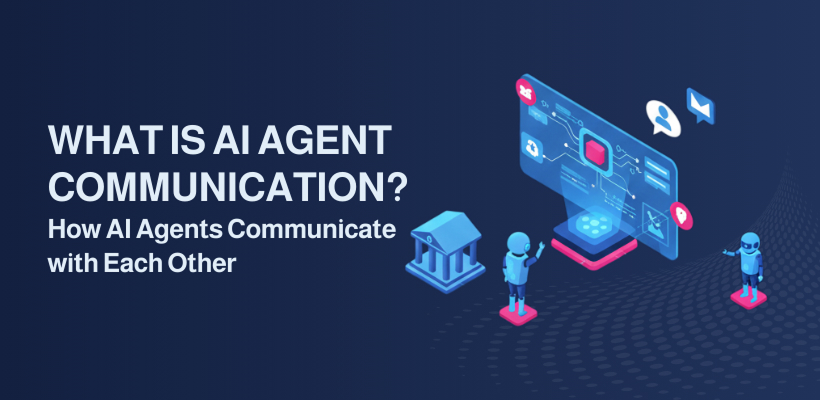
In 2026, the image of a lone AI model processing a single request is becoming a relic of the past.
As businesses transition to multi-agent systems, the true value of artificial intelligence is no longer found in isolated “thinking” but in collaborative “talking.”
This shift has brought a relatively niche field of computer science into the spotlight: AI Agent Communication.
Whether it is a supply chain agent negotiating with a logistics agent or a coding agent peer-reviewing a security agent’s work, the ability for these autonomous entities to exchange information is what transforms a collection of tools into a cohesive, intelligent workforce.
Understanding the nuances of AI Agent Communication is essential for any organization looking to scale its agentic workflows in the coming years.
At its core, AI Agent Communication refers to the standardized protocols and languages that allow autonomous agents to share data, express intentions, and coordinate complex tasks.
Unlike simple API calls where one system dictates an action to another, agent communication is a two-way dialogue characterized by reasoning and negotiation.
In an agentic ecosystem, communication is the “connective tissue.” It allows specialized agents, each with their own context, tools, and goals, to function as a unified team.
Without a robust communication framework, agents would operate in silos, leading to redundant work, conflicting actions, and a total collapse of the system’s collective intelligence.
By 2026, the methods by which agents interact have evolved from rigid, rule-based messaging to dynamic, semantic exchanges. There are three primary layers through which AI Agent Communication occurs:
For agents to understand each other, they need more than just data; they need intent. Modern systems use Agent Communication Languages (ACLs).
While legacy protocols like FIPA-ACL laid the groundwork, 2026-era systems often rely on “Performative-based” messaging. Every message is wrapped in a “verb” that defines its purpose:
Direct messaging is often supplemented by “Shared Memory.” Instead of passing massive files back and forth, agents use shared vector databases or state stores to maintain a “single source of truth.”
When one agent updates a project’s status or adds a new finding to a research log, all other agents in the “squad” instantly have access to that updated context.
This form of AI Agent Communication ensures that every participant is always operating with the most current information.
With the rise of Large Language Models (LLMs) as the reasoning core of agents, we are seeing the rise of “Natural Language Communication.”
In collaborative frameworks like AutoGen or LangGraph, agents actually “talk” to each other in human-readable text.
This allows for complex “reflection loops” where a Critic Agent can provide nuanced, linguistic feedback to an Executor Agent, much like a senior developer mentoring a junior one.
The structure of AI Agent Communication often depends on the orchestration pattern being used. No two agent teams communicate in exactly the same way.
In this model, a “Leader” or “Orchestrator” agent receives a goal from the human user. It decomposes that goal into sub-tasks and communicates them to specialized “Worker” agents.
The workers report back only to the leader, who then synthesizes the results. This is the most common pattern for enterprise automation, as it provides a clear point of control and auditability.
In more decentralized environments, agents communicate directly with one another without a central manager.
This is common in “Zero-Click” economies or smart marketplaces. For instance, a buyer agent might broadcast a “Call for Proposal” (CFP) for a specific service, and multiple seller agents will negotiate terms directly with the buyer agent until a contract is reached.
In high-velocity environments like fraud detection or real-time trading, agents use a “Publish-Subscribe” (Pub/Sub) model.
An agent monitors the environment and “publishes” an event when it detects an anomaly. Any other agent “subscribed” to that type of event- such as a security agent or a compliance agent- instantly receives the alert and initiates its specific workflow.
While the benefits are clear, AI Agent Communication is not without its hurdles. As we move into 2027, the industry is focused on solving three critical problems:

The ultimate goal of AI Agent Communication is a world where agents are not confined to a single app.
We are moving toward a future where your personal scheduling agent (built by one company) can seamlessly “talk” to a restaurant’s booking agent (built by another) to negotiate a dinner reservation.
Protocols such as the Agent-to-Agent (A2A) standard and the Model Context Protocol (MCP) are currently being developed to serve as the “universal translator” for the agentic era.
When this level of interoperability is reached, the global economy will shift from being a network of websites to being a network of communicating intelligences.
AI Agent Communication is the catalyst that turns isolated algorithms into a collaborative force. By moving beyond simple data transfers to semantic, intent-driven dialogues, we are building systems that can solve problems far more complex than any single AI could handle alone.
As we look toward the future, the organizations that master the art of agent coordination will be the ones that define the next era of business efficiency. The conversation has started, and the agents are finally ready to talk.
AI Agent Communication is the set of protocols, languages, and frameworks that allow autonomous AI agents to exchange information, express intentions, and coordinate actions to achieve a shared goal.
They can. Many modern multi-agent systems use natural language (like English) to communicate, as it allows for nuanced reasoning and “reflection.” However, they also use structured formats like JSON or specific protocols like FIPA-ACL for faster, more predictable data exchange.
Communication allows agents to specialize. Instead of one AI trying to do everything, you can have a “squad” of experts that collaborate. This increases the accuracy, scalability, and speed of complex workflows.
Developers use “Communication Budgets” and “Goal-Directed Routing.” This limits the number of messages agents can exchange before reaching a decision, preventing the system from getting stuck in an infinite loop of “chatter.”
In professional enterprise environments, communication is secured using end-to-end encryption and “Identity & Access Management” (IAM) protocols. This ensures that only authorized agents can join a specific communication “room” or share sensitive data.
At [x]cube LABS, we craft intelligent AI agents that seamlessly integrate with your systems, enhancing efficiency and innovation:
Integrate our Agentic AI solutions to automate tasks, derive actionable insights, and deliver superior customer experiences effortlessly within your existing workflows.
For more information and to schedule a FREE demo, check out all our ready-to-deploy agents here.