1-800-805-5783
  GET A QUOTE
![Blog-[x]cube LABS](https://d6fiz9tmzg8gn.cloudfront.net/wp-content/uploads/2016/06/blog_banner.jpg)

By [x]cube LABS
Published: Feb 10 2026
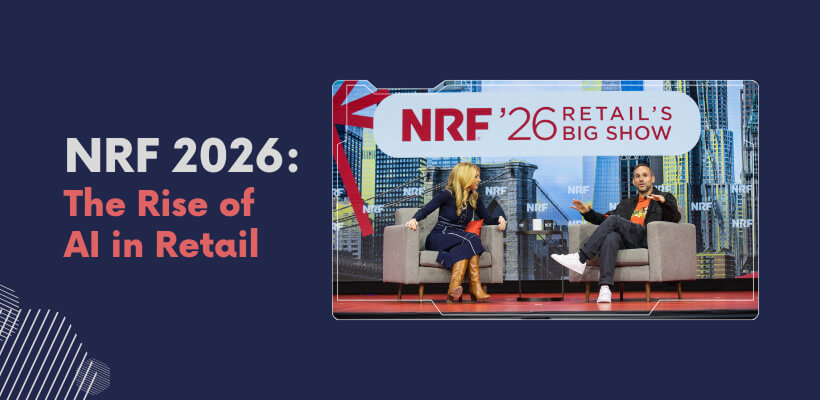
The retail industry has officially moved past the “pilot phase” of digital transformation.
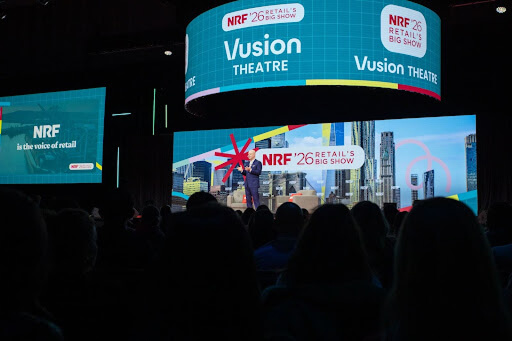
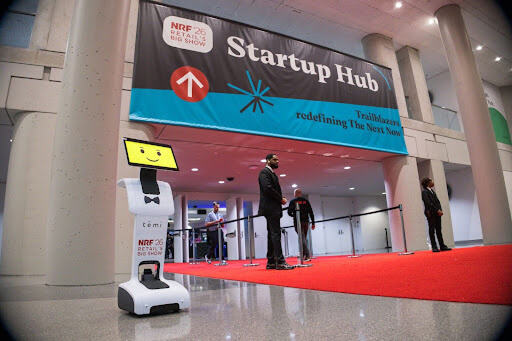
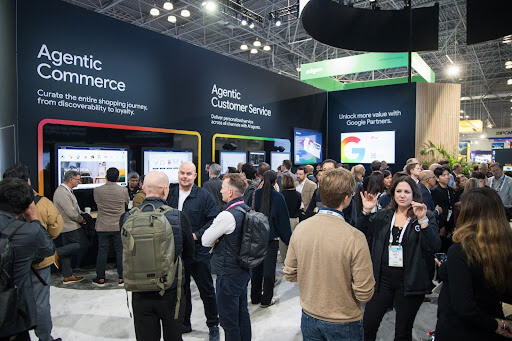
At NRF 2026: Retail’s Big Show in New York City, the atmosphere at the Javits Center was defined by a single, powerful realization: the future of commerce is no longer just digital, it is agentic.
With over 40,000 industry leaders in attendance, including our CEO, Bharat Lingam, the theme “The Next Now” underscored a tectonic shift from theoretical experimentation to the practical, scalable application of AI in Retail.
For retail hubs ranging from the fashion avenues of New York to the rapidly growing tech and retail corridors of Dallas, the message from NRF 2026 was clear: the retailers who thrive in the coming years will be those who successfully automate operational friction while simultaneously elevating the human experience.
As the industry recalibrates, we are witnessing a fundamental architectural reinvention where the silos separating discovery from transaction have finally dissolved.
The most seismic shift discussed at NRF 2026 was the transition from predictive models to “Agentic” systems.
In the previous era, AI in Retail was largely used to predict what a customer might want next.
Today, the focus has shifted to autonomous agents- systems capable of executing complex tasks, making independent decisions, and conducting transactions on behalf of consumers.
As articulated by industry visionaries like Jason “Retailgeek” Goldberg during the summit, we are entering the era of the “AI-Native Consumer.”
This new generation of shoppers doesn’t just use tools; their shopping behaviors are fundamentally shaped by algorithmic mediation.
They are moving away from traditional keyword searches toward natural, conversational interactions with persistent AI concierges.
This evolution is giving rise to the “Zero-Click Economy.” In this landscape, an AI agent can discover a product, negotiate a price based on the user’s loyalty status, and finalize a purchase without the user ever visiting a retailer’s website or app.
For brands, the metric of success is shifting from “share of wallet” to “share of algorithm.”
A major highlight of NRF 2026 was the introduction of the Universal Commerce Protocol (UCP).
This open-source standard acts as the “connective tissue” for AI in Retail, allowing different agents, platforms, and retailers to speak a common language.
For retailers in competitive markets like Dallas, this means their product data must now be structured for “machine comprehension” to ensure they remain discoverable by the autonomous agents that will soon manage the majority of consumer discovery.
Contrary to early predictions of a digital-only future, the physical store is undergoing a massive renaissance, redefined at NRF 2026 as a dynamic hub for fulfillment, brand immersion, and data acquisition.
The store is effectively becoming a “Digital Twin” of the e-commerce experience.
One of the recurring pain points discussed at the Javits Center was the persistent discrepancy between digital inventory and shelf reality.
Technologies showcased at NRF 2026, such as the NexShelf, are solving this via vision AI in Retail. By using Electronic Shelf Labels (ESLs) and shelf-edge cameras, retailers can generate “realograms”: live, digital maps of the physical shelf.
These systems detect out-of-stocks, misplacements, and pricing errors instantly, feeding that data back into the central ERP to ensure that the “promise” made online can be kept in the store.
As physical storefronts become high-compute environments, the infrastructure supporting them must evolve.
Leaders at the summit emphasized the need for secure, self-driving networks and “Zero Trust” security models. With the explosion of IoT devices, from smart carts to biometric payment gates, retailers must treat their physical square footage as an extension of the cloud, capable of processing vast amounts of data at the “edge” to maintain 100% uptime.
In 2026, transactional “earn and burn” points are no longer sufficient to retain a customer base that has infinite choices.
The conversation at NRF 2026 focused on the shift toward Emotional Loyalty, a strategy that moves beyond the transaction to build a sense of community and belonging.
Retail giants like DICK’S Sporting Goods and REI provided masterclasses in this shift. DICK’S “House of Sport” locations, for example, transform the traditional retail space into a place to play, featuring rock walls and batting cages.
By turning the store into a community hub, these retailers increase “dwell time” and build brand affinity that many others cannot replicate.
Furthermore, loyalty programs are evolving into sophisticated revenue-generating engines. By integrating game mechanics, such as virtual scratch cards, tiers, and community challenges, retailers are driving a higher frequency of engagement.
These loyalty apps are increasingly functioning as Retail Media Networks (RMNs), allowing suppliers to fund personalized offers based on first-party data, thereby creating a new, high-margin revenue stream for the retailer.
The “Next Now” requires a supply chain that doesn’t just react to disruptions but anticipates them before they occur. At NRF 2026, the discussion moved from simple resilience to “Predictive Adaptability.”
Companies like PepsiCo are leading the way by using AI in Retail to model cultural shifts, weather patterns, and even geopolitical fluctuations to proactively position inventory.
The goal is “anticipatory logistics”; moving the product closer to the consumer before they even hit “buy.”
Managing inventory, tax, and customer profiles in separate silos is now a critical vulnerability. The industry is moving toward “Unified Commerce,” a single software architecture that provides a “single source of truth” across every channel.
Whether a customer interacts via a social media “buy” button or a physical POS system in a Dallas mall, the system must recognize the user’s preferences and the real-time inventory levels instantly.
This requires a “clean core” ERP strategy that allows for rapid innovation without destabilizing foundational systems.
A critical secondary theme of NRF 2026 was the “human heart” of innovation. Technology is not being deployed to replace human workers, but to “supercharge” them. This is the era of the “Augmented Associate.”
Tools such as “Grocer Genie” and other AI-driven workforce management platforms are assigning tasks in real-time based on store priority, while AI assistants answer complex product questions for staff on the floor.
This reduces training time for new hires and significantly improves job satisfaction by removing the “drudgery” of retail work.
As leaders from Walmart and Ulta Beauty noted, digital transformation is 20% technology and 80% change management; the human associate remains the most powerful brand ambassador.
To understand the magnitude of the changes witnessed at NRF 2026, it is helpful to look at how the core pillars of the industry have evolved:
| Area of Focus | The Old Way (Pre-2025) | The Next Now (2026+) |
| AI Strategy | Generative AI (Content Creation) | Agentic AI (Task Execution) |
| Shelf Management | Static Planograms | Real-time “Realograms” |
| Loyalty | Transactional Points | Emotional & Gamified Engagement |
| Supply Chain | Reactive / Just-in-Time | Predictive / Anticipatory |
| Commerce Interface | Search & Scroll | Zero-Click / AI Concierge |
| Workforce | Manual Task Management | Augmented Associates |
Based on the insights gathered from the summit floor by our leadership team, we recommend the following strategic imperatives for retailers:
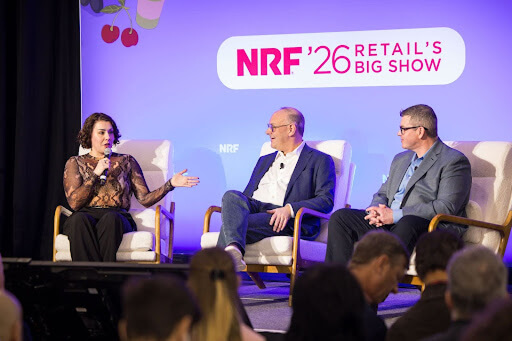
NRF 2026: The Next Now signaled the definitive end of the “pilot phase” for AI in Retail. The rise of autonomous agents, the digital renaissance of physical stores, and the shift toward unified commerce are no longer future trends; they are current table stakes.
As our CEO, Bharat Lingam, observed at the Javits Center, the retailers who will lead the next decade are those who can wield these powerful new agents without losing the human soul of their brand.
Whether you are a global enterprise or a growing brand in Dallas, the roadmap is clear: Automate the friction, elevate the human, and prepare for the era of the agent.
The most significant takeaway was the shift from “predictive” AI to “Agentic” AI in Retail, where autonomous agents can now execute transactions and manage customer journeys without direct human intervention.
The Zero-Click Economy refers to a future where AI agents manage the shopping process (discovery, comparison, and purchase) for the consumer, often without the consumer needing to interact with a traditional UI or visit a specific website.
A Digital Twin is a real-time digital representation of a physical store, created using vision AI, smart shelves, and IoT sensors to track inventory levels, customer flow, and operational efficiency instantly.
Introduced by Google at NRF 2026, UCP is an open-source standard that allows AI agents to discover products and execute purchases across different platforms using a common language.
Unified Commerce eliminates data silos by using a single software architecture for all channels. This ensures that inventory, pricing, and customer data are consistent, whether a customer is shopping in Dallas, online, or through a social media platform.
At [x]cube LABS, we craft intelligent AI agents that seamlessly integrate with your systems, enhancing efficiency and innovation:
Integrate our Agentic AI solutions to automate tasks, derive actionable insights, and deliver superior customer experiences effortlessly within your existing workflows.
For more information and to schedule a FREE demo, check out all our ready-to-deploy agents here.