1-800-805-5783
  GET A QUOTE
![Blog-[x]cube LABS](https://d6fiz9tmzg8gn.cloudfront.net/wp-content/uploads/2016/06/blog_banner.jpg)


By [x]cube LABS
Published: Apr 02 2026
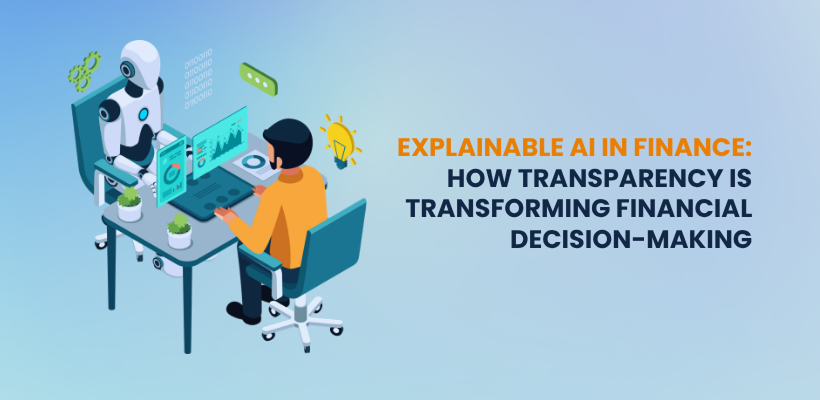
Financial decisions have always relied on trust. Whether it’s approving a loan, detecting fraud, or managing risk, every outcome must be supported by reasoning that stakeholders can understand and rely on. But as AI becomes more embedded into financial systems, that clarity is often lost behind complex models and opaque outputs.
This is where Explainable AI in finance begins to matter. It shifts the focus from just what the model predicts to why it makes that prediction. And in an industry where accountability, compliance, and accuracy are critical, that shift is not optional; it’s essential.
Financial institutions operate in one of the most regulated environments.
Decisions are not evaluated solely by outcomes; they must be justified. When AI systems make decisions without clear reasoning, it creates friction across compliance, risk management, and customer trust.
This is exactly why Explainable AI in finance is gaining attention. In fact, Gartner predicts that by 2028, Explainable AI will drive observability investments to 50% of generative AI deployments, highlighting how critical transparency is becoming for scaling AI responsibly.
This growing emphasis reflects a broader change; AI systems are no longer judged only by performance, but by how clearly their decisions can be understood and trusted.
At its core, Explainable AI in finance refers to the use of AI systems that provide transparent, interpretable, and understandable outputs for financial decision-making.
Unlike traditional AI approaches that prioritize accuracy without visibility, explainability ensures that every prediction or recommendation can be traced back to specific factors.
This is made possible through Explainable AI models, which are designed to reveal how inputs influence outcomes. These models don’t just produce results; they reveal the reasoning behind them. And in finance, context is everything.

The impact of Explainable AI in finance becomes more evident when you look at how it is applied in real-world scenarios.
Lending decisions have long been scrutinized for fairness and transparency.
With Explainable AI applications in finance, institutions can now justify why a loan was approved or denied. Instead of a generic score, they can provide specific factors, such as income stability, credit history, or spending behavior that influenced the outcome. This not only supports compliance but also builds customer trust.
Fraud detection systems rely heavily on pattern recognition. However, when a transaction is flagged, it’s critical to understand why. Explainable AI in finance enables teams to trace anomalies back to specific behaviors or deviations, enabling faster, more accurate investigation.
This reduces unnecessary alerts while improving overall system reliability.
Compliance is not just about following rules; it’s about demonstrating that those rules are being followed.
With Explainable AI in finance, organizations can provide clear audit trails for AI-driven decisions. This makes it easier to meet regulatory requirements and respond to audits with confidence.
Investment strategies increasingly rely on AI-driven insights. Using Explainable AI models, financial analysts can understand which variables influenced a recommendation, whether it’s market trends, historical data, or external factors.
This enables more informed decision-making rather than blindly relying on model outputs.
Trust in AI doesn’t come from accuracy alone; it comes from clarity.
Explainable AI models play a central role in bridging this gap. They provide visibility into decision-making, making it easier for stakeholders to interpret results and identify potential biases.
In the context of Explainable AI in finance, this becomes especially important. Because when decisions affect credit approvals, investments, or fraud detection, stakeholders need more than just results; they need justification.
The rise of Explainable AI in finance is also closely tied to the broader explainable AI market, which is expanding as organizations prioritize transparency and accountability.
According to industry analysis, the global Explainable AI market is projected to grow to nearly $57.90 billion by 2035, at a CAGR of 17.77%.
This rapid growth reflects increasing demand for AI systems that are not only powerful but also interpretable, especially in high-stakes industries like finance.
As the Explainable AI market continues to evolve, more tools and frameworks will emerge to support transparent AI adoption.
While the benefits are clear, implementing Explainable AI in finance comes with its own challenges.
These challenges highlight an important reality: explainability is not just a feature; it’s a design choice.
What makes Explainable AI in finance truly transformative is not just its ability to explain decisions, but its ability to change how decisions are approached.
Instead of relying solely on predictions, organizations are beginning to focus on understanding the reasoning behind them.
This shift creates more accountable systems, more informed teams, and ultimately, more trustworthy outcomes.
Explainable AI in finance is redefining how financial institutions approach decision-making by bringing transparency into systems that were once difficult to interpret.
By enabling visibility into how models operate allows organizations to build trust, meet regulatory expectations, and make more informed decisions.
As Explainable AI applications in finance continue to expand and the explainable AI market evolves, the focus will increasingly move toward designing systems that are not only accurate but also understandable.
In the end, the true value of Explainable AI in finance lies in its ability to align advanced intelligence with the need for clarity and accountability.
1. What is Explainable AI in finance?
Explainable AI in finance refers to AI systems that provide transparent and interpretable insights into financial decision-making processes.
2. Why is explainability important in financial AI systems?
It ensures compliance, builds trust, and allows stakeholders to understand how decisions are made.
3. What are Explainable AI models?
Explainable AI models are designed to provide visibility into how inputs influence outputs, making AI decisions more understandable.
4. What are some Explainable AI applications in finance?
Common applications include credit scoring, fraud detection, regulatory compliance, and investment analysis.
5. How does Explainable AI improve customer trust in financial services?
By clearly explaining decisions, Explainable AI in finance reduces uncertainty and helps customers better understand and trust outcomes.
At [x]cube LABS, we craft intelligent AI agents that seamlessly integrate with your systems, enhancing efficiency and innovation:
Integrate our Agentic AI solutions to automate tasks, derive actionable insights, and deliver superior customer experiences effortlessly within your existing workflows.
For more information and to schedule a FREE demo, check out all our ready-to-deploy agents here.