1-800-805-5783
  GET A QUOTE
![Blog-[x]cube LABS](https://d6fiz9tmzg8gn.cloudfront.net/wp-content/uploads/2016/06/blog_banner.jpg)

By [x]cube LABS
Published: Mar 10 2026
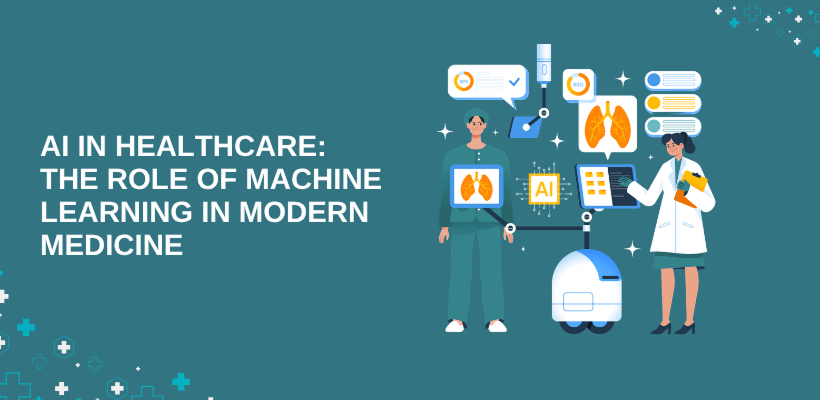
For decades, the promise of AI in Healthcare was centered on a future where machines could “think” like doctors. By 2026, that vision has materialized, but with a critical distinction. AI has moved beyond a standalone tool for diagnosis. It has become an integrated, agentic ecosystem that orchestrates the complexities of modern medicine.
From the tech hubs of Hyderabad to the medical research centers in Dallas, the integration of machine learning into clinical workflows is saving lives by reducing human error and predicting health crises before they manifest.
The shift toward agentic AI in medicine represents a move from reactive care to proactive, precision-based health management.
While traditional software could store patient records, modern AI agents can reason through those records, cross-reference them with global genomic databases, and provide real-time, personalized treatment pathways that adapt as a patient’s condition changes.
The journey of AI in Healthcare began with simple pattern recognition, identifying a fracture in an X-ray or a suspicious mole in a dermatology scan.
Today, machine learning models have moved into the realm of “Predictive Adaptability“, emphasizing the progress of AI in healthcare industry.
In 2026, models are trained on multimodal data, including electronic health records (EHRs), real-time wearable telemetry, and environmental factors, resulting in impactful AI solutions in healthcare.
This allows for a longitudinal view of patient health. Instead of looking at a single blood pressure reading, the AI analyzes three months of continuous data, recognizing subtle “micro-trends” that signal an impending cardiac event weeks before a patient feels a single symptom.
The most significant advancement in AI in Healthcare is the transition from single-purpose algorithms to multi-agent frameworks.
In a modern hospital, several specialized AI agents collaborate to manage a single patient’s journey.

This agent acts as the primary “medical investigator.” It ingests unstructured data from clinical notes and structured data from lab results.
Unlike basic diagnostic tools, this agent uses “Explainable AI” (XAI) to provide a clear reasoning path for its conclusions, citing specific peer-reviewed journals and historical case studies to support its recommendations.
Medication errors are a leading cause of preventable harm in hospitals.
This agent monitors every prescription in real-time.
It doesn’t just check for “allergic reactions”; it cross-references the patient’s unique genetic profile to predict how they will metabolize a specific drug.
Ensuring that the dosage is optimized for the individual’s biology is a core pillar of precision medicine.
Post-discharge care is often where the healthcare system fails. AI agents now follow the patient home via mobile platforms.
These agents monitor adherence to recovery protocols, analyze voice patterns for signs of respiratory distress or cognitive decline, and autonomously trigger a telehealth intervention if the patient’s recovery deviates from the predicted path.
[Image suggestion: A diagram showing a “Patient-Centric Multi-Agent Loop” where Diagnostic, Pharmacological, and Monitoring agents collaborate around a central patient profile.]
One of the most profound impacts of AI in Healthcare is the acceleration of the drug discovery pipeline.
Historically, bringing a new drug to market took over a decade and billions of dollars.
In 2026, machine learning models are “folding” proteins and simulating drug-target interactions in virtual environments.
By using “Digital Twins” of human cells, researchers can test thousands of compounds in a matter of days.
This has led to a surge in treatments for rare diseases that were previously considered “unprofitable” to research.
AI agents are now managing these simulations, identifying the most promising candidates, and even drafting the regulatory documentation required for clinical trials, significantly shortening the time it takes for life-saving medicine to reach the bedside.
As we empower AI agents to make high-stakes medical decisions, the industry is focusing heavily on governance. AI in Healthcare must operate within strict ethical guardrails to ensure patient safety and data privacy:

Going forward, one of the key benefits of AI in Healthcare will be the widespread adoption of “Bio-Digital Feedback Loops.”
We are moving toward a future where implantable sensors communicate directly with AI agents to provide a “self-healing” healthcare experience.
Imagine an insulin pump that doesn’t just react to blood sugar levels but predicts the impact of a meal based on the patient’s stress levels and sleep quality, adjusting the dose autonomously.
This level of integration will turn hospitals from places of “repair” into centers of “prevention.”
The friction of the healthcare experience will vanish, replaced by a seamless, intelligent system that prioritizes the patient’s long-term wellness over short-term symptom management.
The role of AI in Healthcare has evolved from a futuristic concept into the very backbone of modern medicine.
By leveraging machine learning to navigate the vast complexities of human biology, we are entering an era of unprecedented medical precision and accessibility.
As AI agents continue to mature, the focus remains on the ultimate goal: a world where healthcare is not just universal, but personal, proactive, and profoundly human.
The “Next Now” of medicine has moved beyond better machines; it’s about a healthier world for everyone.
Traditional software stores and retrieves data. AI in Healthcare uses machine learning to “reason” through that data, identifying hidden patterns, predicting future health risks, and recommending personalized treatment plans in real-time.
AI agents can analyze images and lab data to suggest highly accurate diagnoses, often outperforming human specialists in specific fields like radiology or pathology. However, these are typically reviewed by a human physician to ensure clinical accuracy and ethical oversight.
In 2026, AI in Healthcare utilizes advanced security measures like “Federated Learning” and end-to-end encryption. This allows the AI to learn and provide insights without the patient’s identifiable personal data ever being exposed or moved outside of secure environments.
The augmented physician is a healthcare professional who uses AI agents to handle time-consuming tasks like data entry, literature review, and routine monitoring. This allows the doctor to spend more time on high-value clinical work and direct patient interaction.
Machine learning in healthcare accelerates drug discovery by simulating how new drugs will interact with human biology. This replaces years of “trial and error” in the lab with months of high-speed digital simulations, bringing treatments to market much faster.
At [x]cube LABS, we craft the future of AI in healthcare technology, enhancing efficiency and innovation: