1-800-805-5783
  GET A QUOTE
![Blog-[x]cube LABS](https://d6fiz9tmzg8gn.cloudfront.net/wp-content/uploads/2016/06/blog_banner.jpg)

By [x]cube LABS
Published: Apr 28 2026
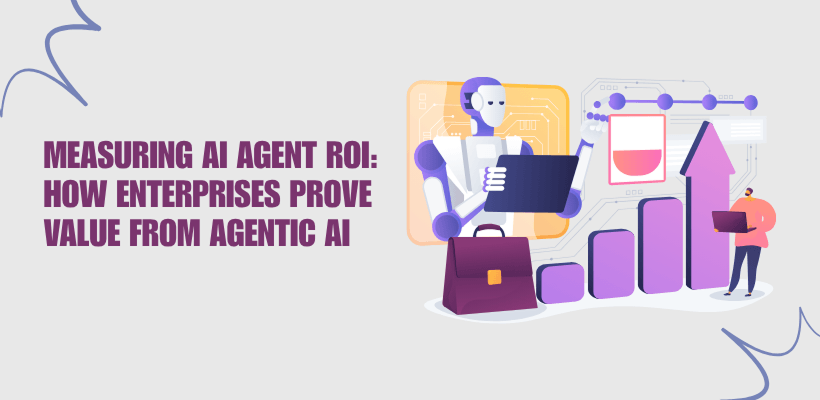
Agentic AI has moved from pilot projects to core enterprise infrastructure faster than almost any technology in the past decade.
AI agents now handle everything from supply chain orchestration to autonomous customer support resolution. Budgets are growing. Expectations are rising. And yet, measuring AI agent ROI remains one of the most poorly understood disciplines in modern enterprise technology.
This blog breaks down exactly how forward-looking organizations are building measurement frameworks, identifying the metrics that actually matter, and communicating value to the stakeholders who control the next round of AI investment.
Standard ROI formulas work brilliantly for a new CRM or a cloud migration. You invest X, you save Y, you calculate the payback period, and everyone moves on. Agentic AI doesn’t work that way.
AI agents create value through compounding and nonlinear behaviors, they improve over time, unlock new workflows that didn’t exist before, and reduce decision latency in ways that ripple across entire business units.
A cost-savings lens alone will make your AI agent ROI calculation look narrow and unconvincing.
Three specific gaps appear repeatedly in enterprise measurement efforts:
Attribution complexity – When an AI agent improves a sales pipeline, how much credit goes to the agent versus the rep?
Intangible upside – Speed-to-insight, reduced cognitive load, and morale improvements are real but hard to monetize.

A robust framework for calculating agentic AI return on investment rests on four interconnected pillars. Think of these as lenses, value often flows through multiple pillars simultaneously.
This is the most quantifiable pillar and should anchor every business case. Operational efficiency gains from AI agents manifest as reduced handle times, lower error rates, fewer escalations, and shorter process cycle times.
AI agents don’t just cut costs, they unlock revenue that would otherwise go untapped. Revenue enablement from agentic AI includes faster lead qualification, personalized outreach at scale, and 24/7 sales assistance in time zones your human team can’t cover.
In B2B SaaS, AI agents that handle inbound demo scheduling and pre-qualification have been shown to increase sales-qualified lead conversion rates by 20–35% simply by eliminating response latency.
Harder to quantify but potentially the highest-stakes pillar: AI agents that monitor transactions, flag anomalies, or ensure regulatory adherence deliver value that is catastrophic in its absence.
The ROI calculation here is often based on the expected value of avoided fines, litigation, and reputational damage.
A single successful fraud prevention intervention can generate more measurable ROI than months of incremental efficiency gains. Enterprises in financial services and healthcare should never underweight this pillar.
This is the most underappreciated dimension of agentic AI ROI. By deploying AI agents today, enterprises build data assets, workflow capabilities, and institutional learning that compound in value. The enterprise that has 18 months of agentic AI operational data has a genuine structural advantage over a competitor starting from scratch.
Strategic option value is difficult to put in a spreadsheet, but investors and boards who understand technology increasingly do factor it into how they value AI-mature companies.
Measurement starts before deployment. The biggest mistake enterprises make is retrofitting metrics onto a live agentic system.
By the time you realize you didn’t capture a baseline, it’s too late to prove incrementality.
Document current performance across every process the AI agent will touch. Capture volume, time, error rate, cost per transaction, and employee effort in hours. These baselines are your proof-of-improvement foundation.
Before go-live, write down: “This agent will reduce X by Y, enabling Z.” A vague hypothesis produces a vague ROI story. A specific hypothesis creates accountability and a clear measurement target.
Modern agentic platforms (LangGraph, Vertex AI Agents, Microsoft Copilot Studio) support detailed logging. Every task completion, escalation, latency event, and error should be logged and tied to a business outcome.
Where possible, run the AI agent in parallel with legacy processes on matched process segments. This A/B structure is the cleanest way to isolate the agent’s contribution from other variables.
AI agent ROI is dynamic. Performance improves with fine-tuning. Adoption grows. Value compounds. A static ROI report at month three will understate long-term returns. Track monthly, report quarterly, review annually.
ROI stories die in committee when no one owns the numbers. Assign a finance or operations partner to co-own measurement for each agent deployment. This creates credibility and ensures metrics are auditable.
Different agentic deployments require different metric sets. Here’s how leading enterprises approach ROI measurement across the most common agent categories:
Track first-contact resolution rate, average handle time, CSAT, and NPS delta versus human-handled interactions, escalation rate, and cost-per-resolution. The gold-standard metric here is the deflection value: the fully loaded cost of each interaction the agent resolves without human involvement.
These are harder to measure but enormously valuable. Use employee time-savings surveys (validated against task logging data), document search success rates, and knowledge-to-decision latency. Some enterprises are now tracking the quality of their decisions. Did the decision made with AI-assisted research produce better results than an equivalent decision made without it?
Mean time to resolution (MTTR), incident recurrence rates, on-call alert noise reduction, and change failure rate are the primary metrics. Agentic AI in this space has delivered some of the highest and fastest ROI of any deployment category, with documented cases of 60–70% MTTR reduction within 90 days.

Forecast accuracy, reduction in inventory carrying costs, time spent handling supplier exceptions, and improvement in the on-time delivery rate are the core metrics. The ROI here often comes in units of working capital freed up, a number that resonates deeply with CFOs.
Measuring the ROI of Agentic AI ultimately involves moving from viewing AI as an experimental cost center to recognizing it as a strategic asset for scalable growth.
For modern enterprises, the true value of an autonomous agent lies in its ability to handle complex, multi-step workflows that were previously tethered to human intervention. By shifting the focus from simple engagement metrics to goal completion and process efficiency, organizations can gain a clearer picture of how these systems impact the bottom line.
To ensure long-term success, stakeholders must remain vigilant about the hidden costs of maintenance and the importance of high-quality data integration.
Proving ROI is not a one-time event at the end of a fiscal year; it is a continuous cycle of monitoring performance, optimizing token usage, and refining agent logic to meet shifting business demands.
When managed with this level of rigor, Agentic AI ceases to be a buzzword and becomes a primary driver of operational excellence.
Hallucinations are a risk multiplier rather than a direct cost. You should subtract the estimated expenses of manual remediation, brand damage, and customer support recovery from your total economic benefits to accurately reflect the financial impact of inaccuracies.
Voice AI requires higher compute power, making it more expensive to run per interaction. However, the ROI is often higher because voice agents handle complex, human-led calls that are significantly more costly for the business to handle than simple text-based inquiries.
For well-implemented enterprise solutions, aim for a breakeven point within 6 to 9 months. If your projected payback period exceeds 18 months, you should re-evaluate the scope and technical complexity of the workflow you are attempting to automate.
Focus on “efficiency gains” and “task augmentation” rather than simple headcount reduction to maintain team morale. The primary value is capacity scaling, handling significantly higher transaction volumes without needing to hire linearly as your business grows.
We help enterprises become AI-native; not by adding AI on top of existing systems, but by rebuilding the intelligence layer from the ground up. With 950+ products shipped and $5B+ in value created for clients across 15+ industries, here is what we bring to the table:
We design and deploy agentic AI systems that sense, decide, and act without human bottlenecks, handling complex, multi-step workflows end-to-end with measurable resolution rates and no manual intervention.
Our voice platform Ello puts production-ready voice agents in front of your customers in minutes. Zero-latency conversations across 30+ languages, with no call centers and no wait times.
We replace manual, error-prone workflows with intelligent automation across invoicing, compliance, customer service, and operations, freeing your teams to focus on work that requires human judgment.
Using machine learning and real-time data pipelines, we build systems that forecast demand, flag risk, optimize inventory, and surface strategic insights before your teams need to ask for them.
We design and build IoT platforms that turn physical devices into intelligent, connected systems with built-in real-time monitoring, remote management, and condition-based automation.
From data lakes and ETL pipelines to AI-ready cloud architecture, we build the foundation that makes everything else possible, scalable, reliable, and designed to grow with your business.
If you are looking to move from AI experimentation to AI-native operations, let’s talk.