1-800-805-5783
  GET A QUOTE
![Blog-[x]cube LABS](https://d6fiz9tmzg8gn.cloudfront.net/wp-content/uploads/2016/06/blog_banner.jpg)


By [x]cube LABS
Published: Feb 12 2026
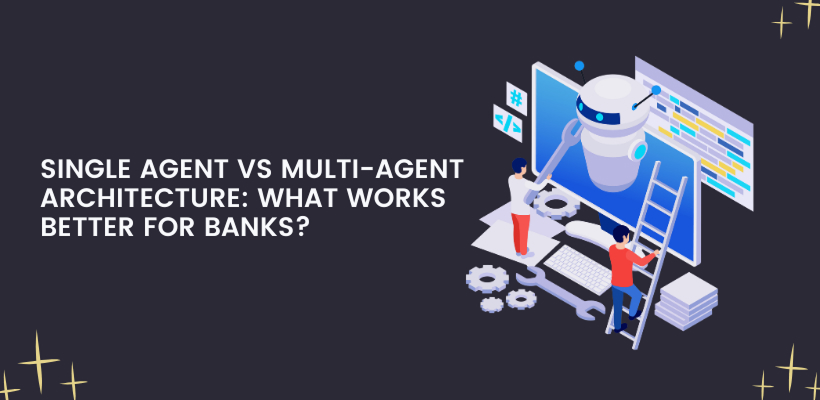
Banks today are moving beyond basic automation. The focus is shifting toward AI Agents that can reason, coordinate, and take action across workflows from onboarding and payments to fraud and compliance.
But as banks scale these systems, one architectural question becomes unavoidable: Single Agent vs Multi-Agent, which approach actually works better for banking operations?
This is not just a technical decision. The way banks design Single-Agent vs Multi-Agent systems shapes how they build resilience, manage risk, and operationalize Agentic AI safely at scale.
At a basic level, Single Agent vs Multi-Agent describes how intelligence is structured within an AI system.
Both approaches are part of modern AI Architecture, but they serve different banking realities. Understanding Single Agent vs Multi-Agent early helps banks avoid building automation that works in pilots but fails under real-world complexity.
A Single AI Agent works well when processes are structured, predictable, and tightly governed.
In banking, that often includes:
The advantage in the Single Agent vs Multi-Agent trade-off here is control. With one agent owning the workflow, execution paths are easier to audit, and exceptions are simpler to manage.
For banks that start early with agent deployments, single-agent designs often offer faster, lower-risk entry points. A Single Agent vs Multi-Agent strategy often begins with a contained workflow before expanding further.
A Single AI Agent also reduces coordination overhead, which is valuable in environments where regulators expect clear accountability for automated decisions.
In banking, a well-designed Multi-agent system becomes essential when workflows involve multiple decision points, specialized roles, and continuous coordination across risk, compliance, and customer operations.
A fraud event, for example, is not one task; it is a chain of decisions: detecting unusual behavior, interpreting policy thresholds, escalating cases, communicating with customers, and documenting actions for compliance.
This is where Single Agent vs Multi-Agent shifts strongly toward multi-agent design.
In a Multi-AI agent architecture, banks can deploy specialists such as:
Instead of one generalist trying to do everything, multiple agents coordinate like operational teams. That modularity is critical for scaling across products, geographies, and risk categories.
This is also where the operational payoff becomes measurable. AI adoption could reduce banking operating costs by 15–20%, especially in risk, compliance, and servicing workflows, where multi-agent coordination is often most effective.
This is why the Single Agent vs Multi-Agent decision matters more in high-exception workflows, where speed and specialization directly impact outcomes.
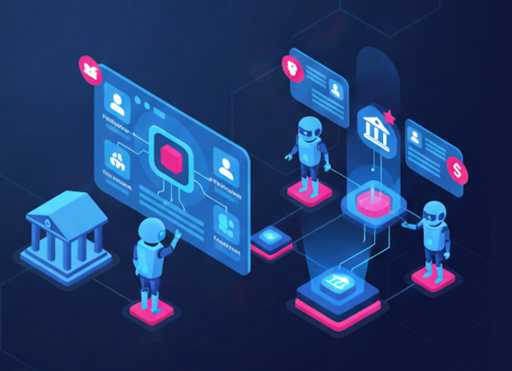
This architectural shift is not theoretical.
The global Multi-Agent System market is projected to grow significantly, reaching USD 184.8 billion by 2034, reflecting rising enterprise investment in collaborative agent-based systems.
For banks, this growth signals something important: multi-agent coordination is quickly becoming foundational infrastructure for next-generation automation.
In many ways, Single Agent vs Multi-Agent is becoming the defining architectural question as banks move from experimentation to operational deployment.
The best way to approach Single Agent vs Multi-Agent is to align architecture with workflow complexity:
Fraud operations, credit risk oversight, and exception-heavy servicing naturally demand multi-agent orchestration, while simpler workflows benefit from single-agent clarity.
Banks should also consider governance. Multi-agent environments require stronger orchestration layers, clear permissions, and well-defined escalation paths. Single-agent setups may be easier to monitor early, but can become bottlenecks as workflows grow.
So the real Single Agent vs Multi-Agent decision comes down to this:
Are you solving one contained task, or building an operating model that spans multiple systems?
The Single Agent vs Multi-Agent question has no universal answer.
Single AI Agent systems shine in linear, well-defined workflows where auditability matters most.
Multi-AI Agent architectures excel in complex banking environments where decisions span multiple domains and systems.
Most importantly, banks don’t need to choose extremes. Many begin with single-agent deployments in low-risk areas and evolve toward multi-agent ecosystems as operational complexity grows.
In the era of Agentic AI, architecture is not an afterthought; it is the foundation of scalable, trustworthy banking automation.
1. What does “Single Agent vs Multi-Agent” mean?
It refers to whether a single agent handles the entire workflow or whether multiple specialized agents collaborate.
2. When should banks use a Single AI Agent?
For structured, predictable workflows like document validation or routine reporting.
3. Why are Multi-AI agent systems important in banking?
Because banking processes like fraud and compliance require multiple specialized decisions working together.
4. Are multi-agent systems harder to govern?
They can be, but strong controls, audit trails, and escalation pathways make them manageable and scalable.
5. Can banks combine both architectures?
Yes. Many banks start with single-agent pilots and expand into multi-agent systems as needs evolve.
At [x]cube LABS, we craft intelligent AI agents that seamlessly integrate with your systems, enhancing efficiency and innovation:
Integrate our Agentic AI solutions to automate tasks, derive actionable insights, and deliver superior customer experiences effortlessly within your existing workflows.
For more information and to schedule a FREE demo, check out all our ready-to-deploy agents here.