1-800-805-5783
  GET A QUOTE
![Blog-[x]cube LABS](https://d6fiz9tmzg8gn.cloudfront.net/wp-content/uploads/2016/06/blog_banner.jpg)


By [x]cube LABS
Published: Feb 05 2026
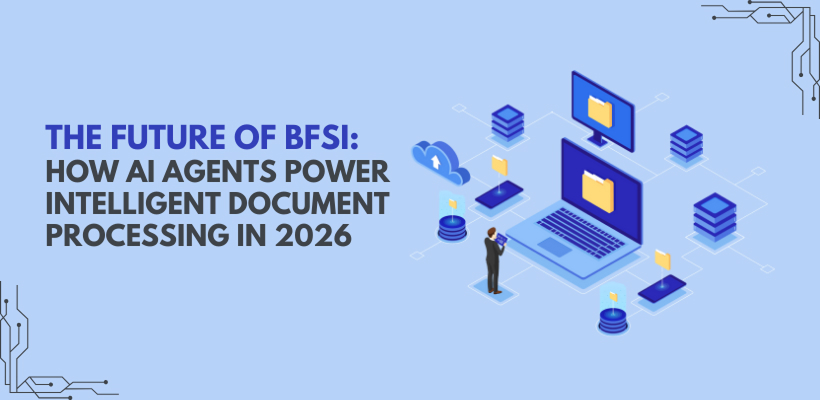
In the Banking, Financial Services, and Insurance (BFSI) sector, the document has always been the primary unit of truth.
From mortgage applications and handwritten insurance claims to thousand-page credit agreements, the ability to extract, verify, and act upon data defines an institution’s speed and security.
In 2026, the industry has reached a tipping point: manual data entry is no longer just a bottleneck; it is a competitive liability.
The solution lies in the evolution of intelligent document processing, where static automation has been replaced by autonomous AI agents capable of reasoning through the most complex “unstructured” content.
The shift toward agentic workflows marks a departure from the “extract-and-score” models of the past. Today’s leading institutions are moving toward “touchless” operations, where AI agents don’t just read words on a page; they understand the financial context, consult regulatory policies, and initiate downstream actions.
This article explores the deep nuances of how these agents are transforming intelligent document processing into a proactive, strategic hub for the digital economy.
For years, the industry relied on Optical Character Recognition (OCR) and basic machine learning templates.
While these tools were effective for structured forms like tax returns, they frequently faltered when faced with the “real world” of finance: smudged scans, handwritten signatures, and varying document layouts across different regions.
Previously, intelligent document processing solutions were often a misnomer, as they still required significant human intervention to fix “broken” extractions.
The 2026 era of intelligent document processing is defined by “Agency.”
An AI agent doesn’t just look for a field labeled “Gross Income”; it reasons that if the income is listed in a foreign currency on a specific bank statement, it must query a real-time exchange rate API to validate the borrower’s eligibility.
This ability to use tools, plan multi-step verifications, and adapt to document variations without being reprogrammed is what separates agentic IDP from its predecessors.

In the previous decade, IDP was often a “black box” that provided a text dump. If the confidence score was low, the document was simply kicked to a human queue.
This created massive backlogs, especially during seasonal surges in loan applications or global economic shifts.
Furthermore, legacy systems lacked “cross-document intelligence”; they couldn’t easily verify if a name on a driver’s license matched a slightly different spelling on a utility bill without complex, pre-written rules.
By contrast, agentic intelligent document processing utilizes Large Language Models (LLMs) as a logical core.
The agent treats the document as an environment to be explored. If it encounters a complex clause in a commercial lease, it “re-reads” the surrounding paragraphs to ensure it has captured the full legal obligation. This level of semantic awareness ensures that the structured output is not just accurate in terms of characters, but accurate in terms of intent.
Modern BFSI institutions are no longer looking for a single “super-app” to handle their paperwork. Instead, they are deploying multi-agent frameworks where specialized agents collaborate in real time.
This modular approach ensures that the intelligent document processing platform is both scalable and highly precise.
This agent acts as the “eye” of the system. It handles data intake from emails, mobile uploads, and legacy portals. Its primary role is to “clean” the data: deskew images, remove noise from poor scans, and identify the document type (e.g., separating a pay stub from a 1040 form).
In an advanced intelligent document processing workflow, this agent also checks for “digital tampering,” ensuring that the pixels of an uploaded document haven’t been altered by a fraudster.
This is where the heavy lifting happens. Once the text is extracted, the Reasoning Agent interprets the data against business logic.
In a trade finance scenario, this agent might analyze a Bill of Lading alongside a Letter of Credit. It doesn’t just extract dates; it checks if the shipping dates align with the credit terms.
By applying “financial common sense,” it reduces the need for human analysts to perform routine cross-referencing.
Total “lights-out” automation is rare in high-stakes finance. The Verification Agent manages the “Human-in-the-Loop” (HITL) process.
When the system encounters an ambiguous data point, perhaps a signature that is partially obscured, this agent prepares a concise “exception memo” for a human reviewer.
It highlights the specific area of concern and provides the necessary context, allowing the human to make a decision in seconds rather than minutes.
In 2026, every automated decision must be auditable. This agent acts as a silent observer, logging every step of the intelligent document processing journey.
It records which version of the model was used, which regulatory database was consulted, and the exact reasoning path taken to reach a conclusion.
This creates an immutable “chain of custody” for every document processed, simplifying regulatory examinations and internal audits.
The impact of agentic workflows is most visible in areas where document volume meets high complexity.
“Know Your Customer” (KYC) requirements have historically been the “friction point” of banking. In 2026, AI agents have turned this into a near-instant experience.
By utilizing intelligent document processing, agents can verify a passport, a utility bill, and a self-sovereign identity token in parallel.
Because the agents can reason through non-standard documents from different countries, they drastically reduce the “onboarding drop-off” rate for international customers.
For commercial lending, the documents aren’t just forms; they are intricate legal contracts. Agentic intelligent document processing allows banks to digest hundreds of pages of financial statements and legal filings in minutes.
The agents can “spread” financials into standard templates, detect “redline” changes in standard contracts, and even flag covenants that are outside of the bank’s risk appetite.
In the insurance world, a claim often involves a “packet” of documents: police reports, medical bills, and repair estimates.
AI agents use intelligent document processing to “triage” these packets.
They can instantly reconcile a hospital bill against the policy’s coverage limits and flag discrepancies, such as a billing code that doesn’t match the reported injury.
This ensures that legitimate claims are paid faster while suspicious ones are flagged for a specialized investigator.
The true “frontier” of 2026 is unstructured data. While 80% of enterprise data is trapped in documents, emails, and PDFs, AI agents are finally unlocking its value.
By treating intelligent document processing as a linguistic task rather than a visual one, agents can find “signals” in the noise.
For example, an agent can analyze the sentiment of a customer complaint letter or the nuance of an email thread to provide a comprehensive “customer health score” that goes beyond just the numbers on a balance sheet.

As BFSI organizations hand over more control to autonomous systems, governance has become the top priority. Agentic intelligent document processing must operate within strict “guardrails.” These include:
When these controls are baked into the agent’s DNA, intelligent document processing becomes a tool for strengthening compliance rather than a source of regulatory risk.
The transformation of the BFSI sector into a document-light, agent-heavy environment is no longer a futuristic dream; it is a current reality.
By moving from static automation to intelligent, reasoning agents, financial institutions are achieving 90% faster processing times and significantly higher accuracy in risk assessment.
In the coming years, the winners in the financial space will be those who view intelligent document processing not as a back-office necessity, but as a strategic engine for growth.
As AI agents continue to evolve, the “friction” of paperwork will vanish, replaced by a seamless, secure, compliant, and, above all, intelligent digital flow.
Traditional OCR only converts images to text. Agentic intelligent document processing uses Large Language Models to “read” and “understand” that text, allowing it to interpret context, verify facts across multiple documents, and make autonomous decisions based on business rules.
Yes. In 2026, modern intelligent document processing solutions utilize end-to-end encryption, “Edge Computing” for local processing, and strict role-based access controls. AI agents are also governed by “compliance agents” that ensure no data leaves the authorized environment.
Absolutely. Modern AI models have reached near-human levels of accuracy in handwriting recognition, even for cursive or poorly formed text. Agentic systems can often “infer” the meaning of messy handwriting by looking at the context of the surrounding printed text.
Human-in-the-Loop (HITL) is a governance framework where an AI agent handles the bulk of the processing but “escalates” high-risk or ambiguous cases to a human expert. This ensures that intelligent document processing maintains 100% accuracy while still benefiting from the speed of automation.
Because modern intelligent document processing agents are “layout-agnostic” (meaning they don’t need to be trained on every specific form), deployment is much faster than in the past. Many institutions can see a “pilot-to-production” cycle in just a few weeks, depending on the complexity of their legacy integrations.
At [x]cube LABS, we craft intelligent AI agents that seamlessly integrate with your systems, enhancing efficiency and innovation:
Integrate our Agentic AI solutions to automate tasks, derive actionable insights, and deliver superior customer experiences effortlessly within your existing workflows.
For more information and to schedule a FREE demo, check out all our ready-to-deploy agents here.