1-800-805-5783
  GET A QUOTE
![Blog-[x]cube LABS](https://d6fiz9tmzg8gn.cloudfront.net/wp-content/uploads/2016/06/blog_banner.jpg)


By [x]cube LABS
Published: Jan 30 2026
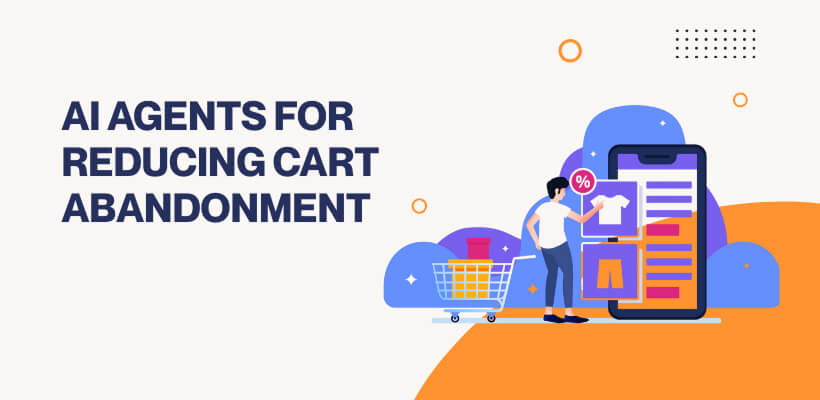
Cart Abandonment remains one of the biggest challenges in e-commerce. Shoppers add items, begin checkout, and then leave, nearly 70% of carts never convert.
For brands at scale, cart abandonment isn’t just a UX problem; it directly impacts revenue, customer lifetime value, and marketing efficiency.
What’s changing is how businesses respond. Instead of static pop-ups or delayed reminders, ecommerce leaders are adopting AI Agents that intervene intelligently and in real time, addressing friction as it appears and reducing cart abandonment across the buyer journey.
Shoppers abandon their carts for predictable reasons: unexpected fees, complex checkout flows, slow delivery, and a lack of personalized trust signals.
Research shows that delivery-related surprises, especially shipping cost shocks, are a leading driver: over 90% of consumers say they’re likely to abandon a purchase if high shipping costs appear at checkout.
That kind of friction directly feeds cart abandonment.

AI Agents are not simple chatbots. In e-commerce, AI shopping assistants and agentic systems constantly observe shopper signals, infer intent, and take coordinated actions, such as personalized messaging, dynamic offers, checkout assistance, or payment alternatives, at the exact moment a shopper hesitates. These actions directly target the causes of cart abandonment.
When orchestrated, these reduce friction and recover carts more effectively than generic remarketing.
When a shopper pauses too long at checkout or navigates away from the payment page, an AI Agent can step in with the right prompt to clarify fees, surface delivery timelines, or offer assistance. These real-time interventions prevent hesitation from turning into cart abandonment.
Lengthy or rigid checkout flows are a common contributor to cart abandonment. AI Agents in e-commerce personalize the experience by pre-filling known details, prioritizing preferred payment methods, and removing unnecessary steps.
This personalization reduces cognitive load and builds confidence at the moment of purchase.

Many shoppers abandon carts simply because they have unanswered questions. AI shopping assistants provide instant, conversational support that clarifies sizing, return policies, warranties, and delivery options without forcing users to leave the checkout page.
This kind of in-the-moment assistance keeps shoppers engaged and lowers the likelihood of cart abandonment.
Even when shoppers leave, the opportunity isn’t lost. AI Agents can trigger highly relevant follow-ups that reference the exact cart contents, shopper preferences, and timing context.
Unlike generic reminder emails, these follow-ups feel purposeful and personalized, making them far more effective in reducing repeated cart abandonment.
A practical rollout doesn’t require replacing your entire ecommerce stack. High-impact steps include:
This approach ensures AI agents for e-commerce deliver measurable impact without overwhelming shoppers or teams.
Tracking these metrics helps refine agent behavior and maintain the right balance between assistance and intrusion.
Cart abandonment isn’t an unavoidable outcome; it’s a signal. A signal that something in the buying experience created friction, doubt, or delay.
By using AI Agents to detect and respond to those moments in real time, ecommerce teams can transform abandonment into conversion. When implemented thoughtfully, AI in e-commerce doesn’t just recover lost carts; it builds smoother journeys, stronger trust, and more resilient revenue.
That’s the real value of AI agents for e-commerce and modern AI shopping assistants: turning hesitation into confidence, and intent into action.
1. Why does cart abandonment remain high even on well-optimized e-commerce sites?
Because shopper hesitation is contextual. Unexpected costs, delivery uncertainty, payment friction, and unanswered questions can still disrupt checkout even on well-designed experiences.
2. How do AI Agents reduce cart abandonment differently than traditional tools?
Unlike static pop-ups or emails, AI Agents act in real time, detecting intent, personalizing responses, and intervening precisely when friction appears.
3. What role do AI shopping assistants play during checkout?
AI shopping assistants provide instant, conversational support to resolve questions about pricing, delivery, returns, or product fit, keeping shoppers engaged throughout the purchase.
4. Are AI Agents only useful after a cart is abandoned?
No. AI Agents for e-commerce are most effective before abandonment, proactively addressing friction during browsing and checkout to prevent drop-off.
5. Can AI-driven cart abandonment reduction improve long-term customer value?
Yes. By creating smoother, more personalized checkout experiences, AI in e-commerce not only recovers carts but also improves trust, loyalty, and repeat purchases.
At [x]cube LABS, we craft intelligent AI agents that seamlessly integrate with your systems, enhancing efficiency and innovation:
Integrate our Agentic AI solutions to automate tasks, derive actionable insights, and deliver superior customer experiences effortlessly within your existing workflows.
For more information and to schedule a FREE demo, check out all our ready-to-deploy agents here.