1-800-805-5783
  GET A QUOTE
![Blog-[x]cube LABS](https://d6fiz9tmzg8gn.cloudfront.net/wp-content/uploads/2016/06/blog_banner.jpg)

By [x]cube LABS
Published: Dec 04 2025
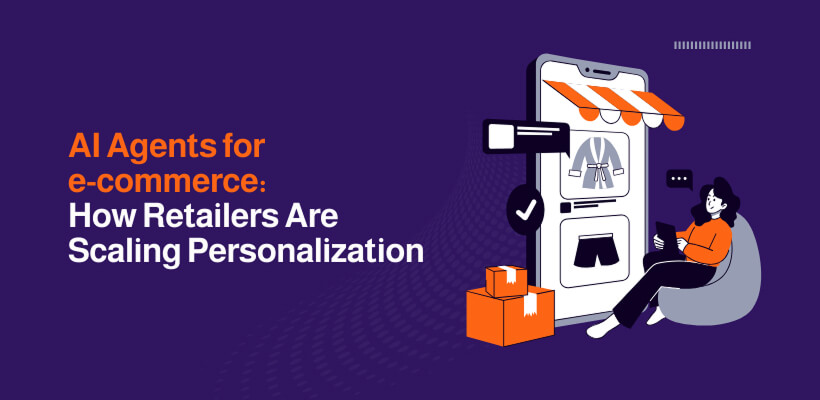
Personalization has always been the heart of great retail. Whether it was a store associate remembering a customer’s preferences or a product expert guiding shoppers toward the right fit, the best experiences were always personal and human. But with modern e-commerce operating at a massive scale, it’s no longer possible for retailers to deliver that level of one-to-one attention manually.
That’s why AI agents for e-commerce are becoming essential. These intelligent systems can understand customer behavior, anticipate needs, recommend the right products, and automate thousands of micro-interactions that once required an entire support or merchandising team. They don’t replace human insight; they extend it across millions of shoppers.
Let’s break down how retailers are using AI agents to rewrite personalization, what these systems actually do, and how leading brands are using them to drive growth, loyalty, and operational efficiency.
An AI agent for e-commerce is an intelligent, autonomous system powered by machine learning, natural language processing, and behavioral modeling. Unlike traditional chatbots that follow scripts or answer basic questions, AI agents can:
They are dynamic, learning systems—not rule-based programs.
In the e-commerce world, AI agents show up as:
What makes them so transformative is their ability to blend human-like reasoning with data-driven precision.
Retailers know personalization isn’t a bonus anymore—it’s a requirement. Here’s what shoppers expect today:
Customers want to feel understood. They want shopping to feel easy. And they prefer brands that remember who they are, what they like, and how they shop.
The challenge? Humans can’t do personalization at that scale. Even traditional recommendation engines are too limited because they rely on static profiles or broad segmentation. Modern shoppers move fast, and their preferences shift constantly.
AI agents for e-commerce solve that problem by learning in real time and adjusting instantly.
Let’s dive into the areas where AI agents are making the biggest impact.
Traditional recommendation engines group customers into categories. AI agents evaluate individuals.
They don’t just look at previous purchases—they analyze intent signals across the entire shopping journey:
This level of granularity allows AI agents for e-commerce to recommend items that feel handpicked.
Examples of what AI agents can do:
The result: higher conversions, larger cart sizes, and better customer satisfaction.
Virtual shopping assistants powered by AI agents act like digital store associates. They don’t just answer questions—they guide the customer journey.
These assistants can:
A customer who says, “I need a jacket for hiking in winter,” gets expert-level help rather than a list of generic jackets.
This is a major leap forward from older chatbots that simply link to product pages.
The magic of AI agents is that they personalize every step—not just the final recommendation.
They can modify:
For example:
AI agents for e-commerce treat every shopper like a unique profile and adjust the experience accordingly.
Site search is a quiet revenue driver, and AI agents radically improve it.
These systems understand natural language queries like:
They interpret intent, not just keywords.
They surface relevant products even when the customer doesn’t know what to search for.
AI-driven search can:
This turns search into a high-converting interaction instead of a frustrating dead end.
AI agents don’t just sell—they serve.
In support, they take on tasks like:
Support used to be reactive. AI agents make it proactive.
For example:
This merges customer satisfaction with operational efficiency.
AI agents help retailers optimize pricing strategies without coming across as random or inconsistent.
They analyze:
Then they customize:
For example:
This isn’t guesswork—it’s data-driven personalization at scale.
Many retailers focus only on conversion. AI agents focus on the entire relationship.
After a purchase, they can:
For example, if someone buys a camera, the AI agent might suggest:
But it won’t blast them with everything—it will tailor recommendations to the customer’s specific interests.

Retailers aren’t just using AI to keep up—they’re using it to lead.
Here’s why adoption is accelerating:
Patience is low. Competition is high. Shoppers want relevance immediately.
No human team can analyze millions of signals in real time.
AI agents cut operational costs while improving outcomes.
DTC brands, marketplaces, and global retail players all fight for the same customer base.
AI agents help reduce stockouts, returns, and mismatches.
AI-driven personalization deepens engagement and boosts lifetime value.
For every retailer—from apparel to electronics to beauty to home goods—AI agents are fast becoming the backbone of digital commerce.
If you’re planning to adopt AI agents for e-commerce, here’s a practical roadmap:
Start where AI can immediately improve performance:
Pick one or two areas and build from there.
AI agents rely on clean, structured, accessible data. That includes:
The better your data foundation, the smarter your AI agent becomes.
AI agents perform best when fully connected to:
Integration enables end-to-end automation.
AI agents handle:
Humans handle:
This balance creates the best outcomes.
Track metrics like:
Then refine the AI model based on real-world performance.
The next generation of e-commerce will be built around AI-first experiences. Here are the trends to watch:
AI agents guiding a shopper from discovery to checkout without friction.
Understanding tone, frustration, excitement, and preference signals.
Voice, video, augmented reality, and real-time product visualization.
Customers voluntarily sharing preference data through interactive AI experiences.
Dynamic product arrangement, automated category management, and predictive inventory recommendations.
Where AI agents help sellers optimize listings, pricing, targeting, and customer engagement.
The retailers who adapt now will set the benchmark for the next decade of digital commerce.
1. What are AI agents for e-commerce?
AI agents for e-commerce are intelligent systems that use machine learning, natural language processing, and behavioral analytics to help shoppers find products, get support, and receive personalized recommendations. They go beyond basic chatbots by understanding intent, learning from interactions, and autonomously performing tasks.
2. How do AI agents improve personalization in e-commerce?
AI agents analyze real-time signals—browsing patterns, purchase history, preferences, price sensitivity, and context—to deliver recommendations and experiences tailored to each individual shopper. This creates highly relevant interactions that increase conversions and improve customer satisfaction.
3. Are AI agents and chatbots the same thing?
Not exactly. Traditional chatbots follow rules or scripts. AI agents for e-commerce are more advanced—they understand natural language, adapt based on outcomes, and can carry out actions like placing orders, managing returns, or updating customer profiles.
4. Can AI agents help reduce cart abandonment?
Yes. AI agents can offer personalized incentives, answer questions instantly, suggest alternatives, help with sizing or compatibility concerns, and guide shoppers through checkout. These interventions reduce friction and improve completion rates.
5. What kind of data do AI agents need to work effectively?
AI agents rely on clean, structured data such as product attributes, customer profiles, browsing behavior, purchase history, inventory information, and support interactions. The richer the data, the smarter and more accurate the AI outputs.
6. Do AI agents replace human customer service teams?
No. AI agents handle routine, high-volume inquiries and repetitive tasks, while human agents focus on complex, emotional, or specialized scenarios. The best results come from a hybrid model where humans and AI work together.
7. How can retailers get started with AI agents?
Start with one or two high-impact use cases—like product recommendations, search optimization, or automated support—ensure data readiness, integrate with core systems, and train internal teams to collaborate with AI. From there, scale gradually.
8. What are the biggest benefits of AI agents for e-commerce?
Key benefits include higher conversions, personalized shopping journeys, reduced operational costs, improved customer satisfaction, better search accuracy, and more efficient support. They also help retailers understand customer behavior more deeply.
9. Are AI agents safe for handling private customer data?
Yes, as long as retailers implement proper governance, security practices, compliance measures, and transparency. AI agents should operate within a well-defined framework that protects customer information and ensures ethical use.
10. What’s the future of AI agents in e-commerce?
Expect more autonomous agents capable of managing entire customer journeys, emotionally aware interactions, multimodal communication (voice, video, images), predictive shopping experiences, and deeper integration with logistics, inventory, and marketing systems.

AI agents for e-commerce are reshaping how retailers deliver personalization at scale. They combine the intelligence of advanced machine learning with the speed of automation to create shopping experiences that feel intuitive, relevant, and human.
From personalized recommendations to proactive support, dynamic pricing, and post-purchase engagement, AI agents are helping brands operate smarter, faster, and more profitably.
The message is clear: retailers who adopt AI agents today will hold the competitive edge tomorrow.
At [x]cube LABS, we craft intelligent AI agents that seamlessly integrate with your systems, enhancing efficiency and innovation:
Integrate our Agentic AI solutions to automate tasks, derive actionable insights, and deliver superior customer experiences effortlessly within your existing workflows.
For more information and to schedule a FREE demo, check out all our ready-to-deploy agents here.