1-800-805-5783
  GET A QUOTE
![Blog-[x]cube LABS](https://d6fiz9tmzg8gn.cloudfront.net/wp-content/uploads/2016/06/blog_banner.jpg)


By [x]cube LABS
Published: Nov 20 2025
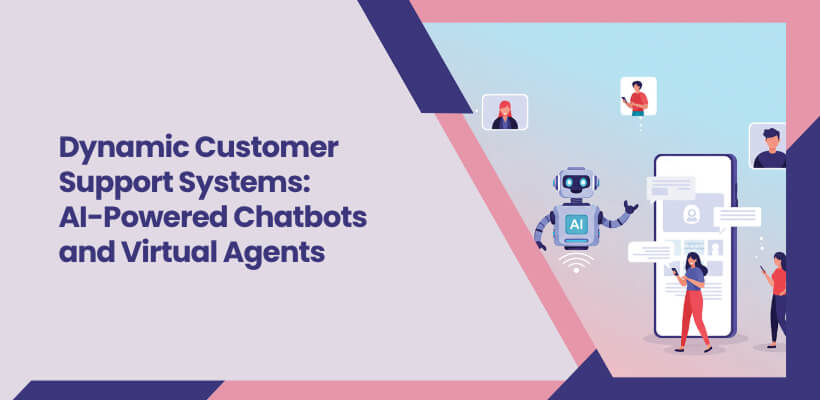
Customer support has evolved quickly, and the rise of virtual agents is driving one of the biggest shifts in the industry.
Traditional channels like phone, email, and in-person service still matter, but today’s customers expect fast, always-available digital support.
That’s where AI-powered chatbots and virtual agents step in. The AI customer support market continues to grow at a strong pace as companies look for better service quality, lower costs, and more scalable operations.
In short, virtual agents are no longer optional—they’re essential for modern customer service.
Basic chatbots rely on rules. They follow scripts, react to keywords, and handle simple questions.
Virtual agents are far more advanced. They use natural language processing (NLP), machine learning (ML), and contextual understanding to interpret intent, personalize responses, and handle more complex interactions.
Also Read: Understanding AI Agents: Transforming Chatbots and Solving Real-World Industry Challenges
A virtual agent can:
Put simply: all virtual agents are chatbots, but not all chatbots qualify as virtual agents.
Multimodal inputs (text, voice, images) are becoming more common

Here’s why companies across industries are adopting virtual agents:
Virtual agents deliver instant, accurate responses—no wait times, no variability from agent to agent.
Customers get help around the clock, without staffing overnight shifts.
Virtual agents can personalize responses based on customer history, preferences, and past interactions.
They can handle thousands of conversations simultaneously, helping businesses grow support capacity without hiring at the same rate.
Virtual agents generate valuable data—patterns, common issues, sentiment trends—that companies can use to improve products and service quality.
Virtual agents don’t get tired or overlook steps in a process. This leads to more accurate and consistent support.
Also Read: Types Of AI Agents: A Guide For Beginners
Even with major advances, virtual agents come with challenges that organizations need to manage carefully.
Successful companies solve this with a hybrid approach: AI for scale, humans for empathy and complexity.

Virtual agents are evolving rapidly, and the next wave will further reshape the customer experience.
Virtual agents will recognize tone and sentiment more accurately and adjust their responses to match the customer’s emotional state.
Support will expand beyond text. Virtual agents will handle voice, video, images, and screen-sharing. For example, a customer could upload a photo of an issue, and the virtual agent could diagnose it.
Instead of waiting for customers to reach out, virtual agents will identify issues early and initiate support automatically—especially when integrated with IoT data or product signals.
Future virtual agents will resolve entire processes end-to-end: updating accounts, submitting claims, processing refunds, troubleshooting devices, and more.
Virtual agents will be connected to:
This gives them the ability not just to answer questions but to take real action in real time.
Human agents won’t disappear—they’ll focus on specialized, emotional, or high-sensitivity cases. Virtual agents will handle the rest. This balance leads to better overall service quality.
If you’re preparing to implement or upgrade virtual agents, focus on:
As customer expectations rise, virtual agents offer a powerful way to deliver fast, personalized, and scalable support.
They help organizations reduce costs, improve consistency, and unlock insights from every interaction.
But the most effective strategy blends virtual agents with human expertise.
When AI handles the repetitive tasks and humans provide empathy and complex problem-solving, companies deliver the kind of service that builds trust and long-term loyalty.
Virtual agents aren’t just a tech upgrade—they’re becoming the foundation of modern customer experience.
1. What’s the difference between a chatbot and a virtual agent?
Chatbots are rule-based and handle simple tasks, while virtual agents use AI, NLP, and ML to understand intent, manage context, and solve more complex issues.
2. How do virtual agents improve customer satisfaction?
They deliver faster responses, personalized interactions, and 24/7 support, reducing friction and improving overall experience.
3. What are the key concerns with AI in customer support?
Privacy, data security, AI model bias, and ensuring customers can reach a human when needed.
4. What does the future of virtual agents look like?
Expect more emotionally intelligent, multimodal virtual agents that deeply integrate with internal systems and can autonomously manage complete workflows.
At [x]cube LABS, we craft intelligent AI agents that seamlessly integrate with your systems, enhancing efficiency and innovation:
Integrate our Agentic AI solutions to automate tasks, derive actionable insights, and deliver superior customer experiences effortlessly within your existing workflows.
For more information and to schedule a FREE demo, check out all our ready-to-deploy agents here.