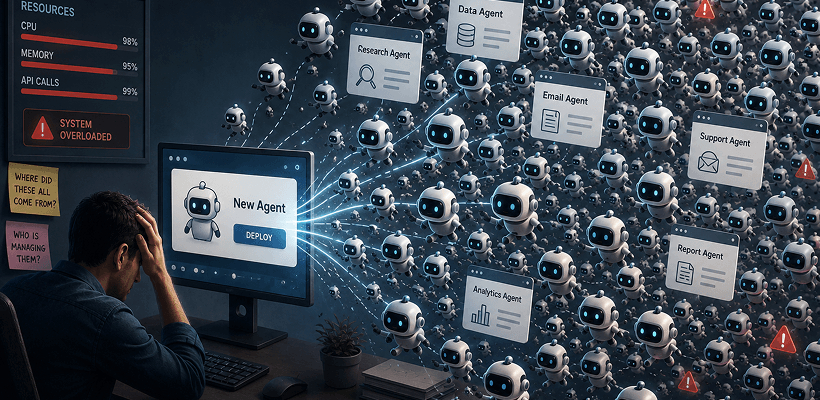
In the early stages of enterprise AI adoption, the primary challenge was simply getting a single model to perform a task reliably. By 2026, the problem has inverted. Organizations are no longer struggling with a lack of artificial intelligence; instead, they are facing an unprecedented explosion of autonomous entities. This phenomenon is rapidly becoming the next major IT governance headache, known across the industry as agent sprawl.
As departments from marketing to finance independently deploy specialized multi-agent systems, businesses are waking up to a chaotic ecosystem of uncoordinated, redundant, and unmonitored digital workers. Left unchecked, this uncontrolled multiplication of AI agents threatens to increase operational costs, compromise data security, and create massive compliance risks. To build a sustainable autonomous infrastructure, technology leaders must understand the root causes of this phenomenon and implement strict frameworks to keep their digital workforce under control.
Understanding the Mechanics of Agent Sprawl
Agent sprawl occurs when autonomous AI agents multiply within an enterprise without centralized oversight, a unified governance framework, or a clear lifecycle management strategy. It mirrors the “VM sprawl” (Virtual Machine) of the early cloud computing era and the “SaaS sprawl” of the late 2010s, but with a critical difference: AI agents possess agency, meaning they can autonomously access data, trigger APIs, and make decisions.
The problem typically accelerates due to three main factors:
- Low Barriers to Entry: Low-code and no-code developer frameworks make it incredibly easy for any business unit to spin up a custom agent to automate a localized workflow.
- Lack of Inter-Agent Communication: Because different departments use different vendor platforms, agents often operate in isolated silos, completely unaware that another agent in a different department has already built the exact tool or dataset they need.
- The “Set and Forget” Mentality: Unlike human employees, digital workers do not resign, and they do not show up on traditional payroll audits. If an engineer creates an agent to monitor a specific temporary project and forgets to decommission it, that agent will continue to run indefinitely, consuming compute resources and pinging APIs.

The Hidden Costs and Risks of an Unmanaged AI Workforce
While a single agentic workflow can drive massive efficiency, an unmanaged network of hundreds of agents introduces compounding liabilities that can quietly erode enterprise security and profitability.
Compute Bloat and Resource Taxing
Every time an agent runs a reasoning loop, calls an LLM API, or queries a vector database, it incurs a computational cost. When duplicate agents are left running in the background, token usage skyrockets. This “context tax” can quickly turn a cost-saving automation initiative into an expensive line item on the IT budget.
The Attack Surface Expansion
An agent requires data access and API permissions to be useful. When agent sprawl sets in, security teams lose visibility into exactly which digital entities hold access tokens to sensitive corporate repositories. A single abandoned, unpatched agent with administrative privileges to a CRM or a financial database represents a massive cybersecurity vulnerability, waiting to be exploited.
Cascading Algorithmic Errors
When multiple autonomous systems interact without a centralized orchestration layer, they can create unpredictable feedback loops. For example, a procurement agent might change inventory levels based on a perceived trend, which triggers a logistics agent to alter shipping schedules, which then causes a pricing agent to fluctuate rates; all without human awareness. Without transparency, diagnosing the root cause of these cascading errors becomes nearly impossible.
How to Stop Agent Sprawl: A Strategic Framework
Defeating the chaos of an uncontrolled digital workforce requires a shift from reactive monitoring to proactive architecture. Forward-thinking enterprises are adopting a five-part roadmap to regain control of their AI environments.
1. Establish an Enterprise Agent Registry
You cannot govern what you cannot see. The first step in combating agent sprawl is creating a centralized repository where every deployed agent must be registered. This registry should track ownership (which department built it), purpose (what problem it solves), data access levels, and specific API permissions. Much like an inventory of human personnel, this digital roster ensures total visibility across the enterprise.
2. Implement a Unified Control Plane
Instead of allowing business units to run isolated multi-agent platforms, organizations must mandate a centralized orchestration layer or control plane. This infrastructure serves as the universal highway for AI agent communication. When agents share a common integration standard, a marketing agent can query the registry to see if a data-scraping agent already exists in the research department, eliminating redundant builds.
3. Mandate Lifecycle Management and Autodestruct Protocols
Every digital worker must have an expiration date. When an agent is registered, developers should define its lifecycle. For temporary projects, agents should feature “autodestruct” protocols or automated freeze states that trigger after a set period of inactivity. Regular lifecycle audits must become standard practice, ensuring that dormant or obsolete agents are systematically decommissioned.
4. Enforce Token-Level and Identity-Linked Security
AI agents must be treated as distinct identities within an organization’s Identity and Access Management (IAM) framework. Rather than granting an agent generalized corporate credentials, engineers must implement token-level scoping. An agent should only have access to the exact data fields required for its specific task, and its actions must be fully traceable via encrypted audit logs.
5. Transition to Human-in-the-Loop AI Governance
Autonomous systems must never operate entirely in a vacuum. For high-stakes or cross-departmental workflows, enterprises must embed specific intervention triggers. When an agent encounters an anomaly, reaches a financial threshold, or attempts to modify a core system parameter, it must pause and seek authorization via a Human-in-the-Loop AI interface. This safety net ensures that human strategic intent always guides the autonomous workforce.
The Shift to Lean, Orchestrated Ecosystems
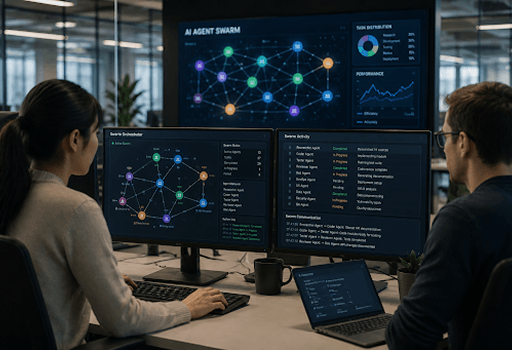
As the industry moves toward 2027, the goal of enterprise AI strategy is shifting from maximizing the quantity of agents to optimizing the orchestration of cohesive agent squads.
Instead of building individual, fragile tools for every micro-task, organizations are focusing on modular, reusable architectures. By creating a lean core of robust, highly communicative agents that share a unified semantic memory, businesses can scale their operations smoothly. This architectural discipline ensures that automation remains an asset that drives growth, rather than a fragmented liability that drains resources.
Conclusion
Agent sprawl is a natural byproduct of rapid, decentralized innovation. However, as the initial excitement of autonomous workflows transitions into operational reality, governance must take center stage.
By implementing centralized registries, enforcing strict identity-linked security, and ensuring meaningful human oversight, enterprises can successfully halt the uncontrolled multiplication of their digital workers. The goal is not to slow down innovation, but to build a structured framework where an intelligent, collaborative workforce can scale safely, securely, and sustainably.
FAQ
1. What is agent sprawl?
Agent sprawl is the unmanaged, rapid multiplication of autonomous AI agents across an enterprise, leading to redundant systems, security blind spots, and increased computational costs due to a lack of centralized oversight.
2. How does agent sprawl impact enterprise cybersecurity?
Every active agent requires specific data access permissions and API keys to perform its tasks. When these entities are deployed without tracking, abandoned or unmonitored agents become vulnerable entry points that hackers can exploit to access sensitive corporate systems.
3. What is an enterprise agent registry?
An agent registry is a centralized corporate directory where every deployed AI agent must be logged. It records the agent’s purpose, its departmental owner, its compute resource consumption, and its specific data access permissions.
4. Can centralized governance slow down AI innovation?
Not when implemented correctly. By utilizing a unified control plane with reusable agent architectures, developer teams can actually build faster, as they can leverage existing, pre-approved sub-agents rather than building every infrastructure component from scratch.
5. What are autodestruct protocols for AI agents?
Autodestruct or lifecycle termination protocols are built-in automation rules that automatically pause, archive, or delete an AI agent after a specific project concludes or following a prolonged period of operational inactivity.