
In just a few short years, we have gone from AI that assists to AI that acts. Welcome to the age of Autonomous AI, where artificial intelligence no longer waits for commands but takes initiative, learns, adapts, and executes with minimal human input.
As businesses and industries face increasing pressure to operate faster, smarter, and leaner, Autonomous AI is emerging as a transformative force. It is not just an evolution of automation—it is an entirely new way of working.
So, what exactly is Autonomous AI, and why does it matter right now?
What Is Autonomous AI?
Autonomous AI refers to artificial intelligence systems that are capable of making decisions and taking actions independently, without requiring step-by-step instructions or direct supervision. These systems can:
- Set and pursue their own goals
- Analyze real-time data
- Choose the best tools or methods to use
- Learn from experience
- Adapt to changing environments.
In short, Autonomous AI operates like a self-managing agent. Think of it less like a tool and more like a proactive digital colleague—one that does not need to be micromanaged.
This new breed of AI does not simply complete tasks—it understands context, makes judgment calls, and often works across multiple tools, APIs, or data streams simultaneously. The result is an agile, constantly learning engine that reshapes how decisions get made.
How Autonomous AI Differs from Traditional Automation
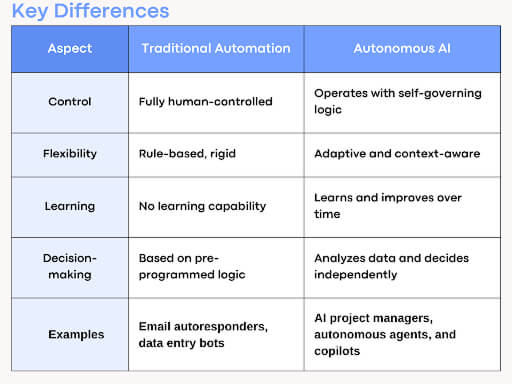
Traditional automation—whether it is a workflow engine, RPA (robotic process automation), or a scripted chatbot—follows predefined rules. It is reliable for repetitive tasks but rigid when conditions change.
Autonomous AI, on the other hand, thrives in complexity. It does not just follow instructions—it figures things out. It decides what to do, how to do it, and when to adjust if things go wrong.
Why Now? The Perfect Storm for Autonomous AI
The rise of Autonomous AI is not random—three converging trends drive it:
1. Explosion of Data
The world generates over 328.77 million terabytes of data every day. Autonomous systems thrive on this volume, transforming raw data into real-time decisions and continuous improvement.
2. Advances in Machine Learning
Breakthroughs in generative AI, LLMs like GPT-4, and reinforcement learning have enabled machines to reason, plan, and even collaborate. For example, OpenAI’s GPT models now outperform 90% of humans on standardized reasoning tasks.
3. The Need for Speed
In sectors such as finance, healthcare, and logistics, decisions cannot wait for human intervention. 72% of business leaders say speed to decision is a top competitive factor—and Autonomous AI delivers on that pressure.
We are also witnessing the rise of multi-agent systems, where different Autonomous AIs collaborate to complete more complex workflows. This evolution extends beyond individual automation, creating true digital ecosystems capable of parallel processing and dynamic execution.

Real-World Applications of Autonomous AI
From startups to global enterprises, Autonomous AI is already being deployed in powerful ways:
Autonomous AI in Software Development
Autonomous AI agents like Devin can now build full-stack apps, test software, and fix bugs autonomously. Gartner predicts that by 2026, over 80% of new software will be written or co-written by AI.
Autonomous AI in Customer Experience
AI systems can now manage over 70% of customer queries without escalation, freeing human agents for only complex cases.
Autonomous AI in Finance
In algorithmic trading, autonomous bots already control over 60% of U.S. equity trades. These systems operate faster than any team could monitor.
Autonomous AI in Marketing
Marketers using AI-driven automation report a 41% increase in campaign ROI. AI autonomously handles segmentation, timing, and copy testing.
Autonomous AI in Supply Chain
Amazon’s supply chain AI autonomously reroutes shipments, adjusts forecasts, and monitors 150+ variables daily, cutting delivery errors by 30%.
Benefits of Embracing Autonomous AI
The shift from basic automation to autonomous intelligence brings significant upside:
Massive Productivity Gains
Companies using AI agents report productivity boosts of up to 40% in operational tasks.
Greater Accuracy
AI agents can reduce human error by up to 85% in high-volume tasks such as data validation, scheduling, or quality control.
Real-Time Decision-Making
Autonomous AI can analyze streams of live data and react instantly, which is crucial in cybersecurity, where the average time to detect a breach remains over 200 days without the aid of AI.
Cost Efficiency
AI-powered automation is projected to save businesses over $1 trillion annually by 2030 through reductions in time, labor, and errors. A 2023 survey found that 62% of executives expressed concerns about trusting AI systems with end-to-end decision-making.
Challenges to Consider
No significant shift comes without hurdles. Autonomous AI is powerful, but it is not a plug-and-play solution.
Trust and Oversight
Transparent governance and explainability are essential.
Ethical Boundaries
Who is accountable when an autonomous agent makes a bad call? Clear guidelines on AI autonomy—especially in areas like finance, healthcare, and HR—are urgently needed.
Training and Maintenance
Like any employee, Autonomous AI needs context, calibration, and ongoing support. Companies investing in AI need to invest in AI literacy and monitoring systems.
The Future: Autonomous AI + Human Collaboration
The most powerful outcome of Autonomous AI is not human replacement—it is human amplification.
Imagine a marketing manager working with an autonomous campaign AI. She sets the vision: “Launch a product to Gen Z customers.” The AI builds content, tests creative, picks platforms, monitors real-time engagement, and reallocates budget—all while updating the human on progress.
This is the future: humans driving strategy, AI handling execution.
As multi-agent systems evolve, we will see Autonomous AIs collaborating across business units, departments, or even companies—negotiating, coordinating, and co-building ecosystems in ways no single tool ever could.

Conclusion
The rise of Autonomous AI marks a turning point in the evolution of work. It is more than innovative software—it is the arrival of systems that think, act, and evolve independently.
We are entering an era where intelligent agents do not just take instructions—they take initiative. They observe, optimize, and operate at scale, without constant human intervention.
For businesses, leaders, and creators, the question is not if Autonomous AI will be part of your operations, but when. Those who embrace it early will not only work faster. However, they will work smarter, adapt more quickly, and lead in a world that rewards innovation and autonomy.
Welcome to the future. Welcome to Autonomous AI.
FAQs
1. What is Autonomous AI?
Autonomous AI refers to systems that can make decisions, act, and learn independently without human intervention.
2. How is Autonomous AI different from traditional automation?
Unlike rule-based automation, Autonomous AI adapts to change, learns from data, and makes real-time decisions.
3. What industries are adopting Autonomous AI?
Industries like finance, healthcare, logistics, and software development are rapidly integrating Autonomous AI to boost efficiency.
4. Why is Autonomous AI important for the future of work?
It enables faster, smarter operations by reducing human workload, enhancing decision-making, and increasing agility at scale.
How Can [x]cube LABS Help?
At [x]cube LABS, we craft intelligent AI agents that seamlessly integrate with your systems, enhancing efficiency and innovation:
- Intelligent Virtual Assistants: Deploy AI-driven chatbots and voice assistants for 24/7 personalized customer support, streamlining service and reducing call center volume.
- RPA Agents for Process Automation: Automate repetitive tasks like invoicing and compliance checks, minimizing errors and boosting operational efficiency.
- Predictive Analytics & Decision-Making Agents: Utilize machine learning to forecast demand, optimize inventory, and provide real-time strategic insights.
- Supply Chain & Logistics Multi-Agent Systems: Improve supply chain efficiency through autonomous agents managing inventory and dynamically adapting logistics operations.
- Autonomous Cybersecurity Agents: Enhance security by autonomously detecting anomalies, responding to threats, and enforcing policies in real-time.
- Generative AI & Content Creation Agents: Accelerate content production with AI-generated descriptions, visuals, and code, ensuring brand consistency and scalability.
Integrate our Agentic AI solutions to automate tasks, derive actionable insights, and deliver superior customer experiences effortlessly within your existing workflows.
For more information and to schedule a FREE demo, check out all our ready-to-deploy agents here.