
A 2024 McKinsey survey found that 72% of organizations have adopted AI in at least one business function. Fewer than 30% report sustained value from those investments.
The gap between adoption and impact almost always traces back to the same root cause: the wrong implementation partner.
Choosing an AI consulting firm is not like hiring a traditional IT vendor. The decision involves technical architecture, change management, data governance, integration complexity, and long-term model maintenance, often simultaneously. A misaligned partner costs more than the engagement fee. It costs momentum, organizational trust, and months of time you cannot get back.
This guide gives enterprise technology leaders a rigorous framework for evaluating AI consulting firms. We cover what to look for in technical capability, how to assess delivery models, what questions expose a firm’s real depth, and how to structure a comparison that reflects your organization’s actual risk profile rather than a vendor’s marketing narrative.
1. Start With the Right Scope: What Kind of AI Help Do You Actually Need?
Before you evaluate a single vendor, get precise about what you are buying. Enterprise AI consulting spans a wide spectrum, and firms that excel at one category often underperform at another.
Strategy and advisory: Defining an AI roadmap, identifying high-value use cases, and aligning leadership around an implementation plan. Valuable, but insufficient on its own.
Proof of concept and pilot development: Building a functioning prototype of a specific AI capability to validate technical feasibility and business ROI before full investment.
Enterprise system integration: This is where most AI projects actually fail. Connecting an AI model to your CRM, ERP, data warehouse, or legacy systems requires a deep understanding of APIs, data schemas, security layers, and workflow orchestration. Firms that can produce a polished demo often cannot execute this phase reliably.
Production deployment and ongoing optimization: Model monitoring, retraining pipelines, performance benchmarking, and the operational work that keeps AI systems accurate and compliant after go-live.
Identify which phases you need help with before your first vendor call. A firm that is AI-native, meaning AI engineering is its core competency rather than an add-on to legacy IT services, will typically outperform generalist consultancies across all four phases. The gap is widest at integration and production, where technical debt accumulates fastest.
2. Evaluating Technical Depth: What to Look for Beyond the Demo
Every AI consulting firm will show you an impressive demo. The demo is not the test. Technical depth reveals itself in different ways, and enterprise buyers need to know exactly what signals to look for.
Model architecture decisions: Ask how the firm decides between fine-tuning a foundation model, retrieval-augmented generation (RAG), or a fully custom model for a given use case. A firm with genuine depth will walk you through the tradeoffs: latency, cost, data privacy, and accuracy thresholds. Firms that always recommend the same architecture regardless of the use case are selling a product, not a solution.
Agentic AI capability: The frontier of enterprise AI has shifted from single-model inference to multi-agent systems: orchestrated networks of AI agents that can reason, plan, use tools, and complete complex workflows autonomously. Ask whether the firm has built production-grade AI agents, not just chatbots. Ask about their experience with orchestration frameworks like LangGraph, AutoGen, or CrewAI. Ask how they handle agent failure modes, hallucination risk, and human-in-the-loop checkpoints.
Data and integration engineering: AI models are only as good as the data they can access and the systems they can act on. Evaluate the firm’s competency in:
- Data pipeline engineering
- Vector database implementation
- API integration patterns
- Enterprise security protocols, including role-based access control and audit logging
Evaluation and testing rigor Production-ready AI requires systematic evaluation frameworks, not just accuracy metrics. Look for:
- Latency benchmarks
- Adversarial testing
- Bias assessments
- Regression testing after model updates
Ask to see their evaluation methodology. Firms that cannot describe a repeatable testing process are not production-ready partners.
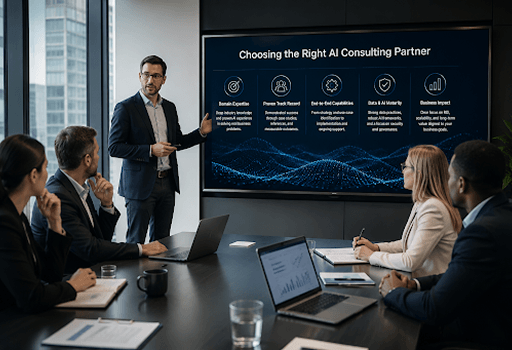
3. Delivery Model and Team Structure: Where Risk Hides in the Contract
How an AI consulting firm structures its delivery is as important as what it delivers. Enterprise buyers frequently underestimate the operational risk that sits inside the engagement model itself.
Offshore-only versus blended delivery: Many firms competing on price offer offshore-only delivery teams. For straightforward development work, this can be cost-effective. For enterprise AI projects involving frequent stakeholder alignment, ambiguous requirements, rapid iteration, and sensitive data, pure offshore models introduce communication latency and coordination overhead that compound over time.
A blended model with onshore engagement leadership and architects who can participate in real-time strategy sessions reduces that risk significantly. For organizations with data residency requirements or federal compliance obligations, onshore delivery may not be optional.
Team continuity and seniority: A common enterprise complaint about consulting engagements is bait-and-switch staffing: senior talent sells the work, junior talent delivers it. Before signing anything:
- Ask specifically who will be assigned to your project and at what seniority level
- Ask what the firm’s policy is on key personnel changes mid-engagement
- Request team bios before contract signature
Agile versus waterfall delivery: AI projects are inherently iterative. A firm that delivers through rigid waterfall phases will struggle to respond to the reality that AI use cases evolve as stakeholders interact with early outputs. Look for genuine agile discipline:
- Regular sprint cadences
- Clear definition of done at each stage
- Working demos at consistent intervals
- Lightweight change management processes
Intellectual property and model ownership: Clarify upfront who owns the models, training data, fine-tuning artifacts, and custom code produced during the engagement. Some firms retain licensing rights to components they build into your system, which creates long-term dependency risk. Insist on full IP assignment and review the contract language carefully before signing.
4. The Vendor Evaluation Framework: A Structured Comparison
Rather than comparing vendors on pitch decks and reference calls alone, use a weighted scorecard that reflects your organization’s actual priorities. The following dimensions most reliably predict the success of enterprise AI projects.
Technical capability (30%)
- Demonstrated experience with your specific AI use case category: agents, NLP, computer vision, predictive analytics
- Depth in enterprise integration and data engineering, not just model development
- Familiarity with your existing tech stack: cloud platform, data infrastructure, enterprise applications
- Evidence of production deployments, not just pilots
Delivery model (25%)
- Team seniority and continuity commitments
- Geographic delivery model and time zone alignment
- Communication protocols and escalation paths
- Agile methodology maturity
Domain expertise (20%)
- Industry-specific knowledge, particularly in regulated industries where compliance constraints are non-negotiable
- Familiarity with the business processes being automated or augmented
- Ability to translate technical outputs into business metrics that your stakeholders care about
Trust and transparency (15%)
- Willingness to share failure cases and lessons learned, not just success stories
- Clear articulation of what the firm will and will not do
- References from comparable enterprise engagements available for live conversations
- Honest scope estimation with named risks and dependencies
Long-term partnership potential (10%)
- Post-deployment support model and SLAs
- Roadmap for ongoing model optimization and retraining
- Pricing model for sustained engagement versus project-only work
- Cultural alignment with your internal engineering organization
Score each vendor on a 1-5 scale, apply the weights, and compare the totals. More importantly, use the framework to structure your vendor conversations. The questions required to accurately score a firm will yield more signals than any amount of unsolicited marketing material.
One additional dimension worth considering separately: whether the firm is AI-native or AI-adjacent. Firms that built their practice on AI engineering from the ground up, rather than adding an AI capability to an existing IT services or management consulting business, typically demonstrate faster delivery cycles, more current technical knowledge, and better judgment about when AI is and is not the right solution.
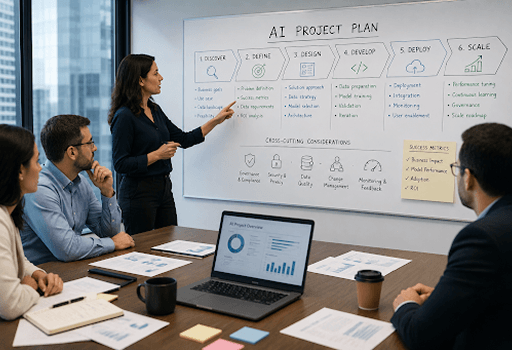
5. Red Flags, Reference Checks, and Deal-Breakers
No evaluation framework is complete without a list of signals that should give you pause, regardless of how well a firm scores elsewhere.
Red flags to watch for during the sales process
- They lead with tools, not outcomes: If a firm’s pitch centers on which LLM they use or which AI platform they are partnered with, rather than business outcomes achieved for comparable clients, they are optimizing for vendor relationships, not client results.
- Vague case studies: Real enterprise AI engagements produce specific, measurable outcomes. “We helped a Fortune 500 company improve efficiency” is not a case study. “We reduced manual invoice processing time by 67% for a $4B manufacturing company by deploying a document extraction agent integrated with SAP” is a case study. Ask for specifics and verify them.
- No mention of failure modes: Any firm that cannot describe how their AI systems fail and what safeguards they build has not operated AI in production. Hallucination, data drift, integration edge cases, and compliance exceptions are normal in enterprise AI. A competent partner has protocols for all of them.
- Overconfident timelines: Be skeptical of firms that provide firm delivery timelines before completing a thorough discovery process. Enterprise AI timelines depend heavily on data quality, integration complexity, and organizational readiness, none of which can be accurately assessed from a sales call.
Reference check questions that reveal actual depth
- How did the team handle a technical setback or significant scope change during the engagement?
- Who was your primary day-to-day contact, and how senior were they?
- What did the handoff to your internal team look like after deployment?
- Would you engage this firm again, and for what type of work specifically?
- What would you do differently if you were starting the engagement over?
That last question is the most revealing. References who can answer it candidly, and whose answers the consulting firm was willing to surface, are the references worth trusting?
Absolute deal-breakers
Do not proceed with any firm that cannot provide:
- Verifiable production references in your industry or use case category
- A clear data handling and security protocol aligned to your compliance requirements
- Contractual IP assignment for all custom work produced during the engagement
- A named delivery team with defined seniority commitments before contract execution
6. Structuring a Pilot Engagement Before Full Commitment
Even after rigorous evaluation, enterprise AI projects carry inherent uncertainty. The most risk-intelligent approach is to structure your first engagement as a bounded, outcome-defined pilot before committing to a larger program.
A well-designed pilot has three characteristics:
- It addresses a real business problem with measurable success criteria, not a toy use case invented to evaluate the vendor.
- It is scoped to a time and budget constraint that your organization can absorb if the engagement underperforms. Six to twelve weeks with a defined budget ceiling is a reasonable range for most enterprise AI pilots.
- It produces an artifact that has standalone value, whether that is a working agent, an integrated data pipeline, or a validated model, even if you choose not to continue with the same vendor.
Before signing a pilot agreement, document the following and review with your legal and procurement teams:
- Specific deliverables
- Technical acceptance criteria
- Personnel commitments
- Decision criteria for proceeding to a full engagement
The pilot serves a secondary purpose beyond technical validation: it reveals how a consulting firm operates under real project conditions. Communication patterns, responsiveness to feedback, quality of documentation, and intellectual honesty about blockers all surface quickly once work is actually in progress. This information is more valuable than any amount of reference checking.
When evaluating pilot outcomes, weigh the quality of the firm’s thinking as heavily as the quality of the deliverable. A partner who surfaces the right problems, makes sound architectural decisions, and communicates clearly about tradeoffs is more valuable over a multi-year program than a partner who delivers a polished demo on time but leaves you with unmaintainable code and undocumented model dependencies.
Conclusion
Choosing the right AI consulting partner is one of the highest-leverage decisions an enterprise technology leader will make in the next three years. The organizations that build a durable competitive advantage through AI will not necessarily be the ones that moved fastest. They will be the ones who built on the right foundation with the right partners.
Use the framework in this guide to move past vendor evaluation and toward genuine partner selection. Define your scope precisely, assess technical depth beyond the demo, scrutinize the delivery model, and structure a pilot that generates real evidence before committing to a full implementation.
If you are evaluating AI consulting services for an enterprise initiative and want to understand how [x]cube LABS would approach your use cases, data environment, and timeline, talk to our team.