The AI Capital No One Saw Coming
When most people think of U.S. artificial intelligence hubs, their minds jump to Silicon Valley, Seattle, or New York City. These are the names plastered across AI headlines, and for good reason. But something significant is happening in the heart of North Texas.
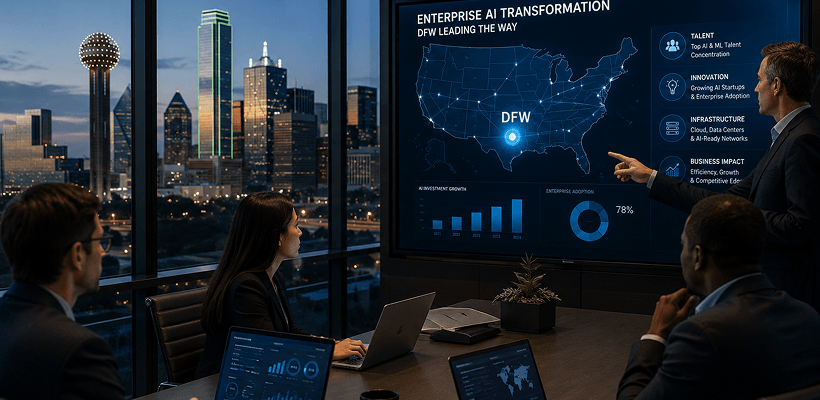
Dallas-Fort Worth is quietly and decisively becoming the enterprise AI capital of the United States.
This isn’t hyperbole. The data, the investments, the corporate footprint, and the talent pipeline all tell the same story: enterprise AI in Dallas is no longer an emerging conversation, it’s a future transformation in progress. From hyperscale data centers rising across the metroplex to Fortune 500 boardrooms embedding intelligent automation into core operations, DFW is building the infrastructure and institutional momentum to lead America’s AI era.
Why Dallas? The Strategic Foundations of an AI Powerhouse
1. A Fortune 500 Fortress
Few cities in the world can match Dallas-Fort Worth’s concentration of enterprise-grade companies. Texas is home to 57 Fortune 500 headquarters, and the DFW metro region claims a disproportionate share, spanning industries from financial services and healthcare to logistics, energy, and telecommunications.
This corporate density matters enormously for enterprise AI adoption. Companies like AT&T, American Airlines, Toyota North America, and McKesson are actively deploying artificial intelligence across their operations. The result is a thriving ecosystem of large-scale AI use cases, implementation partners, and institutional knowledge that smaller markets simply cannot replicate.
For businesses pursuing AI transformation in Dallas, this Fortune 500 presence creates a benchmark environment: real-world proof points, shared talent pools, and procurement patterns that accelerate adoption across the broader market.
2. World-Class Digital Infrastructure
Enterprise AI runs on data, and data runs on infrastructure. On that front, Dallas-Fort Worth is building one of the most formidable AI infrastructure stacks in the country.
ERCOT, the Texas power grid, currently counts over 4.6 gigawatts of data center capacity online, with another 2 GW approved for 2026 and a staggering 12 GW in planning through 2030. These figures rival the scale of entire nations. CyrusOne has broken ground on a new Fort Worth campus with an initial IT capacity of approximately 70 megawatts, while a 768-acre campus being co-developed by PowerHouse Data Centers and Provident Data Centers in the region is being engineered specifically for high-density cloud and AI workloads.
The numbers are extraordinary: in late 2025, a global AI infrastructure consortium acquired the largest shareholder of Aligned Data Centers, valuing the Dallas-anchored company at roughly $40 billion, cementing DFW as a central node in what industry experts are calling America’s “reindustrialization 3.0.”
For any enterprise evaluating AI services in the DFW region, the infrastructure story alone is compelling.
3. An Expanding AI Talent Pipeline
No AI strategy executes itself. It requires people — data scientists, ML engineers, AI architects, and transformation consultants who can translate capability into business value.
Dallas is building that workforce at an impressive pace. According to a CBRE report, the DFW metro currently counts more than 19,000 professionals with AI-related skills, a figure that is growing rapidly. In 2025 alone, more than 300 high school seniors graduated in the region with both a diploma and a professional technology certification, part of a broader initiative to create career pathways into AI-driven industries from the ground up.
Add to this the region’s university partnerships: UT Dallas, SMU, TCU, and UNT all have active AI and data science programs, and DFW has a talent development engine that feeds directly into enterprise demand.
DFW as a Proving Ground for Enterprise AI: The Evidence
The shift from “AI experimentation” to “AI at scale” is the defining challenge for enterprises in 2025 and beyond. DFW is increasingly where that challenge gets solved.
According to the Brookings Institution’s 2025 report, Dallas ranks #13 nationally and stands among just 28 designated “AI Star Hubs” that drive two-thirds of the country’s entire AI job market. Being in that exclusive club signals that DFW’s AI activity has crossed the threshold from promising to essential.

Enterprise AI in Action: Key Industry Verticals
Financial Services: Dallas is a major financial hub, home to giants like Goldman Sachs’s largest technology campus outside New York, Charles Schwab, and Comerica. Firms across the DFW financial corridor are deploying AI for fraud detection, algorithmic trading, risk modeling, and hyper-personalized customer experiences. Intelligent automation is replacing legacy manual workflows at a pace that would have seemed impossible five years ago.
Healthcare and Life Sciences: With major health systems such as Baylor Scott & White, UT Southwestern Medical Center, and Texas Health Resources operating in the metro, Dallas is among the most active markets for healthcare AI adoption in the nation. Use cases range from predictive diagnostics and AI-assisted imaging to intelligent scheduling, revenue cycle automation, and patient engagement platforms powered by natural language processing.
Logistics and Supply Chain: DFW International Airport is the world’s fourth-busiest airport, and the region’s geographic positioning makes it a natural nerve center for North American logistics. Companies like FedEx, USAA, and major third-party logistics providers are deploying machine learning models for route optimization, demand forecasting, and warehouse automation at scale.
Energy and Utilities: Texas’s energy sector is undergoing a parallel transformation. AI-powered grid management, predictive maintenance for infrastructure assets, and intelligent operations platforms are being developed and deployed right here in DFW, with implications that extend well beyond state borders.
The Role of Agentic AI in Dallas’s Enterprise Transformation
One of the most significant developments reshaping enterprise AI in Dallas is the rise of agentic AI services, autonomous AI systems capable of making decisions, executing multi-step workflows, and adapting to changing conditions without constant human intervention.
Unlike traditional AI tools that respond reactively to queries, agentic AI systems proactively pursue goals. They can coordinate across multiple data sources, trigger business processes, and handle complex operational scenarios, from managing customer service escalations to orchestrating supply chain exceptions in real time.
Dallas enterprises are among the earliest adopters of this paradigm shift. Leaders at Thomson Reuters, headquartered in nearby Frisco, have embedded agentic AI into sales, marketing, and customer-facing workflows using multi-agent frameworks that operate within Microsoft Teams. The results are measurable: faster decision cycles, reduced manual workload, and more consistent customer outcomes.
The Convergence AI Dallas Effect: Thought Leadership Meets Action
One of the most visible signs of DFW’s AI ambition is the annual Convergence AI Dallas conference, hosted by the Dallas Regional Chamber. In 2025, the event brought together more than 750 attendees, 75 speakers, and 44 exhibitors, including leaders from Fortune 500 companies, to discuss real-world AI deployment strategies.
This kind of high-profile convening activity does more than generate headlines. It creates a feedback loop of knowledge sharing, partnership formation, and investment that reinforces DFW’s position as a destination for serious enterprise AI work.
What Sets Enterprise AI Transformation in Dallas Apart
Several characteristics make DFW’s approach to enterprise AI distinctly different from other U.S. markets:
Pragmatism over hype. Unlike some tech-heavy coastal markets where AI conversations can get speculative, enterprises in Dallas tend to demand measurable outcomes. The ROI conversation happens early, and it shapes how AI solutions are designed and deployed.
Cross-industry integration. Because DFW hosts major players in financial services, healthcare, logistics, energy, and retail, AI solutions developed here are often stress-tested across multiple business contexts, resulting in more robust, adaptable implementations.
Speed to production. Dallas businesses are operationally oriented. There is cultural pressure to move from pilot to production quickly, which has fostered a local ecosystem of implementation partners specializing in production-ready AI.
Business-first AI culture. Across DFW boardrooms, AI is increasingly framed not as a technology initiative but as a business transformation strategy. That framing changes everything from how budgets are allocated to how success is measured.
How [x]cube LABS Fits Into Dallas’s Enterprise AI Story
For over a decade, [x]cube LABS has been at the forefront of enterprise digital transformation — partnering with Fortune 500 companies including GE, Honeywell, Amazon, and AT&T to build solutions that drive measurable business outcomes. With deep expertise in AI/ML, intelligent automation, product engineering, and application modernization, [x]cube LABS holds a leadership position in DFW’s AI ecosystem.
What differentiates [x]cube LABS in the enterprise AI landscape in Dallas is the intersection of strategic consulting and technical execution. Many firms do one or the other well. [x]cube LABS does both — helping organizations identify where AI delivers the greatest return, then building and deploying the systems to capture it.
Key capabilities include:
AI Strategy and Roadmapping: Assessing an organization’s AI readiness, identifying high-value use cases, and creating phased implementation roadmaps that align with business priorities.
Custom AI and ML Development: Building proprietary AI models tailored to specific industry contexts and enterprise workflows, rather than relying solely on off-the-shelf solutions that may not fit complex environments.
Agentic AI Implementation: Designing and deploying multi-agent AI systems capable of autonomous decision-making and workflow execution across enterprise operations.
Data Engineering and MLOps: Establishing the data pipelines, governance frameworks, and model monitoring infrastructure required to sustain AI performance at enterprise scale.
Application Modernization: Integrating AI capabilities into legacy systems and existing enterprise architecture without requiring costly full-platform replacements.
With a global delivery model, 700+ successful enterprise solutions, and a track record of client satisfaction across industries, [x]cube LABS brings a proven methodology to every engagement and the technical depth to execute it.
Conclusion: The Quiet Capital Is Getting Louder
Dallas-Fort Worth has earned its place among America’s top AI destinations through infrastructure investment, corporate commitment, and a pragmatic bias toward results. Enterprise AI in Dallas is no longer a regional story. It’s a national one.
For companies operating in DFW or evaluating where to anchor their AI transformation strategy, the data is unambiguous: this is where enterprise AI is being built, tested, and deployed at scale.
And for those who want a technology partner that combines strategic vision with the technical capability to execute, [x]cube LABS is ready to lead the journey.
FAQs
1. What is enterprise AI, and how is it different from regular AI?
Enterprise AI refers to AI solutions built for large organizations to automate processes, analyze complex data, integrate with business systems, and drive measurable business outcomes.
2. Why is Dallas becoming a major hub for enterprise AI?
Dallas-Fort Worth combines a dense concentration of Fortune 500 headquarters, world-class data center infrastructure, and a rapidly growing AI talent pool, making it one of the most capable environments for enterprise AI deployment in the U.S.
3. Which industries in Dallas are leading enterprise AI adoption?
Financial services, healthcare, logistics, and energy are the most active sectors driving enterprise AI adoption in DFW. Companies across these industries are using AI for fraud detection, predictive diagnostics, supply chain optimization, and intelligent grid management, respectively.
4. What are agentic AI services, and why do Dallas enterprises need them?
Agentic AI services involve autonomous AI systems that can make decisions, execute multi-step workflows, and adapt to changing conditions without constant human input. Enterprise businesses in Dallas are enabling AI that proactively drives outcomes rather than just responding to queries.