
The machine learning pipeline depends on feature engineering because this step directly determines how models perform. The transformation of unprocessed data into useful features by data scientists helps strengthen predictive models and their computational speed. This record makes sense of what component designing means for AI execution and presents suggested rehearses for execution.
By carefully engineering features, data scientists can significantly enhance predictive accuracy and computational efficiency, ensuring that feature engineering for machine learning models operates optimally. This comprehensive guide will explore feature engineering in-depth, its critical role in machine learning, and best practices for effective implementation to help professionals and enthusiasts make the most of their data science projects.
What is Feature Engineering?
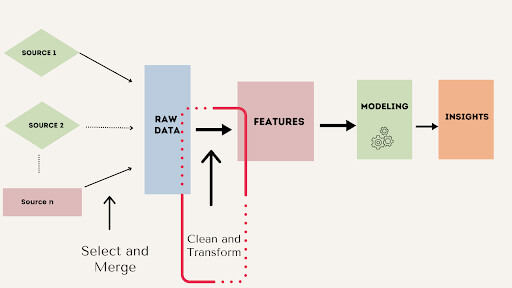
Highlight designing is the method of choosing, changing, and making highlights from crude information to work on presenting AI models. It includes space ability, imagination, and a comprehension of the dataset to extricate significant bits of knowledge.
Importance of Feature Engineering in Machine Learning
AI models depend on highlights to make forecasts. Ineffectively designed elements can bring about failing to meet the expectations of models, while very much-created highlights can emphatically work on model precision. Include designing is fundamental because:
- It enhances model interpretability.
- It helps models learn patterns more effectively.
- It reduces overfitting by eliminating irrelevant or redundant data.
- It improves computational efficiency by reducing dimensionality.
A report by MIT Technology Review states that feature engineering contributes to over 50% of model performance improvements, making it more important than simply choosing a complex algorithm.
Key Techniques in Feature Engineering
Include designing includes changing crude information into enlightening highlights that improve the exhibition of AI models. Utilizing legitimate strategies, information researchers can work on model exactness, decrease dimensionality, and handle absent or boisterous information. The following are a few key methods used in highlight designing:
1. Feature Selection
Feature engineering selection involves identifying the most relevant features from a dataset. Popular methods include:
- Univariate choice: Measurable tests to distinguish and highlight significance.
- Recursive element disposal (RFE): Iteratively eliminating less fundamental highlights.
- Head Part Examination (PCA): Dimensionality decrease method that jams essential data.
2. Feature Transformation
Feature engineering transformation helps standardize or normalize data for better model performance. Standard feature engineering techniques include:
- Normalization: Scaling features to a range (e.g., Min-Max scaling).
- Standardization: Converting data to have zero mean and unit variance.
- Log transformations: Handling skewed data distributions.
3. Feature Creation
Feature engineering creation involves deriving new features from existing ones to provide additional insights. Feature engineering examples include:
- Polynomial elements: Making communication terms between factors.
- Time-sensitive elements: Extricating day, month, and year from timestamps.
- Binning: Changing over mathematical factors into absolute canisters.
4. Handling Missing Data
Missing data can affect model accuracy. Strategies to handle it include:
- Mean/median imputation: Filling missing values with mean or median.
- K-Nearest Neighbors (KNN) imputation: Predicting missing values based on similar observations.
- Dropping missing values: Removing rows or columns with excessive missing data.
5. Encoding Categorical Variables
Machine learning models work best with numerical inputs. Standard encoding techniques include:
- One-hot encoding: Changing over absolute factors into double sections.
- Name encoding: Allotting unique mathematical qualities to classes.
- Target encoding: Utilizing the objective variable’s mean to encode absolute information.
Tools and Libraries for Feature Engineering
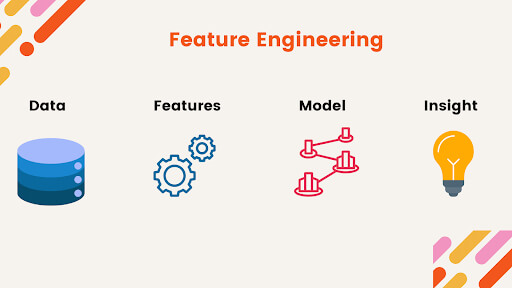
Designing is a significant AI step, including changing crude information into significant elements that work on model execution. Different instruments and libraries help mechanize and work on this cycle, empowering information researchers to separate essential bits of knowledge effectively. The following are a few broadly involved devices and libraries for designing:
Several libraries simplify the feature engineering process in Python:
- Pandas: Data manipulation and feature engineering extraction.
- Scikit-learn: Preprocessing techniques like scaling, encoding, and feature selection.
- Feature tools: Automated feature engineering for time series and relational datasets.
- Tsfresh: Extracting features from time-series data.
Case Study
Case Study 1: Fraud Detection in Banking (JPMorgan Chase)
JPMorgan Pursue attempted to distinguish deceitful exchanges progressively. By designing highlights, such as exchange recurrence, examples, and irregularity scores, they misrepresented location exactness by 30%. They additionally involved one-hot encoding for absolute highlights like exchange type and PCA for dimensionality decrease. The outcome? A robust misrepresentation discovery framework that saved many dollars in possible misfortunes.
Case Study 2: Predicting Customer Churn in Telecom (Verizon)
Verizon needed to anticipate client beats all the more precisely. They fundamentally worked on their model’s prescient power by making elements, for example, client residency, recurrence of client assistance calls, and month-to-month bill variances. Highlight choice procedures like recursive element disposal helped eliminate repetitive information, prompting a 20% increment in stir forecast exactness. This empowered Verizon to draw in dangerous clients and proactively develop degrees of consistency.
Case Study 3: Enhancing Healthcare Diagnostics (Mayo Clinic)
Mayo Facility utilized AI to foresee patient readmissions. They upgraded their model by producing time-sensitive elements from clinical history, encoding clear-cut ascribes like conclusion type, and attributing missing qualities from patient records. Their designed dataset decreased bogus up-sides by 25%, working on tolerant consideration and asset portion.
Key Takeaways:
Feature engineering contributes to over 50% of model performance improvements. 80% of data science work involves data preprocessing and feature extraction. Advanced techniques like PCA, one-hot encoding, and time-based features can significantly enhance machine-learning models.

Conclusion
Designing is principal to the AI model’s turn of events, frequently deciding the contrast between an unremarkable and a high-performing model. Information researchers can extricate the most worth from their datasets by dominating element choice, change, and creation procedures.
As AI develops, mechanized highlight designing instruments are likewise becoming more pervasive, making it more straightforward to smooth out the cycle. Concentrating on designing for AI can open better bits of knowledge, work on model precision, and drive better business choices.
How can [x]cube LABS Help?
[x]cube LABS’s teams of product owners and experts have worked with global brands such as Panini, Mann+Hummel, tradeMONSTER, and others to deliver over 950 successful digital products, resulting in the creation of new digital revenue lines and entirely new businesses. With over 30 global product design and development awards, [x]cube LABS has established itself among global enterprises’ top digital transformation partners.
Why work with [x]cube LABS?
- Founder-led engineering teams:
Our co-founders and tech architects are deeply involved in projects and are unafraid to get their hands dirty.
- Deep technical leadership:
Our tech leaders have spent decades solving complex technical problems. Having them on your project is like instantly plugging into thousands of person-hours of real-life experience.
- Stringent induction and training:
We are obsessed with crafting top-quality products. We hire only the best hands-on talent. We train them like Navy Seals to meet our standards of software craftsmanship.
- Next-gen processes and tools:
Eye on the puck. We constantly research and stay up-to-speed with the best technology has to offer.
- DevOps excellence:
Our CI/CD tools ensure strict quality checks to ensure the code in your project is top-notch.
Contact us to discuss your digital innovation plans. Our experts would be happy to schedule a free consultation.