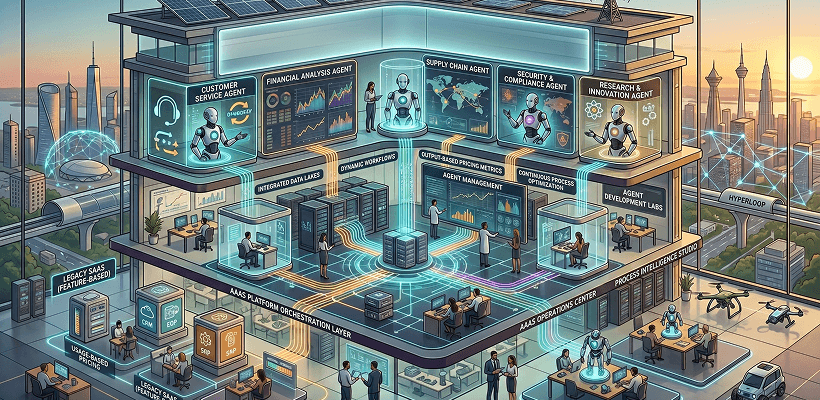
For more than two decades, software has followed a familiar model: organizations subscribe to applications, employees log in, and work gets done through a series of clicks, forms, and workflows. That model is beginning to change.
Instead of giving teams software, they must operate manually. Businesses are starting to deploy intelligent agents that can perform tasks independently. These Autonomous AI agents understand goals, interact with systems, make decisions within defined boundaries, and deliver outcomes with minimal human intervention.
This shift is giving rise to the Agent-as-a-Service model.
Much like Software-as-a-Service transformed software delivery, Agent-as-a-Service introduces a new operating model, one in which organizations consume autonomous capabilities rather than standalone applications. The value no longer comes solely from access to software, but from access to digital agents that can execute work.
Why the SaaS Model Is Being Reconsidered
Traditional SaaS changed how software was purchased and deployed, but it still depends heavily on human effort. Employees must navigate interfaces, interpret data, and manually move work from one step to the next. As processes become more complex, this model creates operational friction.
Agent-as-a-Service addresses that limitation by shifting the focus from software usage to task execution. Instead of asking users to operate the application, the agent operates on the user’s behalf.
This is one of the clearest benefits of the agent-as-a-service business model, allowing enterprises to access operational capabilities directly rather than relying solely on software interfaces.
The timing is significant. Gartner predicts that 40% of enterprise applications will feature task-specific AI agents by the end of 2026.
That projection suggests a broader transition: applications are evolving from passive tools into active participants in enterprise workflows.
What Is Agent as a Service?
Agent-as-a-Service is a delivery model in which organizations access AI agents through a subscription or usage-based model, much as they previously consumed cloud software.
These agents are designed to perform specific business functions such as:
- Processing insurance claims
- Handling customer support requests
- Reconciling financial data
- Monitoring IT systems
- Coordinating supply chain decisions
These are practical agent-as-a-service examples that show how enterprises can subscribe to operational outcomes rather than just software functionality.
Rather than purchasing software licenses and configuring workflows manually, enterprises subscribe to an operational capability. In practical terms, Agent-as-a-Service provides outcomes-as-a-service.
How Agent as a Service Differs from SaaS
The distinction between SaaS and Agent-as-a-Service lies in who performs the work.
| Traditional SaaS | Agent as a Service |
| Humans use software | Agents execute tasks |
| Interfaces are central | Outcomes are central |
| Automation is limited | Agents reason and adapt |
| Productivity depends on users | Productivity scales through autonomy |
SaaS gives organizations tools.
Agent-as-a-Service provides them with digital workers.
This shift is accelerating broader discussions around replacing SaaS with AI agents, particularly in functions where speed, scale, and decision-making are critical.
That difference changes how enterprises think about productivity, operating costs, and scalability.
Why Businesses Are Paying Attention
The growing interest in Agent-as-a-Service reflects a broader shift toward outcome-based technology.
Research estimates that AI agents could generate $2.6 trillion to $4.4 trillion in annual business value across global use cases.
What makes Agent-as-a-Service especially compelling is how quickly it can be deployed. Organizations no longer need to build every agent from scratch. They can subscribe to specialized agents designed for finance, customer operations, procurement, or IT.
This lowers the barrier to adoption while accelerating time-to-value.
Where Agent as a Service Is Creating Impact
The potential of Agent as a Service becomes clearer when viewed through specific enterprise functions.
Customer Operations
Agents can resolve support requests, update systems, and automatically escalate exceptions.
Finance and Accounting
Agents can process invoices, validate transactions, and prepare audit-ready reports.
IT Operations
Agents can investigate alerts, recommend remediation steps, and execute routine actions.
Supply Chain
Agents can monitor inventory, coordinate suppliers, and adapt to disruptions in real time.
Across these functions, Agent as a Service allows organizations to consume operational capacity as needed rather than expanding headcount or adding more software.
What Changes for Enterprise Technology Strategy
The rise of Agent-as-a-Service has broader implications than just a new pricing model.
It changes how software is evaluated. Instead of asking which application to purchase, enterprises are beginning to ask which business outcomes should be delegated to autonomous agents.
This shift is supported by a robust Agent-as-a-Service architecture, in which agents interact with enterprise systems, data sources, and governance controls to reliably deliver outcomes.
Applications remain important, but increasingly they become the environment in which agents operate rather than the primary source of value.
The Future of Agent as a Service
As agentic AI matures, Agent-as-a-Service is likely to become a foundational layer of enterprise technology.
Gartner’s 2026 strategic technology trends identify Multi-agent Systems as a key area shaping how organizations design intelligent operations.
This points toward a future where businesses subscribe to networks of agents that collaborate across functions, continuously adapting to changing business conditions.
In that environment, Agent-as-a-Service will extend beyond isolated use cases and become part of the enterprise operating model itself.
Conclusion
Agent-as-a-Service represents a meaningful shift in how organizations consume technology. Rather than licensing software and having employees manually navigate every process, businesses can subscribe to autonomous agents that execute work directly. As AI agents become more capable and easier to deploy, Agent-as-a-Service offers a practical path to scaling productivity, reducing operational friction, and accelerating business outcomes.
For enterprises evaluating what comes after SaaS, Agent-as-a-Service is emerging as one of the most significant models to watch.
FAQs
1. What is Agent as a Service?
Agent-as-a-Service is a business model in which organizations subscribe to AI agents that autonomously perform specific tasks or workflows.
2. What are some Agent as a Service examples?
Common examples include customer support agents, finance automation agents, IT operations agents, and supply chain coordination agents.
3. What are the main Agent as a Service business model benefits?
Key benefits include faster deployment, lower operational overhead, and the ability to consume outcomes rather than just software.
4. How is Agent as a Service different from SaaS?
SaaS provides software that people use, while Agent-as-a-Service provides autonomous agents that execute work on behalf of users.
5. Could Agent as a Service replace traditional SaaS?
In many cases, it will complement SaaS first, but the trend toward replacing SaaS with AI agents is expected to grow as autonomous systems become more capable.
What [x]cube LABS Builds
We help enterprises become AI-native; not by adding AI on top of existing systems, but by rebuilding the intelligence layer from the ground up. With 950+ products shipped and $5B+ in value created for clients across 15+ industries, here is what we bring to the table:
1. Autonomous AI Agents
We design and deploy agentic AI systems that sense, decide, and act without human bottlenecks, handling complex, multi-step workflows end-to-end with measurable resolution rates and no manual intervention.
2. Enterprise Voice AI
Our voice platformEllo puts production-ready voice agents in front of your customers in minutes. Zero-latency conversations across 30+ languages, with no call centers and no wait times.
3. AI-Powered Process Automation
We replace manual, error-prone workflows with intelligent automation across invoicing, compliance, customer service, and operations, freeing your teams to focus on work that requires human judgment.
4. Predictive Intelligence and Decision Support
Using machine learning and real-time data pipelines, we build systems that forecast demand, flag risk, optimize inventory, and surface strategic insights before your teams need to ask for them.
5. Connected Products and IoT
We design and build IoT platforms that turn physical devices into intelligent, connected systems with built-in real-time monitoring, remote management, and condition-based automation.
6. Data Engineering and AI Infrastructure
From data lakes and ETL pipelines to AI-ready cloud architecture, we build the foundation that makes everything else possible, scalable, reliable, and designed to grow with your business.
If you are looking to move from AI experimentation to AI-native operations, let’s talk.